Showing posts with label quebec student strike 2012. Show all posts

January 15, 2016

"Fuck it all": Review of the Spring 2015 Quebec student strike

Marianne Breton Fontaine

We need to be careful not to underestimate the importance of ideology in shaping our strategies and our daily struggles. This is demonstrated by the latest attempted general strike, which the Quebec student movement initiated last spring. This strike was conducted primarily based on anarchist principles. It was also the result of dissatisfaction among activists from the Maple Spring which ended in 2012, a dissatisfaction that comes from an incorrect analysis of the transformative potential of a student strike.

January 29, 2014

ASSÉ newsletter now available in English


By Geoffrey Vendeville,
The Link, Concordia

One of Quebec’s largest and more militant student federations is reaching out to anglophones by publishing an English-language edition of its quarterly newspaper for the first time since fall 2010.

The Association pour une solidarité syndicale étudiante is releasing the English-language version of its newspaper, Ultimatum, in the next two weeks, said co-spokesperson Benjamin Gingras.

“There is a massive number of anglophone students who are as affected by questions of austerity, tuition fees and basically the whole student condition. The idea is to be inclusive and reach out to all students regardless of language,” he said.

“These are issues that go beyond the language barrier.”

December 30, 2013

The awakening student movement

by Espoir Manirambona
Rebel Youth Magazine

(This article appeared in the Winter 2013-2014 print edition of Rebel Youth together with this commentary.).

Students everywhere in Canada have had it with high tuition fees and are working to build a united student fightback to make education a right, not a privilege.

In many other industrialized capitalist countries such as France, Denmark and Spain post-secondary education is largely free.  Poorer nations, such as socialist Cuba, provide access to education as a guaranteed right.  In Canada students must pay a great deal of money to get the education they need to pursue their dreams or just get a job that’s above the poverty line.

Corporations, of course, want an educated workforce but they are not willing to pay for it through taxes -- and are instead forcing the students and their families to pick up the bill. This «debt sentence» is made heavier by the low wages most youth earn; and doubly hard for aboriginal students, young women, and racialized youth who face additional barriers.

Most students, and a large section of the Canadian people, oppose this full-scale attack on access to education. The challenge for the student movement across Canada is to turn this sentiment into action and mass public pressure. Quebec, which last year saw massive, militant and united student actions that shocked the country, shows the way!

April 3, 2013

Greetings to the 12th Congress of the Union of Communist Youth of Spain


CONTRIBUTION OF THE YOUNG COMMUNIST LEAGUE TO THE SEMINAR
“YOUTH STRUGGLE AGAINST CAPITALIST CRISIS AND IMPERIALISM”
Held at the Congress of the Communist Youth Union of Spain, Madrid.


Dear comrades, members of the presidium, delegates, and honored guests

It is with great pleasure that we greet the 12th Congress of the Communist Youth of Spain (UJCE) being held under the theme «Conquering the future, building socialism» and make a contribution to the seminar "Youth struggle against capitalist crisis and imperialism."

This is an important and very relevant question for today, and especially for the youth.

We are here to tell you that the aggressive, imperialist and pro-NATO policies of the Canadian government towards the peoples of Haiti, Afghanistan, Libya, Mali, Syria and Palestine, and its cavalier position on climate change, do not reflect the true sentiment of the Canadian peoples.

Instead we bring you greetings not just from the Young Communist League of Canada but the progressive youth of our country who continue to demand the opposite direction -- peace, friendship and international solidarity.

We stand with the UJCE and all the youth of Spain in your struggle to conquer the future and build a better world.

As the slogan of the Young Communist League of Canada says –

The Youth are the Future, the future is socialism!

March 26, 2013

Heavy-handed police tactics in Montréal


By J. Boyden

On March 22, I was unexpectedly kettled by Montreal police at a student demonstration together with about 60 protestors. We have all been charged a $625 fine for participating in the "illegal protest," held to mark the anniversary of the start of last year's student strike. Almost 600 arrests have been made in Québec over the past few weeks.

Kettling, also known as corralling, is an increasingly used tactic of mass detention. Police ‑ often in riot gear ‑ will cordon off a street, blocking all exits, and then arrest everyone in between.

In our case, the police announced the demonstration was illegal at exactly the same time as the kettle began. There was five minutes of chaos and panic, then about three hours of limbo.

When riot police charge a crowd they exploit the moment for maximum intimidation. They dress in black, faces covered, holding round shields and pounding them in drum beat. You can hear their stomping heavy boots.

My partner and I turned just before the charge. We were looking for the rest of the Young Communist League, who had fortunately escaped just in time as two lines of riot cops blocked either side of the street. Then an officer smashed his baton across my knuckles ‑ throw down your banner! Moments later we heard the police captain scream at one officer: "stop being so gentle with them!"

Within a few minutes we were backed up against a large store (ironically a travel agency) and shoved into a knot of people. It had been a sunny afternoon when the protest began. But after half‑an‑hour in the kettle it started to get dark. Then it started to snow. A cold wind whistled down the street.

Several shift‑changes of the riot cops surrounding us took place, including a team of horse police at one point. I heard a young woman's teeth start to chatter. "Please just arrest me!" she said. She was wearing in a thin jacket, black polka dot skirt, and heels. Almost three hours...

Finally an all‑female team of officers arrived, processed us for about four minutes each, and doled out the fines. We were shoved across a yellow police cordon. Go! Get lost!

The charges may be dropped, thrown out or defeated in court. The bylaw we were charged under is P‑6, a complimentary municipal regulation brought in basically at the same time as the Charest Liberal's anti‑democratic Bill 78.

Like that now abolished law, P‑6 is almost certainly a violation of our constitutional rights. But that isn't the point. Through our detention we have already been punished.

Québec Solidaire has renewed its calls for a public inquiry, and the progressive ASSÉ student union has condemned the new wave of arrests, which began at the annual march against police brutality.

At the beginning of last year's student struggle the YCL made a conscious decision to actively participate in as many demonstrations as we could, including those declared "illegal" under Bill 78, but to join in a disciplined way because there was nothing to be gained from an arrest and restrictive bail conditions.

At our last YCL meeting we checked‑in about our policy towards arrests, which are sometimes viewed romantically as badges of honour in the youth and student movement. Our approach remained unchanged. But in just a few days Nicolas, our club organizer, Marianne, our magazine editor, myself and another member of our new club at a French‑language college have all been arrested and charged.

What has changed? The demonstrations are smaller now, but the force of the police has stayed the same and thus is proportionally much greater. Our ruling class opponents are well aware the student movement is still re‑grouping and somewhat tired. They are giving us a hard kick while we are down.

Seeming to recognize the intention was to break morale, our kettle held up a proud face. First we launched into the familiar chants. Then, as the temperature dropped, the group began to hold "jumping" to warm up. I saw an elderly man (somebody said he was a university professor) make a few smiling leaps. Anarchopanda ‑ the CEGEP professor who dresses in a giant panda suit ‑ was also there, as well as one of the "Rabbit Crew" who wear bunny‑eared masks to demos. It was like a reunion.

A hip hop artist came forward and began to rhyme. People started to dance. A drummer and a man with a cow bell joined in the music. Then the entire kettle was moving, bouncing around a circle. Somebody began singing popular songs. Classics from Quebec and France, from the 1940s, 50s, 60s and 70s. Soon we were all singing. Near the end we took a group photo. It seemed somehow appropriate.

Johan Boyden is the General Secretary of the Young Communist League of Canada

January 2, 2013

Call-out to the second-annual YCL-LJC student conference


Saturday, January 12, 2013
Open only to members of the YCL-LJC or by invitation

1. We believe in the principle that the student movement is one of the most radical, dynamic and progressive forces for change in society and the future.

2. The uprisings of students in the Middle East and North Africa, the brave united battles of the Chilean students, and the massive struggle in Quebec last winter and spring have shown the validity of the optimistic claim that the young people, united with the working class, are continuously an important catalytic force for social transformation, overthrow and revolution.

3. At the same time, new, contradictory and even confusing developments are taking place internationally and locally. We believe that the student movements in Quebec and English-speaking Canada are at a difficult but significant and even historic juncture.  At stake is our basic access to education.

January 1, 2013

2012 Bye-Bye: Gabriel Nadeau-style


Generally hilarious, always outrageous, often scandalous and sometimes terrible, the Bye Bye is an annual Québécois New Year's Eve cultural icon. The sketch comedy special broadcast by Radio-Canada is virtually unknown outside of Quebec -- except when Anglophones over-react when the Bye Bye pokes fun at them -- but has been taking place since 1968 (with a pause of a few years between 98 and 06 and again in 09 because of scandal).

The first Bye Bye poked fun at Pierre Trudeau, the Vietnam War and reactionary elements of Quebec society; subsequent shows built a reputation on smart and funny comedy, not infrequently with a progressive edge. The show took a pause in the early 2000's and a new comedy crew took over in 2006. Sadly, some of these more recent Bye Bye's have been at best tasteless and at worst garbage. Facing widespread public criticism after 'black-face' skits, repeats of the kind of racist jokes that appear on mainstream US shows like Saturday Night Live, and especially a tasteless satire about child abuse, Radio Canada cancelled the show for a year.

But the Bye Bye lives on. The show remains a New Year's tradition for millions of kids growing up in Quebec. Many people can still remember some of the classic skits, giving the Bye Bye a strong following today.

This year took a turn that was seen as different and welcome by many, with a generally pro-student and anti-Charest Bye Bye. The video below is a short clip: a friendly mock of student leader Gabriel Nadeau-Dubois featuring various characters of the strike like anarcho-panda and protesters in Banana costumes dancing to a re-mix of the hit track Oppan Gangnam Style by South Korean artist PSY (Park Jae-sang).

To give a sample, at one point the young super-star Quebec film-maker Xavier Dolan makes an appearance. Dolan, who convinced the Cannes International Film Festival to wear the red square, made head-lines during the student strike when he described Nadeau-Dubois as sexy. In the film checks-out the bicep of the actor playing the student leader.

Does it trivialize the student struggle or support it? What is the comment about democracy, and personality in the struggle? Comments are open.


December 1, 2012

YCL greetings to WFDY meeting in Ecuador

By Drew Garvie

This meeting of the World Federation of Democratic Youth comes at an important juncture in the world-wide youth and student movement.

It is clear the forces of monopoly capitalism are instituting a strong offensive against the people and the environment through their reactionary, pro-war governments.

In Canada this takes the form of the Harper Conservatives who gained a majority in the Parliament last year.

At the same time the fight back is developing at an accelerating rate.

In Canada, there are some signs of increasing militancy from the labour movement, which is starting to push back against attacks to living standards and further erosions of democratic rights.

But the biggest resistance is in Québec, where the students played a leading role in the magnificent massive popular fightback in the winter and spring of 2012. The Quebec student strike, which brought together all the major components of the Quebec student movement in united struggle and saw 300,000 students and their allies march in the streets again and again, and developed into one of the largest mobilizations in our history winning massive public support.

The Quebec Spring has giving renewed strength to the youth and student movements and the broader peoples’ movements across the country.

The Québec Liberal government declared in a viscous and reactionary 2010 budget that tuition fees were to rise by 75% over a few years, of course citing austerity and the capitalist economic crisis. Students mobilized for over a year and reached out to workers and people’s movements in order to build a broad and militant coalition aimed at stopping the user fee increases.

The students also developed a united escalating plan of action, starting with general mobilization of their membership, towards days of action and finally an unlimited general strike built around the tuition fee increase.  In a break-through moment, all the Quebec student centres which had previously been in disunity where able to find a common, militant basis for action. The English-language schools also joined in.

The YCL had said this was the key to building a broader fightback. But the struggle was very positive and went beyond everyone's initial hopes.

It was also articulated very clearly from the students that the end to the tuition increase was their immediate demand to end the strike, but quality, accessible, fully funded and free post-secondary education was their goal.

Students went on strike from February to August.  They held protests and occupations almost every day, and monthly mass demonstrations with up to 300 000 people on the streets of Montreal, Québec under the slogan of “student strike, people’s struggle”.

It became clear that the slogan was very correct and the strike had become a flash-point for other people's struggles, particularly the environmental movement but also winning support from working-class communities.

The Liberal government reacted with court injunctions to end the mobilization and ignored the democratic decisions taken by students at a local level to go on strike.  The refused to seriously negotiate with the students and instead spent millions on advertisements -- and police.

When these measures did not suceed to break the students and their popular support increased, the government brought in Bill 78 which made it illegal to demonstrate without approval by police, outlawed picket lines and leveled fines of hundreds of thousands of dollars against student unions that advocated the continuation of the strike.

Bill 78 was one of the most serious attacks of civil and democratic rights in recent times. It acted as a sign to the security forces to more explicitly transform into political police. Very quickly, and often under various municipal and provincial legislation, hundreds of students were arrested. By the end, the strike saw the largest number of mass arrests that had taken place in recent history.

This is part of the broader capitalist attack against democratic rights, which is accompanying the capitalist economic crisis.

This legislation was defeated in the streets with even larger demonstrations with more participation from the working people and especially parents, who chose to disobey the law, and organize nightly demonstrations of tens of thousands of Québecois. Suddenly we saw everyone from very young children to very old people in the streets.

Amazingly, these demonstrations soon spread across Canada in every major city and many small localities, symbolizing the general opposition to neo-liberalism and austerity in all parts of the country.

By the end of August, two Education Ministers had been forced to resign and the strike was ended by an election that threw out the Québec Liberals.

The new Parti Québecois government was forced to adopt several progressive demands of the mobilization, including an end to the tuition fee increase and the cancellation of the anti-democratic law.

The Parti Québecois however is still an ally of monopoly capital, and a bourgeois nationalist party.  Its is expected to renege on many of its election promises in its budget. So, the struggle continues.

The outpouring of solidarity and support from student organizations around the world was appreciated and helpful.

The internationalist and anti-imperialist dimension of the Québec student strike was also demonstrated by what the imperialists said about it themselves.

Former advisor to the US state Department David Jones said that the danger of Québec was that "students elsewhere (may) determine Quebec has provided a `learning experience.'”

As the YCL Canada, that is exactly what we want for lessons like those of Quebec, and even more advanced struggles, like those taking place here in Ecuador, to be shared.  Of course, we see the World Festival of Youth and Students as an excellent venue to come together and share our struggles, and build the necessary unity for the struggles ahead.

As communists we know that the fight for accessible education is a class and democratic struggle, and that unites us together.

Comrades,

We would like to also take note of the environmental movement against climate change, which is largely a youth movement. The YCL-Canada believes that the struggle against climate change is objectively anti-imperialist because imperialism is the main cause of climate change.

The YCL Canada calls for deep cuts in climate emissions by the imperialist countries, “climate reparations” owed to the oppressed people’s of the world, and that climate change agreements be strong, legally binding, comprehensive, and audacious.  That they be based on international solidarity, peace and respect for sovereignty, self-determination, democracy and social progress.

In Ottawa, the capital city of Canada, over 1000 youth gathered two weeks ago for a conference in order to discuss the way forward in order to stop climate change and the global environmental crisis. There they had indigenous leaders, leaders from the recently victorious Quebec student strike and labour leaders, as guest speakers.

This conference shows that in Canada we are witnessing an awakening of the youth which now realizes the capitalists and their governments are the cause of the environmental crisis, and that they cannot rely on neo-liberal politics to avert catastrophes.

This is abundantly clear to Canadian youth who have seen the Harper Conservative government allow the Tar Sands oil developments in Alberta Canada become the single largest polluter on the planet.

What is lacking, in our view, is a common and united strategy. Isolated, spontaneous or small symbolic confrontations with police or smashing windows won't change the system.  Nor is it enough to just wait until the next election. Youth should not count in anyway on the political parties within parliament and the increasingly right-of-centre social democratic New Democratic Party opposition.

We seek to build a united and militant movement, that links social movements with the environmentalists, and moves the people into the street, with labour at the core.

The YCL Canada proposes young people get behind a comprehensive Charter of Youth Rights that will unite their demands, including the right to a safe environment, full equality, employment, education, democracy and peace.

Comrades,

Today we must also condemn of the Canadian governments increasing role in the US/NATO imperialist project. In our view the direction of this project has not changed with the re-election of Obama.

The YCL Canada calls for the dismantlement of NATO and to slash military spending, redirecting the money to social programmes like free education. We have opposed Canada's participation in the war in Afghanistan and the bombing of Libya. We have also called for all peace-loving youth in Canada to support a peaceful and political solution by the Syrian and Iranian people themselves -- and to stop imperialist meddling in their affairs and aggression.

As we have seen in other places where Canada has shamefully participated in imperialist aggression like Libya, Afghanistan, Haiti and Honduras, and many other places: the people are not done any favours by imperialist intervention.

We salute you and your efforts to resist imperialism around the world. We salute our host country Ecuador, and the Communist Youth of Ecuador. We salute the people's of Latin American and their progressive governments, who have been an anti-imperialist voice to the world. We stand with  all of you, with our friends today from Cuba, Korea, Palestine, Western Sahara, and many other countries resisting sanctions, aggression, war and occupation.

The good news is that the cynics and the disheartened progressives who thought that the working class and youth of North America were “hopeless” now have examples of mass fightback in Wisconsin, across the continent in the form of the Occupy Wall Street movement in the fall of 2011, and the Quebec student uprising.

This resistance has borne-out what the WFDY had said at the beginning of the economic crisis, that the youth should take courage at the weakness of capitalism and build the fight back.  We are in dynamic times, with many dangers and challenges but also the potential for a better future for Canada and for the world.

Thank you comrades.

November 13, 2012

Quebec news and updates


Labour opposes Harper’s EI reforms
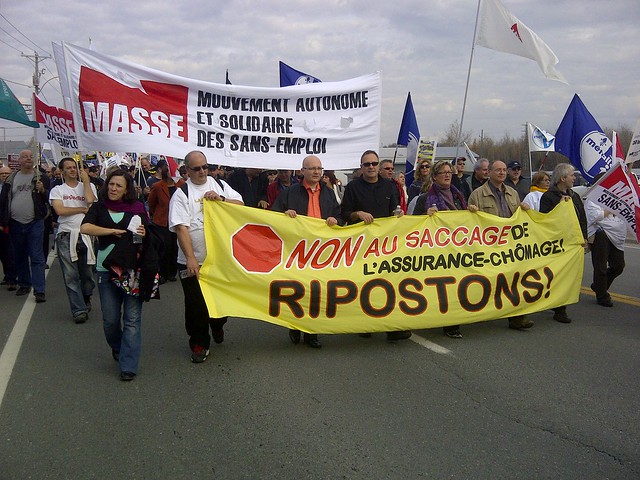
The major trade union centrals of Quebec and the MASSE coalition, a group formed in solidarity with the unemployed, held a series of mass rallies with the biggest one in the town of Thetford Mines in late October. Over 3,000 people from about twelve towns and cities from across Quebec marched to the offices of Christian Paradis, MP for Mégantic-L'Érable (and Stephen Harper's Quebec lieutenant).  Coordinator of MASSE Marie-Hélène Arruda told the rally that "The Conservatives, with their ideology [...] will define by regulation what is a decent job, that is to say a position that an unemployed person cannot refuse for fear of losing their benefits.”

Student legal struggle continues
Drawing attention to the hundreds of students still facing charges from the Quebec student uprising last fall, former spokesperson of the CLASSE, Gabriel Nadeau-Dubois, was convicted November 1 of contempt of court because he publicly criticized a court injunction ordering picket-lines to disperse during the student strike. The judge (who has been linked as a donor to the former Charest Liberal government) based his ruling on a 1972 court decision which tried to smash the Common Front of public sector unions. A support campaign has been launched at www.appelatous.org to fundraise for an appeal.  Meanwhile, the PQ government have announced an education summit to take place in mid-February, with preparatory meetings and consultations starting at the end of November, about the question of post-secondary education funding.

Corruption inquiry exposes P3s
More revelations have been coming forward at the Charbonneau Commission, especially the testimony of ex-construction boss Lino Zambito which has implicated the Liberal party, as well as their political machines on the municipal level and construction firms, into a web of graft with the Mafia.  Media headlines have focused on Montreal mayor Gérald Tremblay’s resignation, the implosion of his Union Montreal party, and now the Mayor of Laval quitting. But the Montreal Gazette has also said that Zambito reported “Public-private partnerships, the sort that are blooming in Quebec to yield hospitals, roads and cultural facilities, are fertile ground for corruption and collusion” because, once big consortiums are ‘awarded’ the contract, the only risk is held by the public sector. One of the biggest P3 projects in Quebec, the McGill University Health Centre, has long been a target of criticism by labour and is currently under police investigation.

QS co-spokesperson steps down
The long standing co-spokesperson of the left-wing political party Quebec Solidaire has stepped down. Amir Khadir was the first “Solidaire” elected to the Quebec National Assembly and the founding leader of the predecessor of QS, the Union of Progressive Forces – which was formed as a federation of left groups including the Communist Party of Quebec.  Khadir will maintain his seat in the National Assembly. Québec solidaire's constitution requires two national spokespersons: one from the legislature and a second from outside it, called a "porte-parole extra-parlementaire", who is not an MNA. The latter also assumes the role of president of the party. A young person is expected to be chosen.

October 11, 2012

The case of officer 728


As progressive-minded activists look back on the past months of protest, a bitter reminder of the police violence and repression has come forward in the form of what is being called "Le cas de l'agente 728."


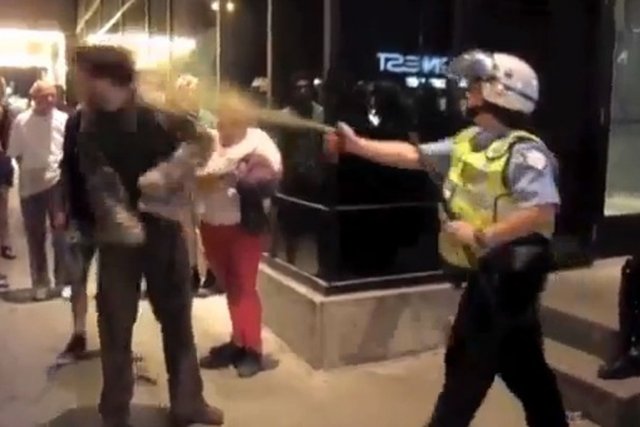
Officer 728 of the Montreal police, Madame Stefanie Trudeau, was widely condemned last spring for her excessive use of force against student demonstrators (see photo at left). While hardly unique, the incident was caught on YouTube. Now, in a video and audio recording presented by Radio-Canada, the violent arrest of four people, for reasons still unclear, by Trudeau has also been exposed.

Home invasion

In the video, Officer 728 with other police invade a residence and grab an individual by the throat, chocking him. The assault took place on October 2nd, when Rudy Orchietti, a resident of Plateau Mont-Royal, opened the door to some musician friends who came to his apartment on rue Papineau, not far from down town Montreal.

Orchietti has a beer in his hands. He is standing on the sidewalk by the door. At that moment, Officer 738 launches into action. Things quickly become chaotic and violent. Orchietti is arrested. When a friend intervenes the police lash out. They force their way into the apartment as if on a hunt. The friend is caught -- pinned by the neck and immobilized.

Officer 728 then confiscated the cell phones of those arrested, but triggered involuntarily a recording on one phone. In the conversation she had with her supervisor, broadcast on Radio-Canada, she speaks of rats referring to the people in the apartment, the fucking red squares, and asshole artists. "I didn't pepper spray them," Officer 728 adds, even though she "was on the edge" -- but fear she would wind up on TV again prevented her.

QS demands more


The SPVM apologized for the "disturbing" images and suspended Officer 728 during an internal investigation. But left-wing political party Québec solidaire expressed distrust of the ethics committee studying this case.

"These committees are composed mainly of former police officers. They are not independent enough, "says MNA Amir Khadir. "We must also tackle the root of the problem, the culture of permissiveness... This culture is of "racial profiling" and "social profiling." And also the lack of accountability," he said.


The violence comes after renewed calls, this time by teachers and educators, for a public investigation into the police violence of last spring and summer.

Over 3000 arrests in Quebec

During the massive mobilization by the Quebec student movement which grew to include widespread public support, and coming less than two years after the brutal G20 protests in Toronto, Quebec was witness to the biggest wave of police repression in recent history, marked by 3387 arrests from February 16th to the 3rd of September, 2012.


(Several of these arrests took place during the notorious "kettle" tactic for which Montreal Police Department (SPVM) have been criticized by the United Nations’ Council of Human Rights. Often these arrests were carried out in a brutal manner, the prison conditions were harsh and they were not permitted to talk to a lawyer or relatives.)

Police brutality also inflicted numerous injuries on demonstrators including, two eyes lost, teeth broken, a fractured skull, as well as broken arms and legs. "Media reports and on-line videos revealed that the police forces generally seemed animated by a profound contempt for students, expressed by the insults, often sexist and homophobic," educator Francis Dupuis-Déri wrote in Le Devoir.


A broader problem

Police brutality is widespread across Canada, compounded by the "law and order" and "war on terror" rhetoric of right-wing politicians and the corporate media, who consistently glorify the police and attempt to justify police crimes.

For example, since November 11, 1987, when Officer Allan Gosset killed Anthony Griffin, police in Montreal have killed at least 37 people. Most have gone unpunished, as coroners, prosecutors, and cabinet ministers cooperate to protect the cops.    The situation in Montreal is not improving. Moroccan immigrant Mohamed Anas Bennis left his Montreal mosque at 6:30 am on Dec. 1, 2005. At 7:20 am, at the corner of Kent Street and Cote-Des-Neiges, he was shot twice and killed by a police officer. The shooting took place during a joint operation by the Montreal police, Quebec Provincial Police, and the RCMP, allegedly targeting "Algerian scam artists" linked to "international terrorism."

Quebec City police were assigned to investigate the killing, starting a process which can only be described as a cover-up. Eleven months later, it was announced that no charges would be laid, since there was "no evidence" that a criminal act had occurred.

In this context the Young Communist League has stepped-up its call for civilian and community control over police and prisons, ending racial profiling by police, and the dismantlement of the RCMP and CSIS.

Maintaining the health tax: Québec solidaire deplores the government's about-face


Québec solidaire deplores the Government's decision to renege on its commitment to eliminate the health tax in an almost complete about-face.

"We find that the government has dropped this demand very quickly; Marois (gave-in) to the emotional blackmail by the Chamber of Commerce and their faithful mouthpieces -- the other opposition parties. Now applied more gradually, this tax (remains) a full frontal attack on the middle class and workers who pay a lot of taxes for fewer public services, " said Françoise David, MP Gouin.

For example, a person who has a net income of $ 20,000 will pay $ 200 this year and $ 100 in the future. "A person of $ 20,000 of income is not rich!" said Ms. David.

QS are upset by the timidity of the government, who will add only one level of taxation for higher net worth individuals. This new level is a meagre increase of 1.75% marginal tax rate, for income above $ 100,000. QS also regrets that the Minister of Finance has abandoned the idea of ​​reducing tax credits on capital gains and dividends.

Rather than measures that affect individuals, Amir Khadir, MNA for Mercier, invites the Government to get more revenue from large corporations and financial institutions.

"Billions are awarded their grants and benefits of all kinds, their tax rate is very low and billions more escape into tax havens. The government could very quickly make some room to move in the budget by ending the tax complacency towards the very wealthy, "said Mr. Khadir.

Approach with caution: CLASSE on upcoming education summit

Camille Robert speaks at a press conference

Montreal, 20 September 2012

Following the announcement of the cancelling of the tuition fee increase and the abrogation of the Law 12 (formerly Bill 78), the CLASSE (the Coalition large de l’Association pour une solidarité syndicale étudiante / Broad Coalition of the Association for Student Union Solidarity) wishes to salute the courage and determination of all those who were active over the last few months.

The organisation wishes, at the same time, to recall that this victory is not the end of the struggle, and that the student and popular mobilization must continue.

“If the Parti Québécois is passing today a series of measures which answer to our demands, it is because we have held to our principles, and have defended them with an approach that was combative, yet unifying,” said Camille Robert, co-spokesperson for the CLASSE. “In the future, our approach will win out over any regressive measure.” The CLASSE therefore notes that it remains opposed to any increase in tuition fees, including indexing to inflation. “Education is a public service, which must remain accessible; not a commodity, with a price that varies with the market,” said Jeanne Reynolds, co-spokesperson of the organisation.

In this sense, the CLASSE is approaching the upcoming summit on education with caution.  ”The PQ deputies are arguing for the indexing of tuition fees to inflation. Until the results of this summit emerge, the cancelling of the tuition hike is, in a way, a temporary victory. The improvements to the student aid system [of loans and bursaries] must also be maintained beyond the current academic year. It is for this reason that we will remain mobilized”, explained Mme Reynolds. Beyond a summit on the financing [of higher education], the CLASSE insists that there be held an “Estates-General” (Etats-Généraux) which will allow collective reflection on the mission of post-secondary education.

Finally, the CLASSE invites once again the population to join them in the streets of Montreal and Quebec on Saturday the 22 September. “We can be proud of what we have accomplished, but we must bear in mind that the battle for access to education does not end today. In this sense, we continue to defend the idea of free education as a project of society”, concluded Camille Robert.

For more information:
Ludvic Moquin-Beaudry, press attaché for the CLASSE:  514-835-2444
Email: communication@asse-solidarite.qc.ca
web: www.bloquonslahausse.com

September 25, 2012

Victories in Quebec, but struggle must continue warn social movements

J. Boyden

In one day, the newly elected Parti Québécois (PQ) minority government led by Pauline Marois swept away most of the keystone austerity policies of the previous Charest Liberals. The new Quebec government, brought to power on winds of change generated by historic mass mobilizations, also realized victories for the environmental movement.

The PQ government cancelled the proposed massive tuition fee hikes; repealed the repressive Bill 78 drafted against the student protests which put severe restriction on civil, labour democratic rights; and announced the cancellation and reimbursement of the new $200 health tax. The action satisfied three out of four of the main demands of the student-labour "Red Hand" Coalition that was at the core of the extended student strike mobilizations last spring. "The abandonment of these measures, criticized by large sections of society, demonstrates that popular mobilization bears fruit," said social housing activist Véronique Laflamme who is also a spokesperson for the Coalition.

An announcement by the PQ on the Coalitions fourth major demand, stopping the increase in Hydro fees, is expected soon. However, as a statement by the Coalition said, "in the context of a minority government, the fate of some [PQ] measures depend on the support received by the Liberal Party or the [ultra-right] Coalition Avenir  Québec (CAQ), two parties that openly advocate user-fees and the privatization of public services, and austerity measures [...] the business community and think tanks use the right-wing media platforms they have to decry tax measures that require greater contributions from big business and the wealthy."

"Mobilization remains necessary now, not only to avoid setbacks but to go further in the implementation of a better redistribution of wealth in order to address growing social inequalities," said Régine Laurent, President of the FIQ Nurses Union and a spokesperson for the Red Hand Coalition.  The PQ is proposing the idea of retro-active taxation on high-income earners, making more than $130,000 and more than $250,000. The tax readjustment will also apply to businesses, and has engendered opposition from pro-corporate forces.

Student organizations have cheered the announcements, while noting that the PQ is planning a mass-consultation with the people of Quebec in the coming months, and that it will likely advocate for a tuition increase at a slower rate. The ASSÉ and its broader CLASSE alliance are heading to convention to determine strategy and if the CLASSE formation should continue. One proposal is to embark on a cross-Canada campaign against the Harper Conservative policy on education and youth issues.

Marois' new cabinet members also made announcements realizing victories for the environmental movement, stating that they will scrap a loan to revive Quebec's last asbestos mine, raise royalties on mining, re-draw the Plan Nord, close the widely criticized Gentilly-2 nuclear power station, and continue the moratorium on shale gas and the procedure of Hydraulic fracturing, widely condemned by scientists and greens alike.

"I don't foresee a day when there will be technology that will allow safe exploitation [of shale gas]," Natural Resources Minister Martine Ouellet told CTV news before her first cabinet meeting, adding: "Our position is very clear: we want a complete moratorium, not only on exploitation but also on exploration of shale gas." Although public outcry and widespread mobilizations forced the former Liberal government to halt shale-gas exploration last year (to conduct more studies on the ecological risks) the PQ leader distanced herself from Ouellet's remarks but said she would close down the Gentilly-2 nuclear plant.

In the 1960s the Gentilly stations, located in Becancour close to Trois-Rivières, were to be the flagship of over thirty nuclear plants in  Québec. Public pressure helped block those plans and today Gentilly-2 is the only nuclear power station in  Québec and generates less than 4% of provincial electric power.

Environmentalist point to studies showing higher rates of cancer, not just five kilometers from the center, but up to 70 km away. While a potential shut-down will be very costly and will be strongly opposed by the Liberal and CAQ parties, it is made much easier by the fact the power station remains under the control of the public corporation Hydro-Québec.

"We support this closure fully but the people can not again fall into the trap of healthy environment or jobs," said Marianne Breton Fontaine, leader of the Young Communist League of  Québec. "Labour, environmentalists and youth must stand together and demand the workers at Gentilly-2 maintain their jobs at Hydro-Québec with no loss in pay or benefits, through Green Jobs that preferably allow them to remain in their current community. Hydro-Québec is hardly in a financial crisis and Québec in general needs to pursue new, environmentally sustainable power sources like wind energy," she said.

September 11, 2012

Quebec election: people give no clear mandate to any party

The election rally of Quebec Solidaire


J. Boyden

A shorter version of the article will be published in the upcoming issue of People`s Voice newspaper

Quebec voters headed to the polls on Sept. 4th for a historic election, coming after a series of major storms of popular discontent had swept the province --  outrage over corruption scandals and opposition against the Liberal government’s austerity budgets, which exploded during last spring’s student strike. But the final results saw no party come out with a clear mandate, as the Liberals, including party leader Jean Charest, went down to defeat while voters granted a slim minority government to the Parti Québécois (PQ) led by Pauline Marois.

The PQ has already announced that its first act will be to cancel the tuition fee hike and abolish repressive law 78, which effectively criminalized the student strikers.  Positively, their party platform also called to abolish tuition increases until 2018, eliminate the health tax, reconsider additional fees for Hydro Quebec usage, increase taxes and fees on natural resource exploitation, expand daycare spaces, and enact Employment Insurance reforms by repatriating EI to Quebec.

Marois’ PQ, however, is nine seats short of a majority to implement this agenda, sitting at 54 Members of the National Assembly (MNAs).  The outgoing Liberals held on to 50 seats in the 125-member National Assembly while François Legault’s new ultra-right and populist Coalition Avenir Québec (CAQ) expanded from 9 to 19 seats. The progressive Quebec Solidaire (QS) party also increased its seat count to two MNAs and is expected to again have a bigger presence in the National Assembly beyond its small numbers.

Voter turnout

Speaking to People’s Voice about the analysis of the Quebec vote break-down which will be published in the next issue of the Communist Party of Quebec’s newspaper Clarté, editor Robert Luxley drew attention to voter participation and the strong mobilization by right-wing forces during the election.

At almost 75 per cent, turn-out in the election broke all recent records of votes in the last ten years, approaching levels similar to the 1998 election (following the second referendum on Quebec’s independence).

Law & Order

On the one hand, as leaked Liberal strategy documents confirmed shortly before the election was called, Charest pursued a cavalier approach of provocation and intransigence towards the student strike for months, hoping to create the basis of for a campaign of fear where they represented law and order, and stability.
On the eve of calling the election the Liberal message shifted to one of blackmail, threatening voters with a political and economic catastrophe if the PQ won and called another referendum.

In the squeeze

On the other hand, unable to avoid convening a commission on corruption scandals due to public outrage, Charest effectively set the timeline for the election when his government convened that commission and established its schedule.  In the end the Liberal’s were squeezed by the student protests – conditions which also favored the PQ.

The pressure from the people’s forces, unleashed as the student struggle broadened into a popular movement, pushed the PQ into adopting a progressive-sounding agenda, to avoid losing votes.  Without the student mobilizations it is probable that the PQ platform would have more accurately reflected their true political identity, a nationalist party of small and large-scale business and not a left party.

Voter break-down

While the higher voter participation no doubt included many new young voters, who also turned to Quebec Solidaire and helped double the popular vote of QS, another large component of high participation came from ridings where the CAQ won.  Often these were in places where the populist ADQ had made gains in the past.

The Liberal’s received 31.2% and the CAQ 27% of the popular vote, eating into the PQ, which received 31.95%, while QS won just over 6%. Thus the division of the right helps explain the victory of the PQ.

Liberal vote

Although the Liberal’s received basically the same total number of votes as the last election (only 5,000 votes less), it was their lowest percentage of the popular vote since Confederation because of the high participation of the people in the election. The Liberals won seats in Quebec City and the regions, but the lions-share of their seats came from Greater Montreal, the Gatineau-Hull area, and the Eastern Townships -- not surprising given that they were the only Federalist party in the election.

An opinion poll conducted by Le Devoir suggested the primary reason Liberal voters chose that party was to voice opposition to the PQ and support Canadian unity, as well as economic stability – rather than the actual values of the party.

National question still burns

Conservative Prime Minister Steven Harper responded to the Quebec election by concluding the vote suggested debate about the national question should now be shut-down. This stiffening of democratic discussion about Quebec’s future is unlikely to happen, however, given the reactionary framework that federalism imposes, as well as continued chauvinism from the corporate media and some Anglophones.
As a case in point, the PQ election victory celebrations were tragically interrupted when a man attempted to set fire to the theatre venue and shot two people, killing a stagehand. As he was arrested he yelled incoherently about the how the English-speakers are now “waking-up.”

The attack was “an isolated act of madness, but it was nevertheless triggered by the socio-political [context]” the Société Saint-Jean-Baptiste said in a statement, calling on the English-language corporate media to tone-down their rhetoric which has labeled soveriegntist voices during the election “Franco-supremacist,” “intolerant,” “anglophobes,” “close-minded idiots,” who “despise minorities” etc.  Comments on some English-language newspaper websites, expressed regret that the gun man was not successful to “kill the bitch”, and other hate speech.

QS makes gains

At the election rally of Quebec Solidaire, held not far from the PQ’s event, newly elected MNA Françoise David congratulated Marois on her election as the first women premier and vowed to work together on any policy the PQ might advance in support of women’s rights, the environment, labour, and other social issues. 

It is more likely however that the PQ will now try to find an excuse to shift away from its election promises and form an alliance with the right. Another election is almost certain well before four years – which has also lead the NDP to officially drop its plan to build a provincial party, good news for QS.

David will now join QS MNA Amir Khadir in Quebec City, meaning that both of QS’s spokespeople will be in the National Assembly, representing back-to-back ridings in urban Montreal. An evaluation of the election by Quebec’s voter-reform coalition suggested that under a Mixed-Member Proportional system, QS would hold 8 seats.  While the actual result is perhaps not as much as that party wished, QS made still important gains and finished second place in at least three other Montreal ridings. 

Marianne Breton Fontaine, the leader of the Young Communist League of Quebec, doubled the popular vote for QS in the riding of Acadie, coming in with almost 2,500 votes and 8%. 

In an upcoming article we will look at the response of labour and people`s movements to the election.

August 30, 2012

Students of Canada: Rise Up!


This documents reflects discussions in the YCL about the way forward for the student movement today. We welcome opinions and comments. It was originally published in the print edition of Rebel Youth, number 13-14.

Other articles and series on this theme: political parties and student struggle; our coverage of the Quebec Student Strike; Students of Canada Rise Up; YCLer Marianne Breton Fontaine speaks on Student Solidarity tour; Call to 2013 YCL student conference; and student actions step ahead but not enough.


* * * *


We are living at a time when a sea change is beginning in people’s way of thinking, not necessarily towards revolution or even progressive politics, but searching for new alternatives to cut-backs, privatization and austerity.

Nowhere is this clearer than among the youth and students, and who is surprised?

At first glance, it might seem like there is an inter-generational war going on – in Québec, the rest of Canada, and around the world.

Youth are being denied even the hope of a future better than their parents, economically and ecologically.

But the austerity budgets just passed on the provincial level, and the Federal Harper Conservative government‘s omnibus Bill C-38, are really a sort of class warfare.

As has been said before, we are being forced to pay for an economic crisis we did not create.

In the gun-sights of the Harper Tories is the labour movement and especially public sector workers, as well as aboriginal people, women, immigrant and non-status workers, the environment, and now even our democratic rights.

An important part of this offensive is spinning the neo-liberal wrecking ball at the foundations of accessible, affordable, quality, public, not-for-profit education from cradle to grave.

August 21, 2012

Quebec heads to crucial vote

Marianne Breton Fontaine, leader of the
Young Communist League of Quebec,
is running for Quebec Solidaire

A shorter version of this article by J. Boyden will be published in the September issue of People's Voice newspaper.

As Québec approaches a crucial election on September 4, the majority of students have decided to halt their long‑lasting strike mobilization that helped trigger the vote.

     About 60,000 students remain on strike according to the militant student union la CLASSE (as of Aug. 21). Most strike votes saw long and intense debates about strategy and tactics. On most campuses, between twenty and forty per cent of students supported continued strike action.  The student's are expected to come back to the question after the election.

     In explaining the vote, the CLASSE pointed to the intense pressure faced by students. Repressive Bill 78 is now Law 12, which bans any kind of strike action (even symbolic) imposing harsh fines both on students, their unions, teachers, and post‑secondary institutions that don't obey the law. Many schools told students that if they voted for a continued strike everyone would receive a failing grade for the semester.

And it seems that this threat is now very real. The 60,000 students who have voted to continue the strike may have their session canceled.

Election battle in full swing

     There is also concern that continued strike action might backfire and actually help the Charest Liberals' "law and order" platform. Polls indicate the Liberals' major challenge is from the pro‑business Parti Québécois (PQ) headed by Pauline Marois. In third place is Francois Legault's ultra‑right Coalition for Québec's Future (CAQ). The main idea of that party is to put the national question on hold for ten years, and create an alliance of the right to attack labour, social movements, environmentalists and Quebec's social programmes in general.  (You can read more about these political parties on RY blog here).

     The big parties have tried to focus on economic development with Plan Nord, and the continued debate about secularism and "reasonable accommodation" (with Quebec culture and immigration) and corruption. But the pressure of the spring's massive popular student struggle refuses to go away.

QS stands out

     The progressive party most strongly identified with the cause of the students, labour and social movements is Québec Solidaire (QS). As one of its star ideas, QS would "eliminate all fees charged to students and their parents when attending any public or parapublic institutions from preschool to university" as part of social project for a progressive and more democratic Quebec.  In election debate, QS was the only party to wear the Red Square symbol of the students.

     Led by co‑spokespeople Dr. Amir Khadir (its one MNA, elected provincially in the Motnreal riding of Mercier) and feminist activist Francoise David, QS hopes to pick up seats in the vote and elect a strong block in the National Assembly. Québec Solidaire is the party with the most women candidates (62 female and 62 male; only 28.1% of all candidates in this election are women), and the party's website lists fourteen candidates who are trade unionists.

Time to stand-up!

     Their campaign slogan roughly translates as 'stand up.' The QS platform advocates many immediate demands that are similar to the policies of the Communist Party of Canada, including:

  • Create a universal public drug insurance plan and "Pharma-Québec", a public pharmaceutical acquisition and production centre, and stopping privatization of health care;
  • Amend anti‑scab legislation to prevent all indirect use of employees by the employer involved in a labour dispute as well as the use of production by alleged volunteers, and ban both lockouts and recourse to injunctions against picketing;
  • Plant‑closure legislation, including financial penalties, forced payment of pensions, and the nationalization of solvent companies converting them to workers' cooperatives.
  • Opposition to the Comprehensive Economic Trade Agreement (CETA) and the North American Free Trade Agreement;
  • Reinforce and re‑establish a progressive tax system, with exceptions for the lowest income brackets, and introducing tax brackets for corporations, as well as reducing tax incentives and eliminating tax loop‑holes.
  • Nationalize the strategic resources for which Québec has extraction and exploitation technical expertise, especially certain raw materials and energy‑related resources.
  • Electoral reform including mixed‑member proportional representation.

     Broad but consistent emphasis is put on social justice and equity issues. The QS platform calls to create 40,000 new childcare spaces, shifting private facilities into the public sector, and expanding the hours during which childcare centres operate, to support parents working in non‑standard jobs.

     QS calls for the Québec National Assembly to pass and apply, without conditions, the United Nations Declaration on the Rights of Indigenous Peoples.

     The platform proposes 50,000 new universally accessible social housing units (public, cooperative, or communal), a guaranteed minimum income starting at $12,000 a year, and a universal Québec pension plan.

     A Québec Solidaire government would advocate reducing greenhouse gas emissions by at least 40% compared to 1990 levels by 2020 and by 95% by 2050. Proposals in this direction include nationalizing wind power, expanding public transit and electrifying transit, banning the exploration and production of fossil fuels (oil, shale gas) and working towards the abandonment of fossil energy consumption by 2030.

     The party calls for a food sovereignty policy that will favour sustainable development of resources, and protect access to clean water as a social right.

Star candidates
   
    The party has attracted some controversy throughout the campaign. Former Federal Bloc leader Gilles Ducept launched into a vicious personal attack at co-leader Amir Khadir early in the campaign.  Corporate media commentators have also seized on the fact that in downtown Montreal the roster of QS candidates includes long-time Queer activist Manon Masse, whose poster was not air-brushed to obscure her facial hair.

   In the north of Montreal, anti-police brutality campaigner Will Prosper is also running for QS, who has attracted attention beyond Quebec for his outspoken criticism of racial profiling and the police murder of unarmed Honduran-Quebec youth Fredy Villanueva.

   Other star candidates in Montreal include Alexandre Leduc in Hochelaga-Maisonneuve, a former student activist and organizer with the FTQ trade union central, and leftist anti-poverty activist and Chilean-Quebeker Andrés Fontecilla who is runing in Laurier-Dorion.

QS, the PCQ and the future of Quebec

    Like the Communist Party, the QS calls to strengthen enforcement of the Charter of the French Language (Loi 101) in all work environments, countering the current direction of increasing exceptions to this law that have allowed a growing number of workplace orders to be again given in English.

     QS has a somewhat concurrent but different emphasis and vision from the CPC when it comes to the question of Québec's future.  The relationship between the two parties goes back to the ancestor of QS, the Union of Progressive Forces (UFP). The UFP was formed following the major anti-globalization protests in Quebec City, as a coalition of several left groups including the PCQ.

     In the long-term, QS calls for a society that moves 'beyond capitalism.'  While this ambiguous phrase is not prominent on the QS website, the campaign is talking about the current experience of Bolivia, Venezuela and Latin America in general as an example of social transformation for Quebec.

    In its interventions about this question, the Communist Party of Quebec (PCQ) has similarly called for QS to develop further towards a united front of labour and social movements around the most advanced and broad left-progressive basis of unity possible -- ie. a democratic, anti-monopoly and anti-imperialist platform, rather than socialism.  The clear orientation of the PCQ is towards socialism and it supports QS as the most helpful within the current context.

   As a founding member of the UFP and QS, the PCQ's approach is also not the same as so-called "enterism" where a radical left group (especially a Trotskist grouping) will join a social democratic political party in order to split that formation and win a large pro-socialist organization. The PCQ views QS in a very different strategic framework of a united front at the present juncture, based on its evaluation of the class struggle in Quebec.

Quebec independence

     The Communist Party of Quebec also has a long history of defending Québec's right, as a nation in Canada, to sovereignty and self‑determination, up to and including the right of separation. (You can read the programme of the Communist Party here). The PCQ proposes a new equal partnership of the Aboriginal peoples, Québec and English-speaking Canada in a confederal republic, with a new constitution enshrining the right to sovereignty.

     Like the PCQ, Quebec Solidaire also rejects the status‑quo of federalism and proposes a strategy that is more or less complimentary: an elected constituent assembly to be convened so that Québec would democratically decide its own future and draft a new constitution:

Québec solidaire recognizes the Quebecers’ right to choose its institutions and its political status. [...] The Constituent Assembly will: be elected by universal franchise, made up of an equal number of women and men and representative of tendencies, different socio-economic backgrounds, and the cultural diversity present in Québec society; conduct a far-reaching, participatory democratic process to consult the population of Québec on: the values, rights, and principles upon which community life should be based; the political status of Québec; the definition of its institutions; heir delegated powers, responsibilities, and resources; develop, from the outcome of the consultation, one or more proposals which will be put to the population in a referendum.

     However, like the majority of the left in Québec (but not the PCQ), QS sees the process of sovereignty as a road to independence. It's platform makes it clear that "Throughout the process, Québec solidaire will advocate for creating a sovereign Quebec state, without assuming what the outcome of the debates will be."

    The line between these two formulations -- summarized by leader Amir Khadir in a phrase that translates as "[QS thinks] indepedance is necessary, but [the result of the process we propose will] not necessarily [be] independence" -- may seem very thin or academic to out-of-province political observers. But within Quebec, this issue is explosive. The fact that QS claims to be a pro-sovereignty party and yet also wants to initiate a process that might not lead to separation (and instead a fundamentally different yet united relationship with Canada) has resulted in polemical denunciations from other nationalist forces like L'Aut' Journal.

     More than in previous campaigns, QS sometimes comes close to putting independence as an objective in itself, which is the approach of the Parti Québécois -- demanding seperation not as a way to social progress (which is the QS' stated policy) but as a means to an end. The platform says QS "will set in motion from the day it takes office a constituent assembly process" and in the televised debates, Françoise David tried to put the leader of the PQ on the spot, asking her when a referendum would take place. QS is clear, she said, that the ball will be set into motion within their first year.

     But is that the main priority task? The PCQ positively views the continued split of the nationalist camp away from the big business PQ and behind a sort of people's agenda of social demands. Placing greater emphasis on such struggle will help develop class consciousnesses that could convince people to understand the national project in a different framework of class solidarity and unity.

    While agreeing that the sovereignty of Quebec is a fundamental question that must be addressed and solved, the PCQ puts much greater immediate priority on uniting all the people of Quebec to confront and reverse the "class war" being waged by the capitalists against the people.  The PCQ also points out the serious danger to both Québec and English-speaking Canada from US imperialism that comes with the path of recognizing sovereignty through Independence, and instead calls for an equal and voluntary partnership of the working class and its allies in both Québec and English‑speaking Canada, united in the struggle for social transformation against our common enemy -- big business.

    Despite this difference, the choice for those looking for a strong left party is clear. (The QS program is available in English here.)


Option nationale

     Another party presenting a left-sounding platform is Option nationale (ON), which currently holds one seat in the Quebec National Assembly. ON is a dissident split from the PQ, and likely believes that PQ is on the edge of break-up -- which could be true if that party fails again to win another election. ON broke from the PQ in order to advance a more immediate and assertive trajectory towards Quebec independence than the PQ is currently prepared to take, and waits in the wings to succeed as the true party of separation.

     ON's platform is arguably a cheap copy and paste job from Quebec Solidaire, hoping to attract young voters who are pro-independence. The party is calling for nationalization of natural resources, free education (from kindergarten to PhD), abolition of nuclear energy in Quebec, a moratorium on shale gas operations, Pharma Quebec (a new crown corporation which will aim to reduce pharmaceutical costs in Quebec), construction of a monorail electric suspended between cities, and implementation of proportional representation in Quebec.

     ON's generally progressive rhetoric most likely reflects an opportunist sentiment. The main social basis of support for a "fast-lane" strategy of independence is from left-leaning voters.  While ON advocates for a pro-independence coalition government, it has vigorously attacked QS at the same time for its strategy stating that "All political programmes corresponding with the interests of Quebec will never be fully realized in the Canadian context. For us, independence is not maybe necessary, it is essential."

    This has left more than a few political observers wondering that if the ruling class had wanted to invent a rival party to split the QS vote, could they have done better? In fact, ON is headed by Jean-Martin Aussant a former PQ Member of the National Assembly (MNA) who is worked as a vice-president of Morgan Stanley Capital International in London, England. As an PQ MNA, Aussant was finance critic  -- a difficult position from which to jump into "left field."


Restrictions on "Third Parties"

     Québec`s election law severely restricts interventions by organizations not officially registered as so-called "third parties." The Liberals have demanded investigation of student groups. One blogger has been forced to take down her site because it was critical of the ruling party, and a labour union central has removed videos critical of the Liberals.

     The Communist Party of Québec (PCQ) is also in this position. The PCQ has issued a statement critically examining the flaws of strategic voting and the connection between electoral struggle and struggle on the streets.

     Marianne Breton Fontaine, who ran for the Communist Party of Canada in the last federal election, is a candidate under the Québec Solidaire banner in Acadie. This riding is currently held by the Liberal Minister of Culture who waded into the student struggle last spring, accusing a famous soft‑spoken Québec storyteller of endorsing "violence and terrorism" by wearing the red square.

August 8, 2012

Students of Canada - Rise up!

Education is a right, not a privilege!

Commentary by the Young Communist League of Canada about the student struggle in Canada and especially Ontario today.

The unity and militancy of the Quebec student struggle has begun to shake the rest of Canada. Across the country, the youth and student movement has been inspired and emboldened by the struggle in Quebec. Many have correctly concluded that the best form of solidarity is to step-up a united fight back at home.

The Young Communist League of Canada supports this growing mobilization, made stronger by work like the Casserole Night in Canada protests that heard post banging from Antigonish, Nova Scotia to Victoria, British Columbia; and here in Ontario, by solidarity tours like that organized by the Canadian Federation of Students - Ontario and the Toronto student strike workshops which drew in over hundred eager participants.

Now is the time to start building a broad, militant and united fight back for accessible education, which is in crisis in our province:

• fees in Ontario are 23 higher than the cross-Canada average
• college tuition has outstripped inflation by 378%
• university tuition has outstripped inflation by 509%
• students graduate with an average debt of $37,000

The McGuinty Liberal government has just announced dangerous plans to compress four year degrees into three. In Canada and around the world we are seeing a new kind of education system where we pay more and learn less. As all students scramble to find work and pay our bills in an economic crisis of capitalism, indigenous peoples, women, and racialized communities face growing barriers to post-secondary education. International students are exploited as ‘cash-cows’.

In place of  accessible education, we are being told to lower our expectations and accept a life of debt and unemployment. 

BOOKS NOT BOMBS

The McGuinty Liberal`s sham 30% tuition grant promised to students in the last election is woefully inadequate. Two-thirds of students aren't eligible. We are told by the government there is not enough money to pay for "luxuries" like education and that we must tighten our belts. 

But if there's billions of dollars that can be spent on corporate tax breaks and fighter jets, why is there no money to spend on education? Free education for Canada would be $5 billion annually. Harper`s annual military budget? $25 billion. 

We must see what the government cuts to education really are - an ideological war being waged against students in tandem with attacks on the working class majority. 

UNITY AND RESISTANCE IS THE WAY FORWARD

It is tempting to reduce the student struggle to a question of magic leaders -- or magic structure. Of course, leadership that understands its duty, listens to members, and shows uniting ways forward is very helpful -- as is a democratic approach as expressed by mass all-campus or department level meetings of students (General Assemblies), and especially when the students themselves not only make the decisions but also carry them out.

On the other hand, the main problem student's face is not a question of personalities or decision-making process: it is the political problem of unity and militancy or bringing together the broadest and most powerful unity of students and their allies, behind a militant political strategy to win access to education.

The vast majority of students already see education as socially positive and support lower fees and greater access. In order to turn this sentiment into a visible force, hard work is required, convincing our campuses of the demand that access to education is a right, and of the urgency and necessity for united and growing strategy. United struggle is the only effective path for students to win.

The way forward for the student struggle must be to place front-and-center the question of a broad, powerful and united fight back with an escalating action plan that reaches beyond access to education and ultimately demands free education. The passive tactics of lobbying, post cards and petitions, isolated or one-day-a-year actions, and campaigns centered on media outreach rather than mass mobilization are simply not enough.

As the most progressive student union in English-speaking Canada, the Canadian Federation of Students (CFS) is in the best position to build such a plan and win the students of Ontario to a program of united struggle. To its credit, not only reduced fees but free education is the policy (at least on paper) of the CFS. This strong mandate has to be put into action now. There is no contradiction between respecting the autonomy of local campuses and the CFS organizing and making a political battle to win students into struggle -- in fact, the opposite.

On the other hand, everywhere reactionary students have won campuses to ditch the CFS, the campus has shifted to the right and political inactivity. If we got rid of the CFS, students would wake up with a big hangover and just have to rebuild.

Many campuses are controlled by right-wing student unions in Ontario, and the Ontario Undergraduate Student Alliance and the Canadian Alliance of Student Associations support tuition increases. Everywhere progressive students must re-double their efforts to win their campuses back from these forces, linked to reactionary political parties like the McGuinty Liberals and Harper Tories.

The vast majority of students view education as socially positive, and strongly support greater access and lower fees!

There is also a new breeze in the air. Emboldened by youth protest internationally, more students are taking up the call of accessible, quality, public not-for-profit education from cradle to grave and challenging the  policies of big business and their  governments.

The neoliberal agenda is being implemented internationally, therefore we must also recognize this international reality in our local struggle. The same struggle is being waged by students in Chile, South Africa, Germany, Britain, Greece, Spain – and Quebec! Across the globe, students are fighting back!

STUDENT STRIKE, PEOPLE’S STRUGGLE!

Hundreds of thousands of students in Québec have mobilized over the last semester, despite violent police repression and the suspension of democratic rights using the strongest tactic to put moral pressure on the government– a student strike – and in doing so, have shown that a broad, mass, united struggle is by far more the most effective strategy.  

The Quebec students have won strong support from labour, community groups and the people. Despite the Mulclair NDP`s silence, the sound of casseroles are clanging across Canada!

Key parts of the escalating mobilization in Québec include (1) campus "mobilization committees," which operate under the regular direction of student General Assemblies, as well as (2) militant and relatively united leadership by student unions, and (3) an escalating action plan that the grassroots membership and all levels of activists feel they are democratically driving forward.

Quebec also shows that the demand for free education can open mass, democratic debate about people`s alternatives and social transformation.

Mass mobilization and cooperation between students and other movements, especially labour, is the only way we can effectively defeat corporate and government attacks on education.  Ontario students cannot afford to wait to find the best direct democratic structure or for spontaneous opportunities, or the next election to fight back. Every month, every week we delay organizing has a cost.

GET ORGANIZED, FIGHT BACK!

• Show solidarity-- wear a red square!
• Get vocal-- demand accessible education as a right, not a privilege!
• Get involved -- help build or grow a local action or mobilization committee
• Support and attend General Assemblies, student elections, and  build your student union 
• Demand an escalating plan of action for a broad and united fight back
• Open a broad democratic debate about free and emancipatory education. 

Free education should be federally funded. Cut military spending by 75%! The YCL also supports the Post-Secondary Education Act, not least as the Feds and Premiers negotiate transfer payments currently. But unity with the Quebec student movement and Aboriginal students (for whom access to education is also a treaty right continually denied) must be found on a new basis of justice and equality of nations, not Canada`s existing Constitution.

The YCL thinks that a bold counter-offensive is necessary, and we propose a Charter of Youth Rights as a basis to bring together the youth movement behind a social vision of a better Canada. 
Ultimately, we can and must win future that guarantees free education, peace, equality, ecological sustainability, and real democracy – which we call socialism!

July 29, 2012

The youth struggle today: reform and revolution, local and general


Based on a greetings given by Drew Garvie on behalf of the Central Executive Committee to a meeting of YCLers in Vancouver, July 2012

Thank you to the Young Communist League British Columbia for having me here today, on behalf of the Central Executive Committee, for your provincial convention which also takes place on the same weekend as Moncada Day.

This is entirely appropriate. Moncada Day celebrates the movement that grew into the triumphant Cuban revolution, which was born on the 26th of July 1953 when Fidel and Raul Castro and around 160 other brave revolutionaries attacked the Moncada Barracks in Santiago de Cuba.

This meeting of the Young Communist League comes at a juncture in the youth and student movement when the forces of monopoly capitalism are instituting a strong offensive against the people and the environment through their reactionary, pro-war governments: the Harper Conservatives in Ottawa and their allies, the Clark Liberals in Victoria.

At the same time, the fight back is developing at an accelerating rate.

Signs of this can be seen especially in the youth and student movement. The development of Occupy successfully popularized the struggle of the “99%” against the 1%. There is some increased militancy from the student movement across English-speaking Canada, drawing inspiration from the ongoing historic and massive Québec student strike. The Charter of Youth Rights campaign is emerging.

Quebec, although on the other side of the country, is especially important. The bold unity and sheer numbers of the mobilization has scared the ruling class and sent a call-out for youth to rise-up.


Millions of people are also participating in general strikes and demonstrations in countries like Greece, Portugal, Britain and India.  Much of Latin America continues to advance as an anti-imperialist front.

The revolutionary uprisings across North Africa and the Middle East which started around 18 months ago have not faded away. In Egypt there are continued strikes by factory workers, and street demonstrations by students.


Comrades,

The growing youth resistance has borne-out what the YCL said almost two years ago at our Central Convention, that the youth should take courage at the weakness of capitalism and build the fight back.  We are in dynamic times, with many dangers and challenges but also the potential for a better future for British Colombia and Canada – and resurgent socialism.

We are being told by the corporate media that the economic crisis is to blame for aggressive budget cutbacks.  For example, the recent Harper Budget, the Omnibus Bill C-38.  We are again told that we can no longer afford the social programs that working people have won after generations of struggle.

Governments are broke and there’s nothing they can do about it, except make the working class pay the bill.

This is what people are hearing in British Colombia, in Ontario, in Quebec, but also internationally in Greece, in Spain, in Britain, in Chile, in India, and elsewhere.  It’s a refrain that the pro-capitalist governments, whether they are right-wing or social democratic, basically have in common around the world.

Is it true?

Young workers and student activists can clearly see the dangerous lie to the claims behind 'austerity' when we have a global perspective. Even in a provincial meeting like yours today, it is important that the international and the local are always dialectically connected.

Consider the global economic crisis; the question of war and peace; and environmental struggles. Or the campus struggles today, with the student uprising in Quebec and the challenges for the student movement here in BC.  How is the general connected with the specific?

First, the 'financial crash' or 'long rescission'  or 'slow recovery' or as we have been accurately calling it from the beginning  the capitalist economic crisis.

This crisis was not created by social programs, or by the people.  It was created by capitalism itself. In fact, because of the internal contradictions of the capitalist economy, it operates in cycles of boom, crisis, depression and recovery which is politely re-labeled by economists 'the business cycle'.

And whether in the form of the velvet glove of “welfare state” reformism or the iron fist of neoliberal reaction, the policies of finance capital and its state have merely created new contradictions.

Over the last 40 years, corporate profits have skyrocketed, and big business has paid less and less taxes to the State. By eroding the tax system, keeping wages down, speeding up the working day, busting unions, privatizing profitable parts of the public sector, and breaking into new markets through trade agreements and even war, the capitalists hoped to survive systemic contradictions -- especially falling rates of profit. Because while Capital has made larger and large profits, the rate of accumulation was not rising (as new technologies were introduced).

Capital put the bill in the hands of government and the people, forcing them to borrow from the capitalists. This debt itself became a commodity.  When the economic crisis hit, it was public money that went to try and resuscitate Capital through bailouts -- causing more debt. Who holds this debt? Well the capitalists, of course!

Now we are told it is our duty to feed the machine more.

As the crisis broke in 2007, debt spiked further.  Now, in Europe, they’re back to demand repayment on their loans, that were given to themselves.  This is called 'the Eurozone crisis' but it is really just another example of the global economic crisis of capitalism. Even Prime Minister Stephen Harper quietly said the last Greek election could effect the world -- including Canada.

The Harper Conservatives would like us to believe the economic crisis has really not effected Canada, but you here in BC know otherwise.

The youth movement understands its local struggles clearer and better when it has a 'big-picture' focus.

Capitalism is a system without democratic social planning, which as Engels said produces an “anarchy of capital” which is the cause of the crisis – of misery, exploitation, unemployment, poverty wages, and environmental devastation around the world. It is what the People are up against, but there are alternatives.

Communism and socialism are not words to be embarrassed of.

Capitalism is the real failed system.

And we putting socialism back onto the negotiation table!

Comrades,

At our most recent meeting of the YCL Central Committee we drew the connection between economic crisis and war.

The World Federation of Democratic Youth, the World Peace Council and the Canadian Peace Congress, and the international meeting of Communist and Worker’s Parties have all warned of the increased aggressiveness by imperialism.

As we report in the latest Rebel Youth magazine, a military intervention in Syria is being planned right now by imperialist alliances like the North Atlantic Treaty Organization or NATO.


As we have seen in Libya, Palestine, Afghanistan, Haiti, Colombia, Paraguay, and many other places: the people are not done any favors by imperialist intervention. ‘Regime change’ in Syria would led to a terrible blood-bath and provide a road for imperialism to hit at Iran.


On the way to BC, I saw the Economist magazine in the airport with an article entitled “Syria: the end game”.
How many millions of dollars will be spent on another war? Money that, as your meeting documents say, should go towards BC’s crisis of child poverty – and job creation with good union jobs.

We have called for all peace-loving youth in Canada to support a peaceful and political solution by the Syrian people themselves.

The question of peace is also a challenge for BC young workers and students to address as a movement, and find ways to mobilize opposition in the streets.

Even when these issues seem forgotten, the YCL has a duty to remember the importance of the struggle for peace. The YCL must never abandon the principle of working-class internationalism, the principle that working people of the world must stand united against capitalist wars and for the class struggle.

And so with the question of internationalism we return to the relationship between the specific and the general.

On the other side of the Pacific, there have been tremendous anti-nuclear protests in Japan. The March 2011 Fukushima Daiichi nuclear disaster has lead to the evacuation of close to 2,000 people and over 500 disaster-related deaths, as well as the release of radioactive material into the Pacific. We would like to take the occasion of this meeting to express our solidarity as the YCL with the environmental movement in Japan.

Turning our eyes to home, we also call for the evacuation of all US troops and the closure of the Nanose Military Base which is a weapons testing area for US nuclear submarines.

The environment is understandably of vital important to the youth, because it is a struggle for the future. Climate change, for example, shows clearly the link between the global and the local.

Just a few days ago, scientists announced a rapid and massive thaw of Greenland’s glaciers. After just a small rise in oceanic water temperatures, and this office could be threatened by tidal storm waters!

In this context, we also join with the people’s movements and shout out that militant solidarity can block the Enbridge Northern Gateway pipeline!

The YCL has a long and proud history of opposing project like this, exporting unprocessed raw materials, which strengthens U.S. imperialism and its Canadian cronies, but fails to create jobs.

It is great to see the youth and student resistance to the pipeline, here in BC!

The cynics and the disheartened progressives who thought that the working class and youth of North America were “hopeless” now have examples in Wisconsin, across the continent in the form of the Occupy movement, and the Quebec student uprising.

The Quebec student struggle is another case where a local struggle is framed in an international context of struggle for accessible education, and then becomes part of that international resistance.

Globally, accessible education is under dangerous attack with the Austerity agenda. Students in Britain and Spain been a part of that renewed militant fight back.

In Chile, students joined a general strike of the miners in the summer, and a political strike was launched to replace the Pinochet-era constitution with a new constitution that would enshrine guaranteed free and accessible education.  600 000 marchers hit the streets in a country of 15 million.  The Young Communists of Chile have been at the forefront of this struggle.

I would like to touch on the Quebec student uprising which is perhaps foremost in our minds in the discussion people`s resistance today.

It is also a topic where the CEC has devoted much attention to, in consultation with the YCL`s all-Canada student working group telephone meeting, which is growing and meets a couple times a month.

We would really like to see the call grow and develop, to include more participating from BC.

One way to get a good handle on how strong a movement is, is to see what the thinkers of the capitalist class are saying about it.  Former advisor to the US state Department on the Quebec student struggle, David Jones has spoken about the Quebec spring. This is not a man who is on our side of the class struggle.

What was David Jones greatest worry?

That "students elsewhere (may) determine Quebec has provided a ‘learning experience.’”

As the YCL, that is exactly what we want: for lessons of Quebec to be shared with other students – and young workers!

We can not simply say – oh, that’s those French speakers. They have a different, culture, history, language, territory and economy, etc.

That is what the corporate media is saying. Quebec is ‘special’ – so the student uprising can not come to BC.

It is striking that when Quebec demands its sovereignty -- which we broadly support, proposing a new constitution on an equal basis with English-speaking Canada, up to and including the right of separation – but when Quebec`s self-determination and the national question comes into question, these factors that make Quebec a nation are suddenly forgotten by the corporate media and Quebec is no longer ‘special.’

However, a communists we know that there is a common class struggle which unites the different nations in Canada.

The fight for accessible education is a class and democratic struggle.

I was in Montreal last May as part of a delegation of student journalists from Guelph, Ontario and we interviewed student leader Gabriel Nadeau Duboise of the CLASSE union. He told me about the repression they have been facing by the police and with Bill 78, but also the slogan – “Student Strike, People’s Struggle.”

The students in Quebec, through struggling for a freeze in tuition fees, have learned a great deal through their battles and are now advancing other people’s movement demands, as their new “Share Our Future” manifesto says. You can read it on our RY blog or in the latest People’s Voice. I would like to quote:

“This is the meaning of our vision, and the essence of our strike: it is a shared, collective action whose scope lies well beyond student interests. We are daring to call for a different world, one far removed from the blind submission our present commodity-based system requires”

This is an important political view for the YCL and also shows the strength of our analysis: that the quantitative struggle for reforms, like accessible education, are necessary because they help build towards a qualitative change in the people’s class consciousness, organization and unity; ultimately it is towards the realizing the necessity of fundamental social transformation and revolutionary change – socialist consciousness.

The struggle for immediate social progress, within the framework of capitalism, and the struggle for making a rupture, a sharp break overthrowing of the system, are objectively linked as a process.
This can be difficult to grasp in the youth and student movement not just because youth (as much as we hate to admit it!) can lack experience with struggle.

That’s true, but it is difficult because it gets at the question of how we understand, as revolutionaries, our basic reality. If reform and revolution are opposite tendencies – ideologically, politically and economically – how can they be a united process?

Reforms are won through the power of the movement. Any fundamental change depends on the mobilisation of the masses of people. Nevertheless, under capitalism reform gains will be temporary and precarious.

Let’s keep in mind Quebec here, which has the lowest tuition fees in the country – this is not the first student strike in Quebec, it is the eight strike. And still the capitalists keep trying to push up fees! While we haven’t seen a significant gain come out of the battle – yet! – the struggle has become a mass and social mobilization far beyond the campuses which maintains, albeit unclearly, a perspective of challenging corporate power.

If the movement, while thick in the action for immediate reform battles, can maintain a revolutionary qperspective of class struggle and overcoming capitalism it will intensify the militancy of the working class.

And that is the kind of position the youth and student movement needs to be in – militant and united.

Conditions are always changing. The earth spins around on its axis, marking each day. It may seem that day after day, or year after year, life is the same. But life proves Marxism`s claim that the capitalist system is unsustainable and crisis-ridden. The moment we are living in is making history. Political ‘ruptures’ have been breaking out around the world – take the Arab spring – and the strength of the movement and its leadership is often decisive.

Perhaps it is too early to judge the results of the Arab spring in Egypt and Tunisia, but we can see how true this strategic perspective is, by remembering the first successful socialist revolution in North America – in Cuba.

The Moncada day we are celebrating this weekend set the revolutionary process into action in Cuba.  But the main demands of the youth who stormed the barracks were free and fair elections. Just a year before, in 1952, US-supported dictator Fulgencio Batista had organized a coup and rigged the elections. And so, disguised as businessmen interested in Clay Pigeon shooting, a group of young radicals came together under the leadership of Fidel, Raul and others, training at the University of Havana.

In the short term, their raid was tremendously unsuccessful. It did not start an uprising. Instead, many of the youth and students died. Fidel, Raul and the rest of the rebels went to prison. But we know the rest of the story. A mass movement of the Cuban people against Batista developed with force, conditions changed and a crisis developed.

Facing armed insurrection that had liberated most of the island, as well as a mass uprising and a general strike, in January 1959 on New Years day Batista fled into exile (to eventually settle in fascist Portugal). And the revolutionaries lead by Fidel and Che marched into a celebratory Havana!

After the overthrow of Batista, the Cuban revolution kept advancing. It developed into a socialist revolution and the Cuban people built the first free territory in the Americas.

By celebrating Moncada, we remember that the Cuban revolution was made possible by the people’s struggles that came before, and took many hard years of organization and work. The small immediate battles and the big sweeping changes were not separate, but in a contradictory relationship together.

The YCL is a unique group in the youth and student movement because it ‘gets’ this unity of reform and revolution.

While we don’t try to impatiently impose our demands on the youth movement, we don’t sit on the sidelines or simply ‘go with the flow.’  We are not compliant or complacent with the situation today where many movements have adopted tepid demands without a common strategy (other than voting NDP).

The vanguard role of the YCL arises in action, working in the political direction of the Communist Party of Canada, and applying that strategic direction within the youth and student movement of unity and militancy.
What can be learned from the Quebec student movement by student activists in English speaking Canada and BC?

This is an important question for your meeting to discuss.

In our statement for the Feburary 1st “Education is a Right” cross-Canada day of action, the YCL made a criticism of the current tactics of the Canadian Federaton of Students or CFS, in a constructive and respectful way.  We called these protests an excellent step in the direction of developing into a truly broad and united fightback.

In other words, February 1st fell far short of being what was necessary but could have been a good start.

Afterwards, in People`s Voice, we said the poor turn-out was a ‘wake-up call’ exposing the ‘lack of an action plan’

We called for ramping‑up actions on campus. Sit ins. Occupations. More rallies. [and] bringing the struggle into the community and winning the moral support of the public which, at least in sentiment, is probably already there - but not yet in a visible way that cannot be ignored.

Our policy is for a united and militant student movement that moves the campuses into action and reaches out beyond, to stand with the struggles of labour and other people`s struggles.

Our current policy in the student movement is that:

1. The student movement and the CFS needs an escalating plan of action for a broad and united fight back;
2.  This struggle should open a broad democratic debate about free, accessible, quality, public, not-for-profit education;
3. That the political reason for the student movement’s struggle must be brought into the hands of the members themselves through democratic empowerment;
4. The student movement must urgently find unity with Quebec and Aboriginal students, and it must be on the basis of their rights to sovereignty and self-determination as nations;

Since the CFS Day of Action, Quebec has exploded. We must say that the solidarity movement in Canada has really been outstanding – but not with any help from Mulclair`s NDP! – but now each point on this list, which may have seemed abstract in January, is very concretely on the table.

The Charter of Youth Rights campaign compliments this perspective on unity.

In addition to free education from cradle to grave (including childcare) the YCL also demands abolishing student debt, grants not loans, kicking military recruitment and research of our campuses, restoring and expanding funding to education including Aboriginal education, and a living stipend for students.

Winning these demands is not a question of magic structures or magic leaders but finding the way to organize for a major battle, drawing hundreds of thousands if not millions of students into struggle.

In such a battle a student strike would be, as we said in January, the most effective way to put moral pressure on the government. It should therefore be part of the student`s arsenal.

But here is an important point.

Beyond the debate about tactics we think there is an ideological battle here, which is also observable in the Labour movement.

On the one side are the strategies of ‘lobby or wait until the Election and vote NDP’ and right-wing social democracy.

On the other side are the left and progressive forces that are calling out for action.

We are not in the arm chair on these questions, we are in action.

The CEC and the YCL student conference call helped support and organize the recent “Student Solidarity Tour”, bringing Quebec activists to 9 cities in Ontario, largely organized by our comrades on the ground and comrade Ryan from YCL Hamilton who is also a member of the Central Committee.

This was a very positive step forward for the League in Ontario as well as Centrally and had a significant impact on the situation in Ontario.  It was the first time that CLASSE leaders and the Canadian Federation of Students were connected on a project as large as this, from Ottawa to Windsor.

Turnout to the events were very good and CEC member and leader of the LJC-Q, comrade Marianne Breton Fontaine had a chance to address about a thousand Ontario student activists with our call for unity and militancy as the way forward.

This was built from other work including the “student activist conference” the YCL CEC and the LJC-Q convened in Montreal in January. Could we do the same thing with a YCL young workers conference?

This weekend, many of our activists are in Toronto at “student strike training workshops” which Marianne will be presenting at. Over lunch, the YCL is holding a special fraction meeting of all our members attending the conference , to coordinate our contribution.

To update you on other activities across the country, the YCL-Ontario just finished their convention a month ago.  14 delegates from 4 clubs were in attendance and dealt with over 60 amendments through thorough debate and we elected a renewed leadership with a PC of ten comrades, including young workers and student activists from our new clubs in Ottawa and Windsor. I was re-elected as the Ontario YCL organizer.

The YCL also had a visible presence through participation in the Toronto Pride parade which concluded the convention weekend.

Rebel Youth, after a delay in printing which some of you in this room will know about directly, has come out with a double issue, which features the Quebec student strike and is in colour.  It is being well received as the youth movement is eager to learn about what is really going on in the streets of Montreal and Quebec city.

I am happy to see that your meeting will be discussing contributions from British Colombia to our magazine and we do need help making sure that issues are produced more frequently.  Above all, we need participation and involvement in the commission, and building the magazine among young workers with new subscriptions.  Our magazine should be at the centre of our agitation, organizational and educational work of the League across Canada.

In Cuba solidarity – which we should draw extra attention to this weekend as it is the anniversary of the July 26th movement and the storming of the Moncada Barracks which marked the beginning of the Cuban revolution – we have sent two members of the YCL on this year’s Che Brigade, including Central Committe member Dan Mozarowski, and will be using this participation to strengthen our solidarity work.

We will be visiting Nova Scotia this Fall for a school, and have started organizing efforts to grow the League on the East Coast.

We need to prioritize more the work of young workers who are being hit hard by the economic crisis.
Where we are visible, active and working collectively as the YCL we are growing, sometimes significantly.

The current economic and political conditions have caused more and more young workers and students to look for alternatives to cut-backs, privatization and austerity.  We have answers to the questions that are now being raised.  The case against war, poverty, misery, environmental devastation, unemployment, exploitation and oppression is really the case for socialism.

With these thoughts, comrades, I think I will conclude.

I also should mention that next year will be a special occasion for the YCL, the 90th anniversary of the League and our founding in 1923.

Our 90th anniversary will be a special occasion that we will have to celebrate in some way as we mark 90 years of fighting history for young workers.

Again, good luck with your work today and we hope your debates are fruitful. As our slogan says:
The Youth are the Future, The Future is Socialism!

Popular stories