Showing posts with label youth unemployment. Show all posts

December 7, 2016

Precariousness & Poverty for Young Workers: StatsCan Report

Drew Garvie

This Monday, Statistics Canada released a report that confirms what young people already knew: youth jobs are few, temporary and part-time. Canada’s so-called “recovery” economy has little to offer youth besides precariousness and poverty.

The report, entitled “Perspectives on the Youth Labour Market in Canada, 1976 to 2015”, focuses on young workers aged 15-24 who are not enrolled as full-time students and compares this generation to past generations of the same age group.

July 2, 2015

80 years since the "On to Ottawa Trek"

Special to Rebel Youth

This spring and summer marked the 80th anniversary of the On to Ottawa Trek. Rebel Youth celebrates this militant struggle and ongoing struggles for work and wages. 80 years later capitalist crisis has again been used by a Tory government to attack the working class. Youth unemployment is reaching almost 20% in several major Canadian cities, and the majority of workers (a larger majority for youth and women) are not covered by Employment Insurance. With this in mind, we look back to past victories for inspiration today!

February 11, 2014

Full analysis of CLC on 2014 Federal Budget

Canadian Labour Congess

The 2014 Federal Budget lacks any vision about how to stop growing inequality and stimulate the economy.

The Conservative plan continues to focus on austerity measures to balance their budget by 2015, and rests their hopes for economic growth on no-strings attached corporate tax cuts. But this plan is not delivering the promised investments in R&D, machinery and training needed to create better paid and more secure jobs.

To compensate, this budget introduces a myriad of small, limited and targeted measured in R&D and training, proposes to create internships instead of good jobs, all paid for with more spending cuts, such as cuts to federal employees' sick benefits and increased costs to retirees benefits.

Overall, federal government spending will be lower in 2014-15 compared to this year, dragging down economic growth and job creation.

September 24, 2013

In the battle to stop EI attack, French-speaking communities rise up

Occupation of a New Brunswick Service Canada office
Special feature report,
Rebel Youth Magazine

As public pressure against the Harper Conservative government's recent Employment Insurance (EI) reforms continues this fall, labour and community activists move forward with one of the more dynamic and united union-led fightbacks Québec, New Brunswick and Nova Scotia have seen in recent years, this special feature of Rebel Youth magazine reports, which appears in the October 1st issue of People's Voice Newspaper.

While a protest movement against the EI cuts has developed over the past year in response to a "double round" of EI cuts effecting the whole country, they've spread like wild-fire especially across French-speaking Acadien and Québécois cities and towns, and even villages.

This is because the double round of attacks to EI by the Harper Tories after the 2012 federal budget is disproportionately impacting workers in seasonal industries. It is a reality linked with long-standing questions of the economic underdevelopment across Canada and social inequalities faced by the French-speaking national communities.

Youth Forum to tackle issue of underemployment


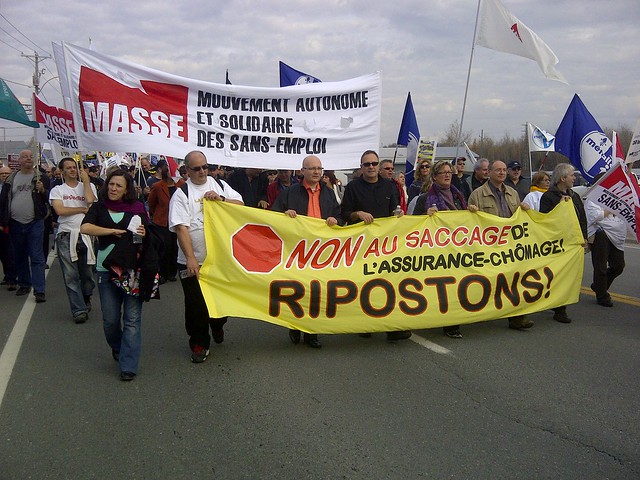
50 000 march in Montreal to say "no to the pillage of EI"!
Peter Miller,
Rebel Youth Magazine

Finding a stable job after graduation from high school, college, or university is becoming increasingly difficult. About two thirds of new jobs are precarious that offer low pay, and part-time work. Meanwhile, many youth are unemployed.

In April 2013, youth unemployment in Ontario was sitting at 17.1 percent, compared to 6.1 percent for those 25 and over. The real percentage of unemployed workers however, is even higher, because unemployment figures do not count part-time and precarious workers looking for full-time jobs, or discouraged unemployed workers who have stopped looking for work. A figure of the amount of unemployed workers in Canada that corresponds more to reality is 12 percent.

June 27, 2013

Thatcher's legacy

By Tristan Dineen and Johan Boyden

Rarely has class conflict been made so blatantly obvious.  Gathered under the vast dome of St Paul’s Cathedral and ringed by legions of police and military personnel, the royalty, robber barons, presidents, oligarchs, bankers, tycoons, war criminals, celebrities and aristocrats of the global capitalist class assembled in grand style to bid farewell to their champion: a woman who had dedicated her life to defending and expanding the profits and privileges of the few -- at the expense of the many.

But mere blocks away from where former British PM Margaret Thatcher lay in state masses of working class people gathered to basically celebrate the death of a woman who had brought them nothing but misery, impoverishment, heartless spending cuts, privatization of public services, foreign wars, union busting, regressive taxes, police crackdowns, and a reactionary legacy that keeps on killing, and uprooting.

Thatcher's trail of destruction is relevant for young people in Canada, to understand an important part of the global story of how gains of past struggle, and prospects for our future, were destroyed.

What went wrong?

May 16, 2013

Reverse Harper's cuts to EI, put Canada back to work!

Statement by the Young Communist League of Canada
YCL-LJC CEC, May 2013

Over the past six months, the Harper Conservative government has put in place vicious "austerity" attacks on the people of Canada by severely restricting access to Employment Insurance (EI) benefits for workers.  Young workers, already at a disadvantage in collecting EI, will be further excluded and impoverished.

Cuts to Employment Insurance are not simply a cut in federal funding to a social program.  They are cuts to a system into which all working people must directly pay into, no matter who they are, and which is intended to guarantee employment.  The working class majority, whose sweat and toil by ‘hand and brain’ has produced all the wealth in this country, are being robbed.

The federal government has built up a huge surplus of $57 billion since the mid-1990s, the result of deep cuts in benefits paid to unemployed workers and rules that prevent most unemployed workers from qualifying for benefits at all:

* Maximum weekly benefits have shrunk from $604 in 1996 to less than $440 today, and an average benefit of just $335 per week;

*  Less than four in ten unemployed workers, and even fewer women, qualify for EI

Workers cannot let this happen without a fight!

That’s why over 50,000 workers rallied in Montreal just before May 1st to celebrate International Workers Day and demand an end to the Harper Tory wrecking of Employment Insurance!
50 000 march in Montreal to say "no to the pillage of EI"!

The fight against the Harper reforms to EI is linked with the battle to build a united resistance against the reactionary agenda of austerity and the Harper Tories.

Recent experiences like the Quebec student struggle show that it is realistically possible to build a stronger resistance against the corporate offensive, and to win broad support from community allies.  Despite the adverse conditions and subjective weaknesses, new forces are coming into the fightback.

As the Communist Party said in its May 1st statement: “Militant tactics and coalition‑building can move labour from a defensive posture towards a fighting strategy of mobilizing the entire working class and its allies to block the right‑wing agenda and to move onto the counter‑offensive. [...] A Canada‑wide common front against the corporate/government attack in turn can win wider support for the goal of a labour‑led People’s Coalition to unite broad sections of the people’s movements, not around a nostalgic return to a “rosy” Keynesian past, but rather around a platform of radical progressive demands, and for a fundamental challenge to the economic and political hegemony of finance capital, both domestic and international.”


What is under the cutting block?

The first wave of cuts, implemented in January, created three "tiers" to EI, based on paid experience in the workforce (not 'under the table' work) as well as time collecting EI.  The cuts basically force those who have needed EI before, or remain unemployed for longer than a few months, to accept any work they can find -- even if it is 70% lower than their previous pay and an almost an hour drive (one-way) from the worker's home.  The system of appeals of EI decisions was replaced with a specialized court which is much less accessible and will take longer. Lastly, the special measures put in place to help workers in areas where economic activity is seasonal have been unilaterally canceled.

The second wave of cuts, implemented in April, drastically reduces eligibility for EI. Before, anyone in a region of Canada with an unemployment rate above 8 per cent was eligible for EI. Now, the benchmark rate has been lifted to 13.1 per cent. Only a few regions therefore quality: parts of Newfoundland-Labrador, eastern Nova Scotia, Gaspésie, Restigouche, northern Manitoba, northern Saskatchewan, Nunavut, Yukon and the Northwest Territories.  And where laid-off workers living in most regions used to be able to use their best 14 weeks of earnings when claiming EI, omitting weeks when hours were inconsistent or the plant was idle, most workers must now use a new formula with a longer time frame, making it harder to filter out lean weeks or temporary layoffs (For example, Windsor now requires 18 weeks, Oshawa 19 weeks, and Toronto 20 weeks).

Nothing in these cuts helps workers find a job.

The Harper government is hoping to weaken social solidarity by pushing nasty and spiteful claims like "there is no bad job" and talking about "repeat users" as if the unemployed were addicts to EI. The reality is that it is almost impossible to support yourself on EI. Benefits are low, run out quickly, and are very difficult to obtain.

Young people should know that current Minister of Finance, Jim Flaherty, who is using this demagogic rhetoric like " I drove a taxi, I refereed hockey, you do what you have to do to make a living " also went to private boys high school before graduating from the Ivy League Princeton University and then Osgoode Law school. His first career in politics was as a cabinet minister in the notorious Mike Harris Ontario Conservative government, when he proposed to solve the homelessness crisis -- by making it illegal.

It is this kind of vicious corporate ideology that has drafted the EI cuts, which mark a fundamental shift in Employment Insurance further away from a programme to protect workers and further towards a system of "workfare" and forced labour.

It has recently been confirmed that the so-called "fraud prevention" investigators in the Ministry have EI quotas or "saving targets" of $40,000 per month per investigator, which means they must penalize many EI recipients and disqualify many to achieve the goal. The government's response to the media exposing this news was an investigation into the whistleblowers! Targets for the recovery of benefits are $120 million for Quebec, $110 million for Ontario, $115 million for the Western provinces and Territories and $58 million for the Atlantic provinces.

Investigators are now also making "home visits" with an interrogation-style 23 question survey to verify the eligibility of EI recipients. Apparently this year, 1200 selected unemployed workers will receive a visit (197 in Quebec, in the Maritimes 220, 384 in Ontario and 374 in the west).

Moreover, activist organizations for the unemployed in Quebec are now finding workers dropped from EI after missing only two phone calls from Service Canada.

The claim that workers "should just go where the jobs are" is not only an admission of capitalism's complete failure in large regions of Canada, like the East Coast, to provide young workers a life with a future. It is also a policy that reduces young workers to "human resources" who can be shuffled around the country at the will of the bosses, and denied the right to make a home where they want.

In addition to restricting access to EI for all domestic workers, Harper and Human Resources and Skills Development Minister Diane Finley have eliminated “special parental benefits” for migrant workers. Previously, this was the only subsection of EI that these workers had access to, despite paying full EI premiums and contributing an estimated $3.4 million annually to the fund. This is a racist and cynical move designed to divide and weaken all workers by pushing a vulnerable portion of the working-class further down.

Other groups particularly hard hit will be women, youth, and workers in industries where employment regularly fluctuates -- like those found in rural, remote, northern and Aboriginal communities.  But to be clear: this is an attack on all working people and the working class.

The cuts must not be seen in isolation from the Tories other priorities -- like tax cuts for the rich, massive increases in military spending and war, environmental destruction, and their other "pay‑less wages" policies. For example, in a type of legalized racism, employers were allowed to pay temporary highly-skilled foreign workers 15% less than the prevailing local wage. Fortunately this was cancelled due to public outrage. The same can and needs to be done for other attacks.


The EI cuts further throw the brunt of the economic crisis onto the backs of working families -- making the people pay for a crisis they did not create.

Currently, about 1.4 million Canadians are officially unemployed -- about 25% higher than before the crisis. This number is going up, not down. Statistics Canada has said that there were at least 300,000 more Canadians looking for work in Oct. 2012 than Oct. 2008. Of the jobs that have been created, on average almost half are temporary. In many areas the ratio is much worse. In British Columbia 60% of new job creation is temporary, 75% in Quebec and 84% in Ontario. For women everywhere between the ages 25 and 44, temporary work accounts for 95% of the new jobs.
In this context, it is important to note that the 2012 rate of eligibility for regular benefits from Employment insurance -- even before the cuts -- is the lowest ever recorded because too few people meet the required qualifying hours in the workforce.

The class-bias of these policies towards the boss and against the worker is crystal clear.  The Harper EI cuts are like manna from heaven for the capitalists.  By swelling the ranks of the unemployed and underemployed, and increasing the danger of being unemployed, big business weakens the position of workers at the bargaining table. The cuts will help create a climate allowing big business to further tear-up collective agreements, bust unions, and force concessions like lower wages, two-tier contracts, and "Defined Contribution Plan" pensions.  As workers exploitation increases, so do corporate profits.

Unemployment is not simply a cyclical feature of capitalism that comes and goes with each crisis. Unemployment has become a permanent structural feature of capitalism with the introduction of revolutionary new science and technologies into production.  Capitalism's liberal apologists have quietly dropped the claim, not uncommon in Canada a generation ago, that we can achieve full employment. Social democracy has generally reversed its position on this demand, with the New Democratic Party of Canada even proposing in the last election that the "private sector" take care of job creation and also campaigning for a change of strategic orientation within the labour movement.

The best solution to unemployment is a job -- safe, well-paying, quality and with a union.


The working class in Canada, and young workers in particular, have a long history of militant struggle for employment and to be protected from the perils of unemployment. 

It is important for young workers to remember these past battles as we look forward in our struggles today. The Harper Conservatives would like to wind-back the clock 100 years when there was no programme of EI. What did exist was Church-delivered relief for the poor. Inconsistently administered only on the municipal level and therefore massively under-funded, Church relief was totally inadequate and further stigmatized poverty because it was charity.

Today the Harper Tories repeat these lies by talking about workers ungrateful for EI who will not accept honest work.  EI is not charity, it is a social right which the working class demands because the toil of working people by hand and brain creates the wealth of this country.  This call for social insurance by the labour movement in Canada and internationally at the beginning of the last century received a major push forward with the victory of the Great October Socialist Revolution in 1917. One of the very first decrees of the Bolshevik revolution was social insurance.

Under increased pressure from the Soviet example, capitalist countries began implementing and extending social insurance programmes. The YCL and Communist Party of Canada called for social insurance from the very first days. However, Canada's flawed Constitution (which was at that time the British North America Act and controlled by the British parliament) grants provinces jurisdiction over a vast range of powers while fails to recognize any national right to self determination for Quebec and other nations. The BNA act thus blocked the development of social insurance programmes.


With the special capitalist crisis of the Great Depression in the 1930s unemployment spiked. The YCL and CPC proposed a comprehensive way out of the Depression and started a campaign for a pan-Canadian Non-Contributory Unemployment Insurance Bill. Instead, the Bennett Conservative government of the time forced tens of thousands of unemployed youth into isolated slave-labour camps.  By this time, the labour movement as well as progressives, socialists and communists were pounding on the doors of government and business for Employment Insurance.

In May 1935 the BC labour camps exploded in protest, with thousands of young workers marching out and, riding on the tops of trains, they began an organized protest movement for 'work and wages' called the On-To-Ottawa Trek.  The Trek was led by members of the YCL, like Arthur 'Slim' Evans.

Brutally attacked and suppressed by the RCMP when they reached Saskatchewan, the Trekers protest nevertheless helped force legislation to be passed on EI in 1935 (with other measures like minimum wages) in a 'death-bed repentance'.  A few months later, the Bennett Conservatives were swept out of office in a federal election by the King Liberals.  But one of the King Liberal's first acts was to refer the 1935 EI law to the supreme court, and then British appeals court. They struck down the law because it over-stepped federal authority into provincial powers.

The ruling triggered a Constitutional crisis. It took more struggle and pressure by people's forces, to make the newly elected King Liberal government enact a Royal Commission of inquiry in 1938, which notably adopted a number of the Communist Party's recommendations. The Liberals shelved the report. Instead, with the support of right-wing provincial governments of Quebec, Ontario and BC, King introduced substitute makeshift measures enabling the federal government to raise revenues to cover expenditures that were approved of by finance-capitalist interests, without committing it to substantive social reforms.

In 1940, King demanded an act of the British Parliament to amend the BNA act (which became Constitution Act, 1940). This was the foundation of Employment Insurance. 
Subsequent campaigning by the labour movement expanded EI coverage from just 42% of the unemployed in 1940 to 95% of the unemployed in 1975, including seasonal workers and some coverage for sickness and maternity. Workers who quit their job were unfairly penalized, but could also receive benefits. The rate was 66% of insurable earnings, ie. your previous wage, and 75% for workers with dependants. The fund was sustained by three-way contribution from employers, the federal government, and workers.

In the late 1970s, however, these terms were changed in a negative way for working people.  The Trudeau Liberal government eliminated the higher rate for the unemployed with dependents and reduced the benefit rate. A large EI fund had now built up, and the government began to use it for other purposes than employment insurance like training.  The first major raid on EI would occur after the signing of Free Trade, to re-train workers in the post-NAFTA economy.

The attack on the unemployed continued in the 1990s. EI was increasingly "privatized" as big business and the state denied any social responsibility for EI. In 1990 the Mulroney Conservative government withdrew the government's contribution for the fund and restricted accessibility to over 100,000 workers. In 1993, attacking the freedom of working people to choose their job, benefits were now denied if you quit your work or were fired due to misconduct.

In 1994, the new Chretien Liberal government lowered benefits to 55% of past wages. The Liberal government then raided the EI fund to pay-off the federal debt (which was not incurred from social program expenses) in a massive billion-dollar theft of funds, originally taken from working people.  By the year 2000, only around 40% of workers were actually eligible for EI despite paying into it, and the number has obviously dropped since then.

Women workers are disproportionally affected. Current policy, for example, does not allow new parents to use the same work weeks to qualify for both maternity leave and EI. Workers who are laid off while on parental leave therefore are generally excluded.

Over the past decade, workers have seen increasingly restrictive eligibility criteria, shortening of benefit duration, restrictions imposed in calculating benefits, lower levels of benefits, and increased exclusions of categories of workers.


The way forward is through mass struggle and unity of working people, with the youth and social movements.

Major mobilizations around Employment Insurance have taken place in Atlantic Canada and especially Quebec.


This history teaches working people and the youth a series of hard lessons about reform struggle. It teaches us that only through a persistent, united and visible battle in the streets, workplaces, campuses and communities can we make advances in social policy.

It teaches us that the 'negotiation' for Employment Insurance has been a struggle over power where what counted was the balance of conscious and militant class forces, and in which the capitalist class made surrenders only for its benefit -- for example, refusing the demand of a non-contributory employment insurance bill.

It teaches us a lesson about the necessity for socialism in that no social progress under capitalism is sacred or protected -- no matter what the politicians from the parties of big business say -- and the capitalist will try to take back any concessions as soon as they can, in this case as quickly as a few years after EI reached its most progressive level of coverage.

The Young Communist League calls for emergency mass mobilization by labour and the youth
Workers protest in PEI
movement to block these cuts and transform EI to a fully accessible programme which comprehensively protects all workers from unemployment.


We have never wavered in this fight and have consistently been a voice calling to defend the rights of young workers, including a new Charter of Youth Rights which would make a job a right:

1.  Spend the entire employment insurance fund on workers and unemployed - providing for EI benefits equivalent to 90% of final salary for the duration of unemployment, no matter where workers live in Canada or their experience in the work force;

2.  Make full employment a top priority, and raise the wages of all workers by $100 per week, the real value of wages 25 years ago;
3.  Increase the minimum wage to $ 16/hour;

4.  Ban "two-tier wages" for new hires;

5.  Legislate for a working week of 32 hours without loss of pay and without loss of net service for the public;

6.  Ban evictions of renters by landlords because of lay-offs;

7.  Ban mandatory overtime, and legislate at least four weeks of paid annual leave;

8.  Guarantee the right of marginal benefits for workers in part-time, home and contract work;

9.  Make massive investments in the reconstruction of social programs, public infrastructure and social housing – including free post-secondary education;

10.  Adopt a policy of fair wage, pay equity and full employment for workers;

11.  Take action against poverty, especially among aboriginal peoples, immigrants, women, youth, the elderly and people with disabilities;

12.  Abolish "workfare" and introduce a livable guaranteed annual income;

13.  Protect and develop the universal public pension system, including a substantial increase in CPP;

14.  Enact voluntary early retirement at the age of 60 years;

15.  Restore and develop funding to provinces allocated to health, education, housing and social welfare, and improve all standards of Canada, while ensuring that Quebec maintains control and administration of its own programs;

16.  Maintain equalization payments to the provinces, and expand transfers dedicated to health, education, childcare and social assistance.

January 30, 2013

UK: Half of jobless youth suffering depression


Morning Star newspaper

A "frightening" wave of austerity-stoked chronic depression is battering young people across the country, researchers found today.

The Prince's Youth Trust (a UK charity - RY) found that 27 per cent of working young people are "always" or "often" depressed - while the figure rocketed to 48 per cent for those not in paid work, education or training.

More than one in 10 young people said they felt unable to cope with day-to-day life, rising to a fifth of those with neither employment, education or training, according to the trust's annual Youth Index.

Pollsters who surveyed more than 2,000 16-to-25-year-olds found a clear link to the economic crisis.

More than a quarter said they believed it had "permanently damaged" their career prospects - and a fifth of those out of work said they believed their self-confidence would never fully recover.

Youth unemployment currently hovers around 20 per cent, with the total number expected to reach more than a million again this year.

Those in work continue to see hours, pay and conditions dwindling.

Official figures in November showed that of the 316,000 new jobs since 2011, more than two-thirds were part-time - with an average 15.8 hours paying just £155 a week (or about $246 CND - RY).

Prince's Trust chief executive Martina Milburn said it was often those from the most vulnerable backgrounds who found it hardest to get work, creating a "demoralising downward spiral."

"A frightening number of unemployed young people feel unable to cope - and it is particularly tough for those who don't have a support network," she said.

The survey follows an alarming study in August directly attributing more than 1,000 suicides since 2008 to the economic crisis.

Researchers at the University of Liverpool found 846 men and 155 women took their lives during the last four years over and above pre-recession trends - meaning around two-fifths of the rise in suicides among men could be attributed to rising unemployment.

Suicidal protests are also on the rise. In December an 18-year-old Torbay man set himself on fire after being refused housing, while a Birmingham man set himself alight outside a jobcentre in June.

Is the same thing taking place in Canada? Share your point of view and experiences in our comment section.

November 13, 2012

Quebec news and updates


Labour opposes Harper’s EI reforms
The major trade union centrals of Quebec and the MASSE coalition, a group formed in solidarity with the unemployed, held a series of mass rallies with the biggest one in the town of Thetford Mines in late October. Over 3,000 people from about twelve towns and cities from across Quebec marched to the offices of Christian Paradis, MP for Mégantic-L'Érable (and Stephen Harper's Quebec lieutenant).  Coordinator of MASSE Marie-Hélène Arruda told the rally that "The Conservatives, with their ideology [...] will define by regulation what is a decent job, that is to say a position that an unemployed person cannot refuse for fear of losing their benefits.”

Student legal struggle continues
Drawing attention to the hundreds of students still facing charges from the Quebec student uprising last fall, former spokesperson of the CLASSE, Gabriel Nadeau-Dubois, was convicted November 1 of contempt of court because he publicly criticized a court injunction ordering picket-lines to disperse during the student strike. The judge (who has been linked as a donor to the former Charest Liberal government) based his ruling on a 1972 court decision which tried to smash the Common Front of public sector unions. A support campaign has been launched at www.appelatous.org to fundraise for an appeal.  Meanwhile, the PQ government have announced an education summit to take place in mid-February, with preparatory meetings and consultations starting at the end of November, about the question of post-secondary education funding.

Corruption inquiry exposes P3s
More revelations have been coming forward at the Charbonneau Commission, especially the testimony of ex-construction boss Lino Zambito which has implicated the Liberal party, as well as their political machines on the municipal level and construction firms, into a web of graft with the Mafia.  Media headlines have focused on Montreal mayor Gérald Tremblay’s resignation, the implosion of his Union Montreal party, and now the Mayor of Laval quitting. But the Montreal Gazette has also said that Zambito reported “Public-private partnerships, the sort that are blooming in Quebec to yield hospitals, roads and cultural facilities, are fertile ground for corruption and collusion” because, once big consortiums are ‘awarded’ the contract, the only risk is held by the public sector. One of the biggest P3 projects in Quebec, the McGill University Health Centre, has long been a target of criticism by labour and is currently under police investigation.

QS co-spokesperson steps down
The long standing co-spokesperson of the left-wing political party Quebec Solidaire has stepped down. Amir Khadir was the first “Solidaire” elected to the Quebec National Assembly and the founding leader of the predecessor of QS, the Union of Progressive Forces – which was formed as a federation of left groups including the Communist Party of Quebec.  Khadir will maintain his seat in the National Assembly. Québec solidaire's constitution requires two national spokespersons: one from the legislature and a second from outside it, called a "porte-parole extra-parlementaire", who is not an MNA. The latter also assumes the role of president of the party. A young person is expected to be chosen.

September 29, 2012

Student organizing in the 1930s and the YCL

The On To Ottawa Trek
In the 1920s, 30s and 40s the Communist movement was under intense surveillance by the political police or Royal Canadian Mounted Police -- we know this because they have made their official secret documents public for this time period. The surveys continued, of course, after the 1940s and actually intensified but the reports from the years before show that the RCMP was already paying very close attention.

Below we present an RCMP report from November 1936, which includes a report about the work of the Young Communist League on campuses and a student conference organized by the YCL at McGill University. No doubt, not everything in this report is true. The informants used by the RCMP often exaggerated the statements of the Communists (saying, for example, that the Communists called for violent and bloody revolution in a public speech) to simply justify their existence as informers and spies. This organizational culture was supported at all levels of the RCMP who always monitored the CPC more closely than the ultra-right groups -- even when Canada was at war with fascist Germany and about to enter into an alliance with the USSR. As historian Chris Frazer writes in the latest issue of The Spark journal:
As chief of the RCMP's intelligence section, Rivett-Carnac argued in early 1939 that fascism was a lesser threat than communism since fascism was a "modified form of capitalism." Rivett-Carnac's opinion corresponded with the anti-communist and anti-labour views of RCMP Commissioner S.T. Wood, who argued later in 1941 that, "it is not the Nazi nor the Fascist but the radical who constitutes our most troublesome problem."[19] Although the charges were never substantiated, as early as October 1939 the RCMP Security Bulletin claimed that "there is more reason to fear ... acts of espionage and sabotage on the part of the Communist Party than from Nazi or Fascist organizations." Source.
The November 1936 report is from a series of security reports that the RCMP issued on a monthly basis. Much of what the YCL is interested in doing, as presented by this report, is anti-fascist work -- or campaigning for peace. At points the language of the document reads as if the informer simply copied the original text in shortened form. The sentence structure and wording is dated and has a kind of 1930s feel, but the thinking of young people at that time shines through.

The report states that student participants came from Queens (Kingston, Ontario) Dalhousie (Halifax, Nova Scotia), McGill (Montreal, Quebec) and Varisty -- which perhaps refers to the University of Toronto, whose student newspaper and sports teams are called that and where the YCL had an established public club at that time (although the word varsity simply means a university sports team or a university).  Two delegations also came from high schools in Montreal.

The conference called on YCLers to continue political and ideological work against "Capitalist ideology and propoganda in schools" but to combine this with immediate struggles and political work like peace, unemployment, youth rights, and united front work with other youth organizations. A strong parallel can be drawn with the work of the League today.

The report calls for "proper combination of broad campaigns on specific issues [...] with careful fostering of permanent student organizations." This approach may have some thing to teach youth and student activists today, with the spirit of Occupy, the "Casserole" solidarity protests, and other spontaneous actions on our campuses and communities. More often than not, these movements unfortunately fail to develop into real organizations and the youth movement swings along, after a few weeks or months, to the next popular issue.

Particular attention was given to the Canadian Youth Congress (CYC). The CYC included progressive religious youth through the Student Christian Movement which was the main social-justice organization on campuses at that time, but also farm youth, the Canadian Cooperative Federation Youth or CCF (forerunner of the NDP), as well as social and sports groups like the YMCA and YWCA (Young Men's and Young Women's Christian Associations). The CYC advocated for a Charter of Rights of the Youth or "Youth Act". It had just held, the year before, a series of protest actions against government policy during the depression -- like peoples courts against Prime Minister R.B. Bennett.

Despite that fact that most university students were not from the working class, interestingly the YCL report does not dismiss political action on campuses. Instead the League states that students are a diverse social group, generally inexperienced, and that schools varied considerably -- depending even on the personality of the school principle (or university President). As a result "no stereotyped formula can be given" but there was a sharp problem of leadership because of inexperience on campuses.

Further discussion

A lot of material is presented here which could be fruitful for further discussion about strategy and tactics.  At this time the YCL itself had only just fought and defeated, with the Communist Party of Canada, an effective ban on the organization. It was still on a precarious edge of legality.  Why would the YCL not want the Student Peace Movement to be an underground organization and forbid that direction?

Why would the YCL want official support of efforts like the CYC and peace clubs but not progressive clubs which are to remain independent?

What do you think about the experience and tactics of the YCL on high school campuses at Baron Byng and Strathcona?

Why do you think they thought it was necessary to write that"the club must neither be a collection of intellectual giants nor ostensibly be interested in nothing but ping pong while in reality acting as a snare for unsuspecting innocents"? What does this mean?

How are "linkages with the labour movement" maintained with YCL clubs in a way that is not "mechanistic"? What do you think about the example at McGill?

What do you think about the proposal for a YCL club meeting agenda on campuses and the idea of "all-talk-no-action"?

Although the story-teller is a police agent, the actual minutes from this meeting no doubt have been long lost. It is, therefore, an invaluable source of information. What we get is not the conference discussion in full, or even the complete final resolution. It is sifted by a police filter from the informant to the official report given here. The reader simply has to trust that most of the document is, more or less, accurate.

At the same time the report tells an important tale not just about the YCL but also the youth movement of the time. The final resolutions of the conference, for better or worse, show the thought-out contribution of the YCL to the students struggle: it identifies key priorities like peace and youth rights; it strives to find the maximum level of unity and militancy in the context; it navigates difficult questions like legality, illegality, and the public presence of the YCL; and it interconnects the youth struggle with other struggles.

The report especially tells its members to strive to work in a way that is not mechanistic or formulaic, to listen to its high school members, and to work in a collective fashion with initiative. Clearly, the League does not dismiss the campuses or reject participation in the political life of students -- even though access to education was much more difficult in 1936 than today for working class youth. And to be sure, campus activities were a relatively lower priority of the League which focused more on young workers. But in tacking the problems of the student movement of the day, the YCL shows its broad sweep of understanding struggle -- a revolutionary perspective of mobilizing the all the oppressed masses of youth in unity with the working class. Clearly the police though this vanguard approach towards the youth struggle in Canada was a real danger.


YCL at McGill

May 11, 2012

People's Voice Editorial: unemployment and resistance


The ruling class appears nervous these days, faced with unruly strikes by workers and students, and setbacks at the ballot box. Underlying this unease is a very real objective factor: the continued growth of mass unemployment. Hunger and poverty are on the rise even in the "developed" capitalist countries, eroding the ideological grip of the bosses.

The International Labour Organisation's "World of Work Report 2012" projects that global unemployment will hit 212 million by the end of this year, up 6 million from 2011. Total unemployment in Ireland, the former "Celtic Tiger", is around 550,000 out of a population of six million. In Spain, 5.64 million (24.4%) are jobless. Some 50 million jobs have been lost since 2008, and unemployment is higher in two‑thirds of countries since 2010.

February 29, 2012

Human Resources Minister quietly axes student job centres

Reprinted from the Globe and Mail,
By Gloria Galloway

The employment centres for students that have opened every spring for more than four decades in communities across Canada have been cancelled by the federal Human Resources department, which says it can offer the same services online.

The centres began as a Hire-a-Student pilot project in Moose Jaw, Sask. in 1968 and quickly spread to other regions. But the government says they have seen their attendance dwindle in recent years as increasing numbers of young people turn to their computers to find employment between April and September.

Popular stories