Antoine SteMarie,
Guest commentary
A recent discussion with friends over facebook had me thinking about why we should consider theory important for the direction of social movements and activism. Here are just a few thoughts.
First of all, theorists and their theories are not simply some separate intellectual strata of people whose ideas have little bearing on the state of the world; at least, not substantial theorists. Theory is an attempt to understand the world.
That's not to deny that a good theory also needs to be easily digestible. Theoretical ideas need to be put in as accessible a format as possible.
Needless to say, a good understanding of the world is required for effective action. It is the same as a doctor requiring real understanding of the body to give an accurate diagnosis and thus a cure. Just taking any theory won't achieve the desired result.
Showing posts with label tactics. Show all posts
November 13, 2013
June 27, 2013
Thatcher's legacy
By Tristan Dineen and Johan Boyden
Rarely has class conflict been made so blatantly obvious. Gathered under the vast dome of St Paul’s Cathedral and ringed by legions of police and military personnel, the royalty, robber barons, presidents, oligarchs, bankers, tycoons, war criminals, celebrities and aristocrats of the global capitalist class assembled in grand style to bid farewell to their champion: a woman who had dedicated her life to defending and expanding the profits and privileges of the few -- at the expense of the many.
But mere blocks away from where former British PM Margaret Thatcher lay in state masses of working class people gathered to basically celebrate the death of a woman who had brought them nothing but misery, impoverishment, heartless spending cuts, privatization of public services, foreign wars, union busting, regressive taxes, police crackdowns, and a reactionary legacy that keeps on killing, and uprooting.
Thatcher's trail of destruction is relevant for young people in Canada, to understand an important part of the global story of how gains of past struggle, and prospects for our future, were destroyed.
What went wrong?
Rarely has class conflict been made so blatantly obvious. Gathered under the vast dome of St Paul’s Cathedral and ringed by legions of police and military personnel, the royalty, robber barons, presidents, oligarchs, bankers, tycoons, war criminals, celebrities and aristocrats of the global capitalist class assembled in grand style to bid farewell to their champion: a woman who had dedicated her life to defending and expanding the profits and privileges of the few -- at the expense of the many.
But mere blocks away from where former British PM Margaret Thatcher lay in state masses of working class people gathered to basically celebrate the death of a woman who had brought them nothing but misery, impoverishment, heartless spending cuts, privatization of public services, foreign wars, union busting, regressive taxes, police crackdowns, and a reactionary legacy that keeps on killing, and uprooting.
Thatcher's trail of destruction is relevant for young people in Canada, to understand an important part of the global story of how gains of past struggle, and prospects for our future, were destroyed.
What went wrong?
June 17, 2013
Force and the struggle for a socialist Canada
This article is part of an seven-part series of short quotes Rebel Youth is issuing about class struggle, revolution, civil-war, and parliamentary democracy. See also: Lenin on elections; the Communist Party of Canada on a counter-offensive against capitalism; Engels on voting and street fighting; Lenin on Democracy and Class struggle; Communist and Worker's parties on the struggle for socialism; and Lenin on tactics and guerilla war; the Communist Party of Canada on force, and a peaceful transition to socialism.
A democratic, anti-monopoly, anti-imperialist alliance will have as its objective the democratic restructuring of Canadian society so that the interests of the majority of Canadians come first, and the stranglehold of finance capital on every aspect of life is broken. It will seek to advance the working people’s interests through all available avenues of struggle, based on massive and united extra-parliamentary action.
The alliance will strive to score electoral advances, and the winning of power by a people’s government dedicated to carrying out sweeping measures to democratize society and transform economic relations in the interests of the working class and the Canadian people as a whole.
Such a breakthrough will be difficult to accomplish given the sophisticated means at the disposal of the ruling class to manipulate public opinion, discourage political activism and otherwise influence the outcome of bourgeois elections. A crucial task for the alliance will be to defend and expand democracy and to fight against corporate and governmental attacks on the electoral process.
A democratic, anti-monopoly government, based on a parliamentary majority, and acting in concert with the united and militant extra-parliamentary movements of the people, would signal a qualitative shift in the balance of class forces in Canadian society, and open the door to the revolutionary transformation to socialism. It would involve the people in a truly meaningful way.
The people’s government would be committed to a program of action geared to serve people before profit. That program would arise in the course of the social, economic and political struggles of the working class and its democratic allies, and be subject to the widest discussion and approval among all of the forces of the alliance.
Communists will struggle to win support for the most advanced program of political, economic and social transformation possible in line with the changing conditions. The program must aim: (1) to confront and restrict the power of finance capital (both foreign and domestic), and to extend public ownership of key sectors of the economy; (2) to redistribute wealth and raise the living standards and conditions of life for the vast majority of the people; and (3) to introduce sweeping democratic reforms to enhance popular control and administration of the Canadian state at all levels of government. (...)
Although such measures would not constitute socialism, the victory of a people’s government devoted to carrying out such a broad program would mark a significant step in the struggle for fundamental change and socialist transformation.
To succeed, a people’s government would require the full and conscious mobilization of the working class and its allies outside Parliament. With each meaningful reform enacted, with each democratic measure secured, with each encroachment on the power and privilege of capital, the ruling class and its imperialist international partners would stiffen their resistance by all means at their disposal. But, at the same time, such measures can help to galvanize the masses, and promote working class actions in support of the people’s government.
This would be a period of intensified class struggle on all fronts – political, economic and ideological.
The successful implementation of the people’s program, and the pace with which it is carried out will depend on the unity and militancy of the working class and its revolutionary vanguard, and on the enduring unity of the entire democratic, anti-monopoly, anti-imperialist alliance. Prevailing regional and international conditions will also affect the pace of social transformations.
Throughout this process there will be social and political mobilization of the working class and people’s forces to support and implement the program of the people’s government – through electoral and workplace struggles, street demonstrations and other actions. At the same time, the threatened ruling class will attempt to shake the confidence and unity of the people’s forces and to frustrate their ability to carry out the people’s program.
To preserve its class privileges and re-establish its supremacy, the capitalist class will be inclined to resort to economic blackmail and sabotage, subversion from within those sections of the state apparatus it still influences and controls, political violence and terrorism, and even open rebellion and foreign intervention. The people’s government, with the full support of the working class, will be fully within its rights to counter any such anti-democratic and illegal assaults on people’s power
From Chapter 6 of the Programme of the Communist Party of Canada
June 10, 2013
Tactics, guerilla war and the struggle for socialism
Labels:
guerilla war,
lenin,
Marxism,
Revolution-series2013,
socialism,
strategy,
tactics
This article is part of an seven-part series of short quotes Rebel Youth is issuing about class struggle, revolution, civil-war, and parliamentary democracy. See also: Lenin on elections; the Communist Party of Canada on a counter-offensive against capitalism; Engels on voting and street fighting; Lenin on Democracy and Class struggle; Communist and Worker's parties on the struggle for socialism; and Lenin on tactics and guerilla war; the Communist Party of Canada on force, and a peaceful transition to socialism.
Let us begin from the beginning. What are the fundamental demands which every Marxist should make of an examination of the question of forms of struggle? In the first place, Marxism differs from all primitive forms of socialism by not binding the movement to any one particular form of struggle. It recognises the most varied forms of struggle; and it does not “concoct” them, but only generalises, organises, gives conscious expression to those forms of struggle of the revolutionary classes which arise of themselves in the course of the movement. Absolutely hostile to all abstract formulas and to all doctrinaire recipes, Marxism demands an attentive attitude to the mass struggle in progress, which, as the movement develops, as the class-consciousness of the masses grows, as economic and political crises become acute, continually gives rise to new and more varied methods of defence and attack. Marxism, therefore, positively does not reject any form of struggle. Under no circumstances does Marxism confine itself to the forms of struggle possible and in existence at the given moment only, recognising as it does that new forms of struggle, unknown to the participants of the given period, inevitably arise as the given social situation, changes. In this respect Marxism learns, if we may so express it, from mass practice, and makes no claim what ever to teach the masses forms of struggle invented by “systematisers” in the seclusion of their studies. We know—said Kautsky, for instance, when examining the forms of social revolution—that the coming crisis will introduce new forms of struggle that we are now unable to foresee.
In the second place, Marxism demands an absolutely historical examination of the question of the forms of struggle. To treat this question apart from the concrete historical situation betrays a failure to understand the rudiments of dialectical materialism. At different stages of economic evolution, depending on differences in political, national-cultural, living and other conditions, different forms of struggle come to the fore and become the principal forms of struggle; and in connection with this, the secondary, auxiliary forms of struggle undergo change in their turn. To attempt to answer yes or no to the question whether any particular means of struggle should be used, without making a detailed examination of the concrete situation of the given movement at the given stage of its development, means completely to abandon the Marxist position.
Lenin, Guerilla warfare (1906)
May 22, 2013
The peaceful struggle for socialism
This article is part of an seven-part series of short quotes Rebel Youth is issuing about class struggle, revolution, civil-war, and parliamentary democracy. See also: Lenin on elections; the Communist Party of Canada on a counter-offensive against capitalism; Engels on voting and street fighting; Lenin on Democracy and Class struggle; Communist and Worker's parties on the struggle for socialism; and Lenin on tactics and guerilla war; theCommunist Party of Canada on force, and a peaceful transition to socialism.
From November 14-16, 1957, representatives of 12 Communist and Workers Parties of Socialist countries, came together in Moscow for the celebration of the fortieth anniversary of the great October Socialist Revolution in Russia, and adopted a declaration, from which is taken this excerpt about the struggle for socialism. Among the endorsers were the Communist Party of China and the Communist Party of the Soviet Union. The text below is one section of the full statement.
The forms of the transition of socialism may vary for different countries. The working class and its vanguard—the Marxist-Leninist party—seek to achieve the Socialist revolution by peaceful means. This would accord with the interests of the working class and the people as a whole as well as with the national interests of the country.
Today in a number of capitalist countries the working class headed by its vanguard has the opportunity, given a united working-class and popular front or other workable forms of agreement and political cooperation between the different parties and public organizations, to unite a majority of the people, to win state power without civil war and ensure the transfer of the basic means of production to the hands of the people. It has this opportunity while relying on the majority of the people and decisively rebuffing the opportunist elements incapable of relinquishing the policy of compromise with the capitalists and landlords. The working class then, can defeat the reactionary, anti-popular forces, secure a firm majority in parliament, transform parliament from an instrument serving the class interests of the bourgeoisie into an instrument serving the working people, launch a non-parliamentary mass struggle, smash the resistance of the reactionary forces and create the necessary conditions for peaceful realization of the socialist revolution.
All this will be possible only by broad and ceaseless development of the class struggle of the workers, peasant masses and the urban middle strata against big monopoly capital, against reaction, for profound social reforms, for peace and socialism.
In the event of the ruling classes resorting to violence against people, the possibility of non-peaceful transition to socialism should be borne in mind. Leninism teaches, and experience confirms, that the ruling classes never relinquish power voluntarily. In this case the degree of bitterness and the forms of the class struggle will depend not so much on the proletariat as on the resistance put up by the reactionary circles to the will of the overwhelming majority of the people, on these circles using force at one or another stage of the struggle for socialism.
The possibility of one or another way to socialism depends on the concrete conditions in each country. In the struggle for better conditions for the working people, for preservation and extension of democratic rights, winning and maintaining national independence and peace among nations, and also in the struggle for winning power and building socialism, the Communist Parties seek cooperation with the Socialist parties. Although the Right-Wing Socialist Party leaders are doing their best to hamper this cooperation, there are increasing opportunities for cooperation between the Communists and Socialists on many issues. The ideological differences between the Communist and the Socialist parties should not keep them from establishing unity of action on the many pressing issues that confront the working-class movement.
Declaration of the Twelve Communist and Workers Parties, Meeting in Moscow, USSR, Nov. 14-16, 1957
From November 14-16, 1957, representatives of 12 Communist and Workers Parties of Socialist countries, came together in Moscow for the celebration of the fortieth anniversary of the great October Socialist Revolution in Russia, and adopted a declaration, from which is taken this excerpt about the struggle for socialism. Among the endorsers were the Communist Party of China and the Communist Party of the Soviet Union. The text below is one section of the full statement.
The forms of the transition of socialism may vary for different countries. The working class and its vanguard—the Marxist-Leninist party—seek to achieve the Socialist revolution by peaceful means. This would accord with the interests of the working class and the people as a whole as well as with the national interests of the country.
Today in a number of capitalist countries the working class headed by its vanguard has the opportunity, given a united working-class and popular front or other workable forms of agreement and political cooperation between the different parties and public organizations, to unite a majority of the people, to win state power without civil war and ensure the transfer of the basic means of production to the hands of the people. It has this opportunity while relying on the majority of the people and decisively rebuffing the opportunist elements incapable of relinquishing the policy of compromise with the capitalists and landlords. The working class then, can defeat the reactionary, anti-popular forces, secure a firm majority in parliament, transform parliament from an instrument serving the class interests of the bourgeoisie into an instrument serving the working people, launch a non-parliamentary mass struggle, smash the resistance of the reactionary forces and create the necessary conditions for peaceful realization of the socialist revolution.
All this will be possible only by broad and ceaseless development of the class struggle of the workers, peasant masses and the urban middle strata against big monopoly capital, against reaction, for profound social reforms, for peace and socialism.
In the event of the ruling classes resorting to violence against people, the possibility of non-peaceful transition to socialism should be borne in mind. Leninism teaches, and experience confirms, that the ruling classes never relinquish power voluntarily. In this case the degree of bitterness and the forms of the class struggle will depend not so much on the proletariat as on the resistance put up by the reactionary circles to the will of the overwhelming majority of the people, on these circles using force at one or another stage of the struggle for socialism.
The possibility of one or another way to socialism depends on the concrete conditions in each country. In the struggle for better conditions for the working people, for preservation and extension of democratic rights, winning and maintaining national independence and peace among nations, and also in the struggle for winning power and building socialism, the Communist Parties seek cooperation with the Socialist parties. Although the Right-Wing Socialist Party leaders are doing their best to hamper this cooperation, there are increasing opportunities for cooperation between the Communists and Socialists on many issues. The ideological differences between the Communist and the Socialist parties should not keep them from establishing unity of action on the many pressing issues that confront the working-class movement.
Declaration of the Twelve Communist and Workers Parties, Meeting in Moscow, USSR, Nov. 14-16, 1957
May 20, 2013
Force and the peaceful transistion to a socialist Canada
This article is part of an seven-part series of short quotes Rebel Youth is issuing about class struggle, revolution, civil-war, and parliamentary democracy. See also: Lenin on elections; the Communist Party of Canada on a counter-offensive against capitalism; Engels on voting and street fighting; Lenin on Democracy and Class struggle; Communist and Worker's parties on the struggle for socialism; and Lenin on tactics and guerilla war; theCommunist Party of Canada on force, and a peaceful transition to socialism.
Ample historical evidence testifies to the fact that reactionary capitalist forces will not give up their power and privilege voluntarily. They will try to halt the democratic process. The danger will inevitably arise of capitalist violence against the socialist state and the expressed will of the majority of the people. This cannot be overlooked except at severe cost. The working class and its allies, when they achieve socialist power, will be justified in using the power and authority of the state to protect the democratic will of the majority against the minority, who will strive to restore their lost positions. The nature of the laws and measures enacted to protect working class power will depend on the amount of resistance that the reactionary capitalist elements offer to socialist law and order.
The peaceful transition to socialism, which is desirable, depends not only on the wishes of the people but on the relationship of forces at the time. The maximum unity and single-minded purpose of the people, the united participation of the widest masses of the working class in political struggle and the forging of unity with the small producers (farmers, fishers and artisans) and with the middle strata of the population will be crucial to withstand and paralyze capitalist violence and political reaction. The working class must be ready to use all forms of struggle to combat capital’s inevitable resistance to social progress.
For the first time in Canada’s history, however, the majority of the people will rule the country and establish a genuine democracy. The dictatorship of capital over labour – the rule of the minority over the majority – will be abolished and replaced by a socialist democracy in which political power will reside with the working class and its allies. For the first time, the interests of the Canadian people will be the prime determinant of our economic, political and cultural life.
Irrespective of the form it will take, the socialist state, from the point of view of its class essence, will represent working class rule. Marx referred to this as “the dictatorship of the proletariat.” In practical terms, state power will be exercised by the great majority of the Canadian population – over the former capitalist minority.
From Chapter 7 of the Programme of the Communist Party of Canada
Ample historical evidence testifies to the fact that reactionary capitalist forces will not give up their power and privilege voluntarily. They will try to halt the democratic process. The danger will inevitably arise of capitalist violence against the socialist state and the expressed will of the majority of the people. This cannot be overlooked except at severe cost. The working class and its allies, when they achieve socialist power, will be justified in using the power and authority of the state to protect the democratic will of the majority against the minority, who will strive to restore their lost positions. The nature of the laws and measures enacted to protect working class power will depend on the amount of resistance that the reactionary capitalist elements offer to socialist law and order.
The peaceful transition to socialism, which is desirable, depends not only on the wishes of the people but on the relationship of forces at the time. The maximum unity and single-minded purpose of the people, the united participation of the widest masses of the working class in political struggle and the forging of unity with the small producers (farmers, fishers and artisans) and with the middle strata of the population will be crucial to withstand and paralyze capitalist violence and political reaction. The working class must be ready to use all forms of struggle to combat capital’s inevitable resistance to social progress.
For the first time in Canada’s history, however, the majority of the people will rule the country and establish a genuine democracy. The dictatorship of capital over labour – the rule of the minority over the majority – will be abolished and replaced by a socialist democracy in which political power will reside with the working class and its allies. For the first time, the interests of the Canadian people will be the prime determinant of our economic, political and cultural life.
Irrespective of the form it will take, the socialist state, from the point of view of its class essence, will represent working class rule. Marx referred to this as “the dictatorship of the proletariat.” In practical terms, state power will be exercised by the great majority of the Canadian population – over the former capitalist minority.
From Chapter 7 of the Programme of the Communist Party of Canada
May 15, 2013
Revolutionary tactics: Engels on voting and street fighting
This article is part of an seven-part series of short quotes Rebel Youth is issuing about class struggle, revolution, civil-war, and parliamentary democracy. See also: Lenin on elections; the Communist Party of Canada on a counter-offensive against capitalism; Engels on voting and street fighting; Lenin on Democracy and Class struggle; Communist and Worker's parties on the struggle for socialism; and Lenin on tactics and guerilla war; theCommunist Party of Canada on force, and a peaceful transition to socialism.
There had long been universal suffrage in France, but it had fallen into disrepute through the way it had been abused by the Bonapartist government. After the Commune there was no workers’ party to make use of it. It had also existed in Spain since the republic but in Spain election boycotts had been the rule for all serious opposition parties from time immemorial. The experience of the Swiss with universal suffrage was also anything but encouraging for a workers’ party. The revolutionary workers of the Latin countries had been wont to regard the suffrage as a snare, as an instrument of government trickery. It was different in Germany.
The Communist Manifesto had already proclaimed the winning of universal suffrage, of democracy, as one of the first and most important tasks of the militant proletariat, ["the first step in the revolution by the working class is to raise the proletariat to the position of ruling class to win the battle of democracy" source] and Lassalle had again taken up this point.
Now that Bismarck found himself compelled to introduce this franchise as the only means of interesting the mass of the people in his plans, our workers immediately took it in earnest and sent August Bebel to the first, constituent Reichstag.
And from that day on they have used the franchise in a way which has paid them a thousandfold and has served as a model to the workers of all countries. The franchise has been, in the words of the French Marxist programme, transformé de moyen de duperie qu'il a été jusquici en instrument d'emancipation — transformed by them from a means of deception, which it was before, into an instrument of emancipation. [Engels quotes the theoretical Preamble to the French Workers’ Party’s programme adopted at the 1880 congress in Le Havre. The Preamble was written by Marx.]
And if universal suffrage had offered no other advantage than that it allowed us to count our numbers every three years; that by the regularly established, unexpectedly rapid rise in our vote it increased in equal measure the workers’ certainty of victory and the dismay of their opponents, and so became our best means of propaganda; that it accurately informed us of our own strength and that of all opposing parties, and thereby provided us with a measure of proportion second to none for our actions, safeguarding us from untimely timidity as much as from untimely foolhardiness — if this had been the only advantage we gained from the suffrage, it would still have been much more than enough. But it did more than this by far.
In election propaganda it provided us with a means, second to none, of getting in touch with the mass of the people where they still stand aloof from us; of forcing all parties to defend their views and actions against our attacks before all the people; and, further, it provided our representatives in the Reichstag with a platform from which they could speak to their opponents in parliament, and to the masses outside, with quite different authority and freedom than in the press or at meetings. Of what avail was their Anti-Socialist Law to the government and the bourgeoisie when election campaigning and socialist speeches in the Reichstag continually broke through it?
With this successful utilisation of universal suffrage, however, an entirely new method of proletarian struggle came into operation, and this method quickly took on a more tangible form. It was found that the state institutions, in which the rule of the bourgeoisie is organised, offer the working class still further levers to fight these very state institutions. The workers took part in elections to particular diets, to municipal councils and to trades courts; they contested with the bourgeoisie every post in the occupation of which a sufficient part of the proletariat had a say. And so it happened that the bourgeoisie and the government came to be much more afraid of the legal than of the illegal action of the workers’ party, of the results of elections than of those of rebellion.
For here, too, the conditions of the struggle had changed fundamentally. Rebellion in the old style, street fighting with barricades, which decided the issue everywhere up to 1848, had become largely outdated....
.... Does that mean that in the future street fighting will no longer play any role [in revolution] ? Certainly not. It only means that the conditions since 1848 have become far more unfavourable for civilian fighters and far more favourable for the military. In future, street fighting can, therefore, be victorious only if this disadvantageous situation is compensated by other factors. Accordingly, it will occur more seldom at the beginning of a great revolution than at its later stages, and will have to be undertaken with greater forces. These, however, may then well prefer, as in the whole great French Revolution or on September 4 and October 31, 1870, in Paris, the open attack to passive barricade tactics.
Does the reader now understand why the powers-that-be positively want to get us to go where the guns shoot and the sabres slash? Why they accuse us today of cowardice, because we do not take without more ado to the streets, where we are certain of defeat in advance? Why they so earnestly implore us to play for once the part of cannon fodder?
Engels, Introduction to Karl Marx’s The Class Struggles in France (1895)
There had long been universal suffrage in France, but it had fallen into disrepute through the way it had been abused by the Bonapartist government. After the Commune there was no workers’ party to make use of it. It had also existed in Spain since the republic but in Spain election boycotts had been the rule for all serious opposition parties from time immemorial. The experience of the Swiss with universal suffrage was also anything but encouraging for a workers’ party. The revolutionary workers of the Latin countries had been wont to regard the suffrage as a snare, as an instrument of government trickery. It was different in Germany.
The Communist Manifesto had already proclaimed the winning of universal suffrage, of democracy, as one of the first and most important tasks of the militant proletariat, ["the first step in the revolution by the working class is to raise the proletariat to the position of ruling class to win the battle of democracy" source] and Lassalle had again taken up this point.
Now that Bismarck found himself compelled to introduce this franchise as the only means of interesting the mass of the people in his plans, our workers immediately took it in earnest and sent August Bebel to the first, constituent Reichstag.
And from that day on they have used the franchise in a way which has paid them a thousandfold and has served as a model to the workers of all countries. The franchise has been, in the words of the French Marxist programme, transformé de moyen de duperie qu'il a été jusquici en instrument d'emancipation — transformed by them from a means of deception, which it was before, into an instrument of emancipation. [Engels quotes the theoretical Preamble to the French Workers’ Party’s programme adopted at the 1880 congress in Le Havre. The Preamble was written by Marx.]
And if universal suffrage had offered no other advantage than that it allowed us to count our numbers every three years; that by the regularly established, unexpectedly rapid rise in our vote it increased in equal measure the workers’ certainty of victory and the dismay of their opponents, and so became our best means of propaganda; that it accurately informed us of our own strength and that of all opposing parties, and thereby provided us with a measure of proportion second to none for our actions, safeguarding us from untimely timidity as much as from untimely foolhardiness — if this had been the only advantage we gained from the suffrage, it would still have been much more than enough. But it did more than this by far.
In election propaganda it provided us with a means, second to none, of getting in touch with the mass of the people where they still stand aloof from us; of forcing all parties to defend their views and actions against our attacks before all the people; and, further, it provided our representatives in the Reichstag with a platform from which they could speak to their opponents in parliament, and to the masses outside, with quite different authority and freedom than in the press or at meetings. Of what avail was their Anti-Socialist Law to the government and the bourgeoisie when election campaigning and socialist speeches in the Reichstag continually broke through it?
With this successful utilisation of universal suffrage, however, an entirely new method of proletarian struggle came into operation, and this method quickly took on a more tangible form. It was found that the state institutions, in which the rule of the bourgeoisie is organised, offer the working class still further levers to fight these very state institutions. The workers took part in elections to particular diets, to municipal councils and to trades courts; they contested with the bourgeoisie every post in the occupation of which a sufficient part of the proletariat had a say. And so it happened that the bourgeoisie and the government came to be much more afraid of the legal than of the illegal action of the workers’ party, of the results of elections than of those of rebellion.
For here, too, the conditions of the struggle had changed fundamentally. Rebellion in the old style, street fighting with barricades, which decided the issue everywhere up to 1848, had become largely outdated....
.... Does that mean that in the future street fighting will no longer play any role [in revolution] ? Certainly not. It only means that the conditions since 1848 have become far more unfavourable for civilian fighters and far more favourable for the military. In future, street fighting can, therefore, be victorious only if this disadvantageous situation is compensated by other factors. Accordingly, it will occur more seldom at the beginning of a great revolution than at its later stages, and will have to be undertaken with greater forces. These, however, may then well prefer, as in the whole great French Revolution or on September 4 and October 31, 1870, in Paris, the open attack to passive barricade tactics.
Does the reader now understand why the powers-that-be positively want to get us to go where the guns shoot and the sabres slash? Why they accuse us today of cowardice, because we do not take without more ado to the streets, where we are certain of defeat in advance? Why they so earnestly implore us to play for once the part of cannon fodder?
Engels, Introduction to Karl Marx’s The Class Struggles in France (1895)
April 30, 2013
Lenin on elections and struggle
Labels:
lenin,
Marxism,
Revolution-series2013,
socialism,
strategy,
tactics,
theory,
ultra-leftism
This article is part of an seven-part series of short quotes Rebel Youth is issuing about class struggle, revolution, civil-war, and parliamentary democracy. See also: Lenin on elections; the Communist Party of Canada on a counter-offensive against capitalism; Engels on voting and street fighting; Lenin on Democracy and Class struggle; Communist and Worker's parties on the struggle for socialism; and Lenin on tactics and guerilla war; the Communist Party of Canada on force, and a peaceful transition to socialism.
In Western Europe and America, parliament has become most odious to the revolutionary vanguard of the working class. That cannot be denied. It can readily be understood, for it is difficult to imagine anything more infamous, vile or treacherous than the behaviour of the vast majority of socialist and Social-Democratic parliamentary deputies during and after the war. It would, however, be not only unreasonable but actually criminal to yield to this mood when deciding how this generally recognised evil should be fought. (...) Certainly, without a revolutionary mood among the masses, and without conditions facilitating the growth of this mood, revolutionary tactics will never develop into action. In Russia, however, lengthy, painful and sanguinary experience has taught us the truth that revolutionary tactics cannot be built on a revolutionary mood alone. Tactics must be based on a sober and strictly objective appraisal of all the class forces in a particular state (and of the states that surround it, and of all states the world over) as well as of the experience of revolutionary movements. (...) It is very easy to show one’s "revolutionary" temper merely by hurling abuse at parliamentary opportunism, or merely by repudiating participation in parliaments; its very ease, however, cannot turn this into a solution of a difficult, a very difficult, problem. To attempt to "circumvent" this difficulty by "skipping" the arduous job of utilising reactionary parliaments for revolutionary purposes is absolutely childish. You want to create a new society, yet you fear the difficulties involved in forming a good parliamentary group made up of convinced, devoted and heroic Communists, in a reactionary parliament! Is that not childish?
From Lenin, Should we Participate in Bourgeois Parliaments?
In Western Europe and America, parliament has become most odious to the revolutionary vanguard of the working class. That cannot be denied. It can readily be understood, for it is difficult to imagine anything more infamous, vile or treacherous than the behaviour of the vast majority of socialist and Social-Democratic parliamentary deputies during and after the war. It would, however, be not only unreasonable but actually criminal to yield to this mood when deciding how this generally recognised evil should be fought. (...) Certainly, without a revolutionary mood among the masses, and without conditions facilitating the growth of this mood, revolutionary tactics will never develop into action. In Russia, however, lengthy, painful and sanguinary experience has taught us the truth that revolutionary tactics cannot be built on a revolutionary mood alone. Tactics must be based on a sober and strictly objective appraisal of all the class forces in a particular state (and of the states that surround it, and of all states the world over) as well as of the experience of revolutionary movements. (...) It is very easy to show one’s "revolutionary" temper merely by hurling abuse at parliamentary opportunism, or merely by repudiating participation in parliaments; its very ease, however, cannot turn this into a solution of a difficult, a very difficult, problem. To attempt to "circumvent" this difficulty by "skipping" the arduous job of utilising reactionary parliaments for revolutionary purposes is absolutely childish. You want to create a new society, yet you fear the difficulties involved in forming a good parliamentary group made up of convinced, devoted and heroic Communists, in a reactionary parliament! Is that not childish?
From Lenin, Should we Participate in Bourgeois Parliaments?
November 27, 2012
"As long as the struggle remains a perspective of overcoming capitalism, the militancy of the working class will be intensified"
Rebel Youth is reprinting this selections from General Conclusions of the International Communist Seminar held in two years ago in Brussels, which was hosted by the Workers Party of Belgium. Despite the time past, we think it is still very relevant. The excerpt is taken from part two of the statement which can be read online in full here. We present it with our own suggested discussion questions, below, developing the idea of reform and revolution.
Being fully submerged in class struggle offers an excellent opportunity to train new generations of [communist] cadres. A major part of today's youth, and certainly the generation that has known the anticommunist wave since 1989, has never experienced a crisis of the current magnitude or seriousness. It is today that this generation is preparing itself to take up its revolutionary role for the coming decades.
Every Communist Party [and every YCL - RY eds.] is faced with the challenge to acquire a profound knowledge and a Marxist analysis of the systemic crisis. The writings of Marx and Lenin are astonishingly relevant today to understand the profound origins of the current crisis and to formulate a socialist alternative.
Today, Communist and workers' Parties have an excellent occasion to strengthen their links with the masses. Marxist-Leninist theory has to be a guide for practice. It depends on the work of the communists among the masses, particularly in the class struggle, to what extent the conscientisation of the masses broadens and deepens.
This means that first and foremost, they have to be present and active in every struggle, to support the demands put forward by the workers themselves. Communists must propose a complete package of demands, based on the workers' needs. The class in power has accumulated its wealth on the back of the workers and they continue to enrich themselves during this very crisis. For the struggle to advance, it is important to formulate demands that put the burden of the crisis on the side of the big fortunes and the big capitalists.
Throughout these struggles, the perspective of socialism must be made clear. Communists must bring forward demands for which the workers are willing to fight today, while orienting them towards socialism. The Communist Parties must advance demands that break with the logic of capitalism, that enhance political consciousness and that forge class unity. It is of the highest importance that this struggle is politicised, allowing people to understand that more fundamental changes in the balance of power are necessary in order to enjoy the wealth that they themselves produce.
Every struggle must serve to broaden class solidarity, to build alliances, to counter division, racism, bourgeois nationalism and yellow trade unionism. The yellow trade unions accept the governments’ plans for social destruction in the name of the 'salvation of the nation'. In reality, there is no common interest the working class and the bourgeoisie.
It is important to support the troops' morale. We must have a feeling for the issues the masses are ready to mobilise for and to obtain small victories. We must continuously fight for immediate demands, for concrete measures that cushion the gravity of the problems and offer some relieve. They must be imposed through the power of the movement. Nevertheless, under capitalism these gains will be temporary and precarious. The militancy of the working class will be intensified as long as the struggle maintains the perspective of overcoming the capitalist framework and challenging the bourgeois power.
For the Communist Parties, parliamentary work serves to better develop the struggle. Any fundamental change depends on the mobilisation of the masses. In the capitalist system, there can only be victories through the development of class struggle. We should not count on parliaments but develop extra-parliamentary movements.
Strengthening the Parties as such deserves particular attention. We must recruit new members, convince and organise them. The role of the communist newspaper is irreplaceable and an important tool for the mass work. In addition, it is necessary to make better use of the new technologies for our propaganda work and to broaden the contacts.
For discussion:
1. The above text is a
statement, or declaration (meaning that it aims to proclaim rather than debate
and convince) and reflects the conclusions of a seminar of several Communist
and left organizations. What are the
main points it is trying to make? What do you think?
2. The statement
claims that the writings of Marx and Lenin, while written many years ago, have ‘astonishing’
relevance. What do you think? How is Marxism useful for understanding today?
Have you read any theoretical works that have impressed you? How, or why not?
3. What do you think the text means when it says
Communists have to present ‘a complete package of demands’ that ‘put the burden
of the crisis on the side of the big fortunes’? Why not just call for immediate
revolution?¨
4. What do you think
about the claim that the struggle must be ‘politicized’ – what do the authors
mean by politics? What is the connection of their conception of ‘politics’ with
the state? The statement also says that, by engaging in elections, Communists can
develop the struggle but at the same time they should not count on parliaments.
Why or why not? Do parliaments have any use in the struggle? How could Communist
participation in parliaments ‘sharpen’ the struggle? How could parliamentary
gains be unreliable?
November 3, 2012
Why Canadians must oppose the war effort
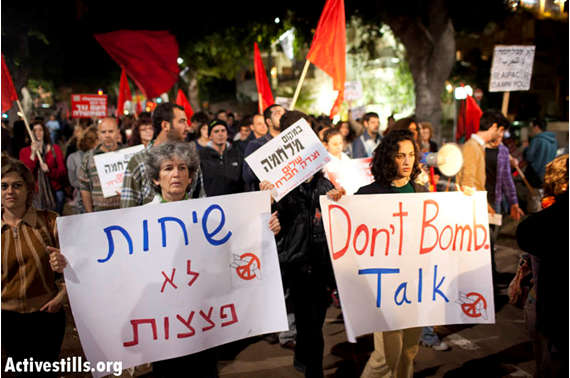
| Photo: Protest in Israel against the war |
By Darrell Rankin
The question of war or peace in the Middle East is at a critical moment. The people and sovereignty of Iran and Syria are in grave danger. A small spark could set off a huge war engulfing many countries, including the NATO military alliance.
Backed by the corporate media and joining other Western powers, the Harper government is imposing sanctions and cutting diplomatic ties as a cover for its own war preparations. Adding to the problem, it is hard to find disagreement on this issue between Harper and the main opposition parties.
We need millions of Canadians to understand that Harper's war drive must be stopped. We need to explain the reasons behind Harper's role on the world stage, and his government's growing isolation from the world majority on the issue of peace in the Middle East.
We need to pressure Parliament to make Canada a voice for peace and disarmament in the region. Working people would lose from such a war, as any party that represents workers should know.
Trade unions and other popular organizations in Canada need to help build the anti‑war movement. This would be the greatest act of solidarity with working people of all nations and religions in the region, because a new war would kill workers of all kinds.
We need to understand the motivations why the corporate ruling class here and in the Middle East is moving towards war. Only a small handful of people would benefit, especially the arms dealers. To them, a new war is useful as a tool to blind workers and prevent their unity for a better world.
The Harper Tories have the foolish expectation that a new war would place Syria and Iran under the reactionary control of Turkey and Saudi Arabia, and give more time for Israel to tighten its grip over the Palestinian people.
Like masters at the chess board, Western powers want to alter the Middle East balance. Colonial attitudes that support regime change in Arab countries are alive and well in Ottawa and other Western capitals. But wars do not always reach the desired end.
For the West, the usual reason for Middle East wars ‑ oil ‑ is receding to the background. There is a growing anti‑popular, reactionary purpose to the latest war drive.
According to Prime Minister Stephen Harper the "hopeful spring of democracy" has given way to an "angry summer of populism... (R)arely has the free and democratic world been less secure."
These are convenient words for a true imperialist. They paint the world as full of threatening chaos, a world we must bring under control for the danger to disappear.
The words are a ruse employed by apologists to justify the drive to dominate other nations. They are used to conceal the danger and chaos created by imperialism in the first place, through sanctions, the arms race and open bellicose threats.
At first, a war might help the most reactionary circles in the West, who continue to use workers as pawns and cannon fodder. These corporate global overlords intend to crush the democratic, popular character of the Arab Spring and stop it from spreading.
As emphasized by Harper's own words, hatred of the popular movements is a prominent motivation behind the threats to Iran and Syria. War is a desperate measure by the West and its allies in the region to crush the popular movements and the hopes for global anti-imperialist unity. Even more serious, another Middle East war could easily grow into a world war, pitting the West against China and Russia.
Intense military preparations in several global hotspots are putting realistic solutions to hunger and climate change on the back burner, where the big oil and grain corporations want them to be. Militarism guarantees that the jobless will continue to go hungry.
Communist and workers' parties have long stated that another world war can be stopped by a very broad anti‑imperialist alliance. A new Middle East war would complicate building this unity.
From that perspective, it is vital to block a new war against Iran or Syria. At home and globally, the peace movement has much work ahead to explain the democratic alternatives to war.
We need to build broad, popular support for comprehensive, mutually agreed and verifiable disarmament in the Middle East, and for the right of the Palestinian people and all nations in the Middle East to decide their future.
This means ending arms shipments into Syria that violate its sovereignty. Canada must end arms sales to regimes that are violating Syria's sovereignty, such as Saudi Arabia, Turkey and the United States.
One thing has not changed about the escalating war threat. The wallets of the Western arms corporations are growing fat off the Middle East.
This is a war we must stop!
October 3, 2012
Debate and discussion: imperialism and the war on Iran.
As peace and anti-war activists build for the October 6th rally against war on Syria or Iran, Rebel Youth is providing the following article and commentary for discussion about the looming military threat on Iran. A lot of critical analysis is being given to this danger, and as youth and student activists we need to make the link with the day-to-day fight for peace in our communities, campuses, workplaces, unions, and other organizations.
What is a good approach?
The main article below presents one way of approaching this question. The article is by the website Global Research published by the Canadian-based Centre for Research on Globalization. To get discussion started we are also presenting a commentary reply, by a writer for People's Voice newspaper on international issues. You can read more about the protest events against the war here and we provide some more links at the end of this article.
From Global Research:
According to U.S. officials, Israel is training and supporting Iranian terrorists who are trying to topple the Iranian government. Those Israeli-funded terrorists have faked documents to falsely indicate that Iran is building a nuclear bomb.
Israel has admitted to previous use of false flag attacks to justify war against Middle Eastern nations.
For example, Israel admits that an Israeli terrorist cell operating in Egypt planted bombs in several buildings, including U.S. diplomatic facilities, then left behind “evidence” implicating the Arabs as the culprits (one of the bombs detonated prematurely, allowing the Egyptians to identify the bombers, and several of the Israelis later confessed).
Please read the rest of the article on Global Research, which presents a series of facts to support this claim.
Commentary reply:
The article "Will Israel Launch a False Flag Against Iran to Start War?" (Global Research, Sept. 28h 2012) presents an interesting speculation, but really, why would Israeli Prime Minister B. Netanyahu think he needs a "false flag" incident? He and other warmongers in the Israeli leadership, and the most belligerent sections of the U.S. ruling class, have argued that they have all the evidence they need to launch pre-emptive strikes against Iran.
In a region overflowing with deadly weapons and conflicting interests, there are constant clashes and military confrontations. Any such incident could be seized upon by the war hawks to attack Iran. Could the constant chatter about "false flags" divert people from the difficult but necessary task of mobilizing against the drive to militarism and war?
That's a problem some anti-war activists have with those who are often predicting "false flags" at any moment. Just in the past couple of months, this included failed predictions about the opening ceremonies of the Olympics, the closing ceremonies, the 9-11 anniversary, and various others. We cannot become mesmerised by trying to guess which date will see some type of provocation, or else we will become immobilized observers.
Yes, there are conspiracies at the highest levels of the ruling class, and always have been. But this is not what drives imperialism. A meteor from space could hit the next Bilderberg meeting and the capitalist system would carry on as usual after the mess was cleaned up.
That said, the danger in the Middle East is very real. War could break out before the US Presidential election, but not necessarily. Will be too late to protest the day after it begins, considering the ability of Iran to strike back against the U.S. and Israel with unpredictable consequences? Clearly the answer is yes. That's why now is the time to do everything we can to mobilize in the streets for Oct. 6th.
For discussion:
1. What did you think about the Global Research (GR) article? What is a "false flag" attack? What do you think of the main idea? What do you think of the sources and documentation? Have you ever read similar articles on the internet? Who is the intended audience and what does the author want to achieve in terms of action?
2. The "Commentary Reply" is written from a different point of view. How would you characterize the main argument? Unlike the GR article, the Reply does not site any sources -- do you think that weakens its argument? Who is the intended audience and what does the author want to achieve in terms of action?
2. What do you think? Both writers claim that conspiracy exists, but one author emphasizes that conspiracy does not "drive" imperialism. What is a conspiracy theory? How is it different from (or similar to) a class-based analysis of imperialism? What does drive imperialism?
3. Thinking more broadly from this concert example, how theory and analysis connected with action, strategy and tactics?
5. What ways can we make the struggle against war and for peace stronger in the youth and student movement in Canada?
Read more: http://www.canadianpeacecongress.ca/
September 29, 2012
Student organizing in the 1930s and the YCL
| The On To Ottawa Trek |
Below we present an RCMP report from November 1936, which includes a report about the work of the Young Communist League on campuses and a student conference organized by the YCL at McGill University. No doubt, not everything in this report is true. The informants used by the RCMP often exaggerated the statements of the Communists (saying, for example, that the Communists called for violent and bloody revolution in a public speech) to simply justify their existence as informers and spies. This organizational culture was supported at all levels of the RCMP who always monitored the CPC more closely than the ultra-right groups -- even when Canada was at war with fascist Germany and about to enter into an alliance with the USSR. As historian Chris Frazer writes in the latest issue of The Spark journal:
As chief of the RCMP's intelligence section, Rivett-Carnac argued in early 1939 that fascism was a lesser threat than communism since fascism was a "modified form of capitalism." Rivett-Carnac's opinion corresponded with the anti-communist and anti-labour views of RCMP Commissioner S.T. Wood, who argued later in 1941 that, "it is not the Nazi nor the Fascist but the radical who constitutes our most troublesome problem."[19] Although the charges were never substantiated, as early as October 1939 the RCMP Security Bulletin claimed that "there is more reason to fear ... acts of espionage and sabotage on the part of the Communist Party than from Nazi or Fascist organizations." Source.The November 1936 report is from a series of security reports that the RCMP issued on a monthly basis. Much of what the YCL is interested in doing, as presented by this report, is anti-fascist work -- or campaigning for peace. At points the language of the document reads as if the informer simply copied the original text in shortened form. The sentence structure and wording is dated and has a kind of 1930s feel, but the thinking of young people at that time shines through.
The report states that student participants came from Queens (Kingston, Ontario) Dalhousie (Halifax, Nova Scotia), McGill (Montreal, Quebec) and Varisty -- which perhaps refers to the University of Toronto, whose student newspaper and sports teams are called that and where the YCL had an established public club at that time (although the word varsity simply means a university sports team or a university). Two delegations also came from high schools in Montreal.
The conference called on YCLers to continue political and ideological work against "Capitalist ideology and propoganda in schools" but to combine this with immediate struggles and political work like peace, unemployment, youth rights, and united front work with other youth organizations. A strong parallel can be drawn with the work of the League today.
The report calls for "proper combination of broad campaigns on specific issues [...] with careful fostering of permanent student organizations." This approach may have some thing to teach youth and student activists today, with the spirit of Occupy, the "Casserole" solidarity protests, and other spontaneous actions on our campuses and communities. More often than not, these movements unfortunately fail to develop into real organizations and the youth movement swings along, after a few weeks or months, to the next popular issue.
Particular attention was given to the Canadian Youth Congress (CYC). The CYC included progressive religious youth through the Student Christian Movement which was the main social-justice organization on campuses at that time, but also farm youth, the Canadian Cooperative Federation Youth or CCF (forerunner of the NDP), as well as social and sports groups like the YMCA and YWCA (Young Men's and Young Women's Christian Associations). The CYC advocated for a Charter of Rights of the Youth or "Youth Act". It had just held, the year before, a series of protest actions against government policy during the depression -- like peoples courts against Prime Minister R.B. Bennett.
Despite that fact that most university students were not from the working class, interestingly the YCL report does not dismiss political action on campuses. Instead the League states that students are a diverse social group, generally inexperienced, and that schools varied considerably -- depending even on the personality of the school principle (or university President). As a result "no stereotyped formula can be given" but there was a sharp problem of leadership because of inexperience on campuses.
Further discussion
A lot of material is presented here which could be fruitful for further discussion about strategy and tactics. At this time the YCL itself had only just fought and defeated, with the Communist Party of Canada, an effective ban on the organization. It was still on a precarious edge of legality. Why would the YCL not want the Student Peace Movement to be an underground organization and forbid that direction?
Why would the YCL want official support of efforts like the CYC and peace clubs but not progressive clubs which are to remain independent?
What do you think about the experience and tactics of the YCL on high school campuses at Baron Byng and Strathcona?
Why do you think they thought it was necessary to write that"the club must neither be a collection of intellectual giants nor ostensibly be interested in nothing but ping pong while in reality acting as a snare for unsuspecting innocents"? What does this mean?
How are "linkages with the labour movement" maintained with YCL clubs in a way that is not "mechanistic"? What do you think about the example at McGill?
What do you think about the proposal for a YCL club meeting agenda on campuses and the idea of "all-talk-no-action"?
Although the story-teller is a police agent, the actual minutes from this meeting no doubt have been long lost. It is, therefore, an invaluable source of information. What we get is not the conference discussion in full, or even the complete final resolution. It is sifted by a police filter from the informant to the official report given here. The reader simply has to trust that most of the document is, more or less, accurate.
At the same time the report tells an important tale not just about the YCL but also the youth movement of the time. The final resolutions of the conference, for better or worse, show the thought-out contribution of the YCL to the students struggle: it identifies key priorities like peace and youth rights; it strives to find the maximum level of unity and militancy in the context; it navigates difficult questions like legality, illegality, and the public presence of the YCL; and it interconnects the youth struggle with other struggles.
The report especially tells its members to strive to work in a way that is not mechanistic or formulaic, to listen to its high school members, and to work in a collective fashion with initiative. Clearly, the League does not dismiss the campuses or reject participation in the political life of students -- even though access to education was much more difficult in 1936 than today for working class youth. And to be sure, campus activities were a relatively lower priority of the League which focused more on young workers. But in tacking the problems of the student movement of the day, the YCL shows its broad sweep of understanding struggle -- a revolutionary perspective of mobilizing the all the oppressed masses of youth in unity with the working class. Clearly the police though this vanguard approach towards the youth struggle in Canada was a real danger.
YCL at McGill
September 11, 2012
Quebec election: people give no clear mandate to any party
Labels:
elections,
Marxism,
quebec,
quebec solidaire,
quebec student strike 2012,
tactics,
YCL
| The election rally of Quebec Solidaire |
J. Boyden
A shorter version of the article will be published in the upcoming issue of People`s Voice newspaper
Quebec voters headed to the polls on Sept. 4th for a historic election, coming after a series of major storms of popular discontent had swept the province -- outrage over corruption scandals and opposition against the Liberal government’s austerity budgets, which exploded during last spring’s student strike. But the final results saw no party come out with a clear mandate, as the Liberals, including party leader Jean Charest, went down to defeat while voters granted a slim minority government to the Parti Québécois (PQ) led by Pauline Marois.
The PQ has already announced that its first act will be to cancel the tuition fee hike and abolish repressive law 78, which effectively criminalized the student strikers. Positively, their party platform also called to abolish tuition increases until 2018, eliminate the health tax, reconsider additional fees for Hydro Quebec usage, increase taxes and fees on natural resource exploitation, expand daycare spaces, and enact Employment Insurance reforms by repatriating EI to Quebec.
Marois’ PQ, however, is nine seats short of a majority to implement this agenda, sitting at 54 Members of the National Assembly (MNAs). The outgoing Liberals held on to 50 seats in the 125-member National Assembly while François Legault’s new ultra-right and populist Coalition Avenir Québec (CAQ) expanded from 9 to 19 seats. The progressive Quebec Solidaire (QS) party also increased its seat count to two MNAs and is expected to again have a bigger presence in the National Assembly beyond its small numbers.
Voter turnout
Speaking to People’s Voice about the analysis of the Quebec vote break-down which will be published in the next issue of the Communist Party of Quebec’s newspaper Clarté, editor Robert Luxley drew attention to voter participation and the strong mobilization by right-wing forces during the election.
At almost 75 per cent, turn-out in the election broke all recent records of votes in the last ten years, approaching levels similar to the 1998 election (following the second referendum on Quebec’s independence).
Law & Order
On the one hand, as leaked Liberal strategy documents confirmed shortly before the election was called, Charest pursued a cavalier approach of provocation and intransigence towards the student strike for months, hoping to create the basis of for a campaign of fear where they represented law and order, and stability.
On the eve of calling the election the Liberal message shifted to one of blackmail, threatening voters with a political and economic catastrophe if the PQ won and called another referendum.
In the squeeze
On the other hand, unable to avoid convening a commission on corruption scandals due to public outrage, Charest effectively set the timeline for the election when his government convened that commission and established its schedule. In the end the Liberal’s were squeezed by the student protests – conditions which also favored the PQ.
The pressure from the people’s forces, unleashed as the student struggle broadened into a popular movement, pushed the PQ into adopting a progressive-sounding agenda, to avoid losing votes. Without the student mobilizations it is probable that the PQ platform would have more accurately reflected their true political identity, a nationalist party of small and large-scale business and not a left party.
Voter break-down
While the higher voter participation no doubt included many new young voters, who also turned to Quebec Solidaire and helped double the popular vote of QS, another large component of high participation came from ridings where the CAQ won. Often these were in places where the populist ADQ had made gains in the past.
The Liberal’s received 31.2% and the CAQ 27% of the popular vote, eating into the PQ, which received 31.95%, while QS won just over 6%. Thus the division of the right helps explain the victory of the PQ.
Liberal vote
Although the Liberal’s received basically the same total number of votes as the last election (only 5,000 votes less), it was their lowest percentage of the popular vote since Confederation because of the high participation of the people in the election. The Liberals won seats in Quebec City and the regions, but the lions-share of their seats came from Greater Montreal, the Gatineau-Hull area, and the Eastern Townships -- not surprising given that they were the only Federalist party in the election.
An opinion poll conducted by Le Devoir suggested the primary reason Liberal voters chose that party was to voice opposition to the PQ and support Canadian unity, as well as economic stability – rather than the actual values of the party.
National question still burns
Conservative Prime Minister Steven Harper responded to the Quebec election by concluding the vote suggested debate about the national question should now be shut-down. This stiffening of democratic discussion about Quebec’s future is unlikely to happen, however, given the reactionary framework that federalism imposes, as well as continued chauvinism from the corporate media and some Anglophones.
As a case in point, the PQ election victory celebrations were tragically interrupted when a man attempted to set fire to the theatre venue and shot two people, killing a stagehand. As he was arrested he yelled incoherently about the how the English-speakers are now “waking-up.”
The attack was “an isolated act of madness, but it was nevertheless triggered by the socio-political [context]” the Société Saint-Jean-Baptiste said in a statement, calling on the English-language corporate media to tone-down their rhetoric which has labeled soveriegntist voices during the election “Franco-supremacist,” “intolerant,” “anglophobes,” “close-minded idiots,” who “despise minorities” etc. Comments on some English-language newspaper websites, expressed regret that the gun man was not successful to “kill the bitch”, and other hate speech.
QS makes gains
At the election rally of Quebec Solidaire, held not far from the PQ’s event, newly elected MNA Françoise David congratulated Marois on her election as the first women premier and vowed to work together on any policy the PQ might advance in support of women’s rights, the environment, labour, and other social issues.
It is more likely however that the PQ will now try to find an excuse to shift away from its election promises and form an alliance with the right. Another election is almost certain well before four years – which has also lead the NDP to officially drop its plan to build a provincial party, good news for QS.
David will now join QS MNA Amir Khadir in Quebec City, meaning that both of QS’s spokespeople will be in the National Assembly, representing back-to-back ridings in urban Montreal. An evaluation of the election by Quebec’s voter-reform coalition suggested that under a Mixed-Member Proportional system, QS would hold 8 seats. While the actual result is perhaps not as much as that party wished, QS made still important gains and finished second place in at least three other Montreal ridings.
Marianne Breton Fontaine, the leader of the Young Communist League of Quebec, doubled the popular vote for QS in the riding of Acadie, coming in with almost 2,500 votes and 8%.
In an upcoming article we will look at the response of labour and people`s movements to the election.
Marianne Breton Fontaine, the leader of the Young Communist League of Quebec, doubled the popular vote for QS in the riding of Acadie, coming in with almost 2,500 votes and 8%.
In an upcoming article we will look at the response of labour and people`s movements to the election.
July 29, 2012
The youth struggle today: reform and revolution, local and general
Labels:
90th anniversary,
bc,
cuba,
economic crisis,
economy,
fukashima,
iran,
japan,
Marxism,
moncada,
peace,
quebec student strike 2012,
reform,
revolution,
strategy,
students,
syria,
tactics,
theory
Based on a greetings given by Drew Garvie on behalf of the Central Executive Committee to a meeting of YCLers in Vancouver, July 2012
Thank you to the Young Communist League British Columbia for having me here today, on behalf of the Central Executive Committee, for your provincial convention which also takes place on the same weekend as Moncada Day.
This is entirely appropriate. Moncada Day celebrates the movement that grew into the triumphant Cuban revolution, which was born on the 26th of July 1953 when Fidel and Raul Castro and around 160 other brave revolutionaries attacked the Moncada Barracks in Santiago de Cuba.
This meeting of the Young Communist League comes at a juncture in the youth and student movement when the forces of monopoly capitalism are instituting a strong offensive against the people and the environment through their reactionary, pro-war governments: the Harper Conservatives in Ottawa and their allies, the Clark Liberals in Victoria.
At the same time, the fight back is developing at an accelerating rate.
Signs of this can be seen especially in the youth and student movement. The development of Occupy successfully popularized the struggle of the “99%” against the 1%. There is some increased militancy from the student movement across English-speaking Canada, drawing inspiration from the ongoing historic and massive Québec student strike. The Charter of Youth Rights campaign is emerging.
Quebec, although on the other side of the country, is especially important. The bold unity and sheer numbers of the mobilization has scared the ruling class and sent a call-out for youth to rise-up.
Millions of people are also participating in general strikes and demonstrations in countries like Greece, Portugal, Britain and India. Much of Latin America continues to advance as an anti-imperialist front.
The revolutionary uprisings across North Africa and the Middle East which started around 18 months ago have not faded away. In Egypt there are continued strikes by factory workers, and street demonstrations by students.
Comrades,
The growing youth resistance has borne-out what the YCL said almost two years ago at our Central Convention, that the youth should take courage at the weakness of capitalism and build the fight back. We are in dynamic times, with many dangers and challenges but also the potential for a better future for British Colombia and Canada – and resurgent socialism.
We are being told by the corporate media that the economic crisis is to blame for aggressive budget cutbacks. For example, the recent Harper Budget, the Omnibus Bill C-38. We are again told that we can no longer afford the social programs that working people have won after generations of struggle.
Governments are broke and there’s nothing they can do about it, except make the working class pay the bill.
This is what people are hearing in British Colombia, in Ontario, in Quebec, but also internationally in Greece, in Spain, in Britain, in Chile, in India, and elsewhere. It’s a refrain that the pro-capitalist governments, whether they are right-wing or social democratic, basically have in common around the world.
Is it true?
Young workers and student activists can clearly see the dangerous lie to the claims behind 'austerity' when we have a global perspective. Even in a provincial meeting like yours today, it is important that the international and the local are always dialectically connected.
Consider the global economic crisis; the question of war and peace; and environmental struggles. Or the campus struggles today, with the student uprising in Quebec and the challenges for the student movement here in BC. How is the general connected with the specific?
First, the 'financial crash' or 'long rescission' or 'slow recovery' or as we have been accurately calling it from the beginning the capitalist economic crisis.
This crisis was not created by social programs, or by the people. It was created by capitalism itself. In fact, because of the internal contradictions of the capitalist economy, it operates in cycles of boom, crisis, depression and recovery which is politely re-labeled by economists 'the business cycle'.
And whether in the form of the velvet glove of “welfare state” reformism or the iron fist of neoliberal reaction, the policies of finance capital and its state have merely created new contradictions.
Over the last 40 years, corporate profits have skyrocketed, and big business has paid less and less taxes to the State. By eroding the tax system, keeping wages down, speeding up the working day, busting unions, privatizing profitable parts of the public sector, and breaking into new markets through trade agreements and even war, the capitalists hoped to survive systemic contradictions -- especially falling rates of profit. Because while Capital has made larger and large profits, the rate of accumulation was not rising (as new technologies were introduced).
Capital put the bill in the hands of government and the people, forcing them to borrow from the capitalists. This debt itself became a commodity. When the economic crisis hit, it was public money that went to try and resuscitate Capital through bailouts -- causing more debt. Who holds this debt? Well the capitalists, of course!
Now we are told it is our duty to feed the machine more.
As the crisis broke in 2007, debt spiked further. Now, in Europe, they’re back to demand repayment on their loans, that were given to themselves. This is called 'the Eurozone crisis' but it is really just another example of the global economic crisis of capitalism. Even Prime Minister Stephen Harper quietly said the last Greek election could effect the world -- including Canada.
The Harper Conservatives would like us to believe the economic crisis has really not effected Canada, but you here in BC know otherwise.
The youth movement understands its local struggles clearer and better when it has a 'big-picture' focus.
Capitalism is a system without democratic social planning, which as Engels said produces an “anarchy of capital” which is the cause of the crisis – of misery, exploitation, unemployment, poverty wages, and environmental devastation around the world. It is what the People are up against, but there are alternatives.
Communism and socialism are not words to be embarrassed of.
Capitalism is the real failed system.
And we putting socialism back onto the negotiation table!
Comrades,
At our most recent meeting of the YCL Central Committee we drew the connection between economic crisis and war.
The World Federation of Democratic Youth, the World Peace Council and the Canadian Peace Congress, and the international meeting of Communist and Worker’s Parties have all warned of the increased aggressiveness by imperialism.
As we report in the latest Rebel Youth magazine, a military intervention in Syria is being planned right now by imperialist alliances like the North Atlantic Treaty Organization or NATO.
As we have seen in Libya, Palestine, Afghanistan, Haiti, Colombia, Paraguay, and many other places: the people are not done any favors by imperialist intervention. ‘Regime change’ in Syria would led to a terrible blood-bath and provide a road for imperialism to hit at Iran.
On the way to BC, I saw the Economist magazine in the airport with an article entitled “Syria: the end game”.
How many millions of dollars will be spent on another war? Money that, as your meeting documents say, should go towards BC’s crisis of child poverty – and job creation with good union jobs.
We have called for all peace-loving youth in Canada to support a peaceful and political solution by the Syrian people themselves.
The question of peace is also a challenge for BC young workers and students to address as a movement, and find ways to mobilize opposition in the streets.
Even when these issues seem forgotten, the YCL has a duty to remember the importance of the struggle for peace. The YCL must never abandon the principle of working-class internationalism, the principle that working people of the world must stand united against capitalist wars and for the class struggle.
And so with the question of internationalism we return to the relationship between the specific and the general.
On the other side of the Pacific, there have been tremendous anti-nuclear protests in Japan. The March 2011 Fukushima Daiichi nuclear disaster has lead to the evacuation of close to 2,000 people and over 500 disaster-related deaths, as well as the release of radioactive material into the Pacific. We would like to take the occasion of this meeting to express our solidarity as the YCL with the environmental movement in Japan.
Turning our eyes to home, we also call for the evacuation of all US troops and the closure of the Nanose Military Base which is a weapons testing area for US nuclear submarines.
The environment is understandably of vital important to the youth, because it is a struggle for the future. Climate change, for example, shows clearly the link between the global and the local.
Just a few days ago, scientists announced a rapid and massive thaw of Greenland’s glaciers. After just a small rise in oceanic water temperatures, and this office could be threatened by tidal storm waters!
In this context, we also join with the people’s movements and shout out that militant solidarity can block the Enbridge Northern Gateway pipeline!
The YCL has a long and proud history of opposing project like this, exporting unprocessed raw materials, which strengthens U.S. imperialism and its Canadian cronies, but fails to create jobs.
It is great to see the youth and student resistance to the pipeline, here in BC!
The cynics and the disheartened progressives who thought that the working class and youth of North America were “hopeless” now have examples in Wisconsin, across the continent in the form of the Occupy movement, and the Quebec student uprising.
The Quebec student struggle is another case where a local struggle is framed in an international context of struggle for accessible education, and then becomes part of that international resistance.
Globally, accessible education is under dangerous attack with the Austerity agenda. Students in Britain and Spain been a part of that renewed militant fight back.
In Chile, students joined a general strike of the miners in the summer, and a political strike was launched to replace the Pinochet-era constitution with a new constitution that would enshrine guaranteed free and accessible education. 600 000 marchers hit the streets in a country of 15 million. The Young Communists of Chile have been at the forefront of this struggle.
I would like to touch on the Quebec student uprising which is perhaps foremost in our minds in the discussion people`s resistance today.
It is also a topic where the CEC has devoted much attention to, in consultation with the YCL`s all-Canada student working group telephone meeting, which is growing and meets a couple times a month.
We would really like to see the call grow and develop, to include more participating from BC.
One way to get a good handle on how strong a movement is, is to see what the thinkers of the capitalist class are saying about it. Former advisor to the US state Department on the Quebec student struggle, David Jones has spoken about the Quebec spring. This is not a man who is on our side of the class struggle.
What was David Jones greatest worry?
That "students elsewhere (may) determine Quebec has provided a ‘learning experience.’”
As the YCL, that is exactly what we want: for lessons of Quebec to be shared with other students – and young workers!
We can not simply say – oh, that’s those French speakers. They have a different, culture, history, language, territory and economy, etc.
That is what the corporate media is saying. Quebec is ‘special’ – so the student uprising can not come to BC.
It is striking that when Quebec demands its sovereignty -- which we broadly support, proposing a new constitution on an equal basis with English-speaking Canada, up to and including the right of separation – but when Quebec`s self-determination and the national question comes into question, these factors that make Quebec a nation are suddenly forgotten by the corporate media and Quebec is no longer ‘special.’
However, a communists we know that there is a common class struggle which unites the different nations in Canada.
The fight for accessible education is a class and democratic struggle.
I was in Montreal last May as part of a delegation of student journalists from Guelph, Ontario and we interviewed student leader Gabriel Nadeau Duboise of the CLASSE union. He told me about the repression they have been facing by the police and with Bill 78, but also the slogan – “Student Strike, People’s Struggle.”
The students in Quebec, through struggling for a freeze in tuition fees, have learned a great deal through their battles and are now advancing other people’s movement demands, as their new “Share Our Future” manifesto says. You can read it on our RY blog or in the latest People’s Voice. I would like to quote:
“This is the meaning of our vision, and the essence of our strike: it is a shared, collective action whose scope lies well beyond student interests. We are daring to call for a different world, one far removed from the blind submission our present commodity-based system requires”
This is an important political view for the YCL and also shows the strength of our analysis: that the quantitative struggle for reforms, like accessible education, are necessary because they help build towards a qualitative change in the people’s class consciousness, organization and unity; ultimately it is towards the realizing the necessity of fundamental social transformation and revolutionary change – socialist consciousness.
The struggle for immediate social progress, within the framework of capitalism, and the struggle for making a rupture, a sharp break overthrowing of the system, are objectively linked as a process.
This can be difficult to grasp in the youth and student movement not just because youth (as much as we hate to admit it!) can lack experience with struggle.
That’s true, but it is difficult because it gets at the question of how we understand, as revolutionaries, our basic reality. If reform and revolution are opposite tendencies – ideologically, politically and economically – how can they be a united process?
Reforms are won through the power of the movement. Any fundamental change depends on the mobilisation of the masses of people. Nevertheless, under capitalism reform gains will be temporary and precarious.
Let’s keep in mind Quebec here, which has the lowest tuition fees in the country – this is not the first student strike in Quebec, it is the eight strike. And still the capitalists keep trying to push up fees! While we haven’t seen a significant gain come out of the battle – yet! – the struggle has become a mass and social mobilization far beyond the campuses which maintains, albeit unclearly, a perspective of challenging corporate power.
If the movement, while thick in the action for immediate reform battles, can maintain a revolutionary qperspective of class struggle and overcoming capitalism it will intensify the militancy of the working class.
And that is the kind of position the youth and student movement needs to be in – militant and united.
Conditions are always changing. The earth spins around on its axis, marking each day. It may seem that day after day, or year after year, life is the same. But life proves Marxism`s claim that the capitalist system is unsustainable and crisis-ridden. The moment we are living in is making history. Political ‘ruptures’ have been breaking out around the world – take the Arab spring – and the strength of the movement and its leadership is often decisive.
Perhaps it is too early to judge the results of the Arab spring in Egypt and Tunisia, but we can see how true this strategic perspective is, by remembering the first successful socialist revolution in North America – in Cuba.
The Moncada day we are celebrating this weekend set the revolutionary process into action in Cuba. But the main demands of the youth who stormed the barracks were free and fair elections. Just a year before, in 1952, US-supported dictator Fulgencio Batista had organized a coup and rigged the elections. And so, disguised as businessmen interested in Clay Pigeon shooting, a group of young radicals came together under the leadership of Fidel, Raul and others, training at the University of Havana.
In the short term, their raid was tremendously unsuccessful. It did not start an uprising. Instead, many of the youth and students died. Fidel, Raul and the rest of the rebels went to prison. But we know the rest of the story. A mass movement of the Cuban people against Batista developed with force, conditions changed and a crisis developed.
Facing armed insurrection that had liberated most of the island, as well as a mass uprising and a general strike, in January 1959 on New Years day Batista fled into exile (to eventually settle in fascist Portugal). And the revolutionaries lead by Fidel and Che marched into a celebratory Havana!
After the overthrow of Batista, the Cuban revolution kept advancing. It developed into a socialist revolution and the Cuban people built the first free territory in the Americas.
By celebrating Moncada, we remember that the Cuban revolution was made possible by the people’s struggles that came before, and took many hard years of organization and work. The small immediate battles and the big sweeping changes were not separate, but in a contradictory relationship together.
The YCL is a unique group in the youth and student movement because it ‘gets’ this unity of reform and revolution.
While we don’t try to impatiently impose our demands on the youth movement, we don’t sit on the sidelines or simply ‘go with the flow.’ We are not compliant or complacent with the situation today where many movements have adopted tepid demands without a common strategy (other than voting NDP).
The vanguard role of the YCL arises in action, working in the political direction of the Communist Party of Canada, and applying that strategic direction within the youth and student movement of unity and militancy.
What can be learned from the Quebec student movement by student activists in English speaking Canada and BC?
This is an important question for your meeting to discuss.
In our statement for the Feburary 1st “Education is a Right” cross-Canada day of action, the YCL made a criticism of the current tactics of the Canadian Federaton of Students or CFS, in a constructive and respectful way. We called these protests an excellent step in the direction of developing into a truly broad and united fightback.
In other words, February 1st fell far short of being what was necessary but could have been a good start.
Afterwards, in People`s Voice, we said the poor turn-out was a ‘wake-up call’ exposing the ‘lack of an action plan’
We called for ramping‑up actions on campus. Sit ins. Occupations. More rallies. [and] bringing the struggle into the community and winning the moral support of the public which, at least in sentiment, is probably already there - but not yet in a visible way that cannot be ignored.
Our policy is for a united and militant student movement that moves the campuses into action and reaches out beyond, to stand with the struggles of labour and other people`s struggles.
Our current policy in the student movement is that:
1. The student movement and the CFS needs an escalating plan of action for a broad and united fight back;
2. This struggle should open a broad democratic debate about free, accessible, quality, public, not-for-profit education;
3. That the political reason for the student movement’s struggle must be brought into the hands of the members themselves through democratic empowerment;
4. The student movement must urgently find unity with Quebec and Aboriginal students, and it must be on the basis of their rights to sovereignty and self-determination as nations;
Since the CFS Day of Action, Quebec has exploded. We must say that the solidarity movement in Canada has really been outstanding – but not with any help from Mulclair`s NDP! – but now each point on this list, which may have seemed abstract in January, is very concretely on the table.
The Charter of Youth Rights campaign compliments this perspective on unity.
In addition to free education from cradle to grave (including childcare) the YCL also demands abolishing student debt, grants not loans, kicking military recruitment and research of our campuses, restoring and expanding funding to education including Aboriginal education, and a living stipend for students.
Winning these demands is not a question of magic structures or magic leaders but finding the way to organize for a major battle, drawing hundreds of thousands if not millions of students into struggle.
In such a battle a student strike would be, as we said in January, the most effective way to put moral pressure on the government. It should therefore be part of the student`s arsenal.
But here is an important point.
Beyond the debate about tactics we think there is an ideological battle here, which is also observable in the Labour movement.
On the one side are the strategies of ‘lobby or wait until the Election and vote NDP’ and right-wing social democracy.
On the other side are the left and progressive forces that are calling out for action.
We are not in the arm chair on these questions, we are in action.
The CEC and the YCL student conference call helped support and organize the recent “Student Solidarity Tour”, bringing Quebec activists to 9 cities in Ontario, largely organized by our comrades on the ground and comrade Ryan from YCL Hamilton who is also a member of the Central Committee.
This was a very positive step forward for the League in Ontario as well as Centrally and had a significant impact on the situation in Ontario. It was the first time that CLASSE leaders and the Canadian Federation of Students were connected on a project as large as this, from Ottawa to Windsor.
Turnout to the events were very good and CEC member and leader of the LJC-Q, comrade Marianne Breton Fontaine had a chance to address about a thousand Ontario student activists with our call for unity and militancy as the way forward.
This was built from other work including the “student activist conference” the YCL CEC and the LJC-Q convened in Montreal in January. Could we do the same thing with a YCL young workers conference?
This weekend, many of our activists are in Toronto at “student strike training workshops” which Marianne will be presenting at. Over lunch, the YCL is holding a special fraction meeting of all our members attending the conference , to coordinate our contribution.
To update you on other activities across the country, the YCL-Ontario just finished their convention a month ago. 14 delegates from 4 clubs were in attendance and dealt with over 60 amendments through thorough debate and we elected a renewed leadership with a PC of ten comrades, including young workers and student activists from our new clubs in Ottawa and Windsor. I was re-elected as the Ontario YCL organizer.
The YCL also had a visible presence through participation in the Toronto Pride parade which concluded the convention weekend.
Rebel Youth, after a delay in printing which some of you in this room will know about directly, has come out with a double issue, which features the Quebec student strike and is in colour. It is being well received as the youth movement is eager to learn about what is really going on in the streets of Montreal and Quebec city.
I am happy to see that your meeting will be discussing contributions from British Colombia to our magazine and we do need help making sure that issues are produced more frequently. Above all, we need participation and involvement in the commission, and building the magazine among young workers with new subscriptions. Our magazine should be at the centre of our agitation, organizational and educational work of the League across Canada.
In Cuba solidarity – which we should draw extra attention to this weekend as it is the anniversary of the July 26th movement and the storming of the Moncada Barracks which marked the beginning of the Cuban revolution – we have sent two members of the YCL on this year’s Che Brigade, including Central Committe member Dan Mozarowski, and will be using this participation to strengthen our solidarity work.
We will be visiting Nova Scotia this Fall for a school, and have started organizing efforts to grow the League on the East Coast.
We need to prioritize more the work of young workers who are being hit hard by the economic crisis.
Where we are visible, active and working collectively as the YCL we are growing, sometimes significantly.
The current economic and political conditions have caused more and more young workers and students to look for alternatives to cut-backs, privatization and austerity. We have answers to the questions that are now being raised. The case against war, poverty, misery, environmental devastation, unemployment, exploitation and oppression is really the case for socialism.
With these thoughts, comrades, I think I will conclude.
I also should mention that next year will be a special occasion for the YCL, the 90th anniversary of the League and our founding in 1923.
Our 90th anniversary will be a special occasion that we will have to celebrate in some way as we mark 90 years of fighting history for young workers.
Again, good luck with your work today and we hope your debates are fruitful. As our slogan says:
The Youth are the Future, The Future is Socialism!
Subscribe to:
Posts (Atom)
Popular stories
-
Rebel Youth is looking for hitchhiking stories, and also experiences with the challenges faced by women, trans people, hitchhickers facing ...
-
The real abuse taking place in Cuba is the crippling and inhumane American blockade Rob Miller The Guardian, Thursday 26 November 2009 Your ...
-
Special to RY Tyson Strandlund is the Communist Party of BC’s candidate in the upcoming election in Esquimalt-Metchosin, British Columbi...
-
A very important meeting for labour and social movements is taking place from August 21-24th in Ottawa. The People’s Social Forum (PS...
-
J. Boyden Yesterday, January 18 th , was the 24 th anniversary of the death of Renato Guttuso. Renato Guttuso (1911-1987) was a com...
-
Jay Watts In 1995, a report issued as part of the Royal Commission on Aboriginal Peoples called suicide “one of the most urgent problems ...
-
World Federation of Democratic Youth (WFDY) would like to express its deepest condolences and sympathy to all those affected by the mu...
-
Adrien Welsh On April 23rd, the French people were called to chose two out of the eleven candidates running for the Presidential e...
-
This article is part of an seven-part series of short quotes Rebel Youth is issuing about class struggle, revolution, civil-war, and par...
-
Ajit Singh A couple weeks ago, a Palestinian child was beheaded by the "moderate rebels" in Syria, created, funded, and backe...