A semi-parody by Peter Miller
The Toronto Raptors are, I think, an exciting team to watch, and with Kawhi Leonard, they could win the finals for the first time in franchise history. Any time I watch them play it can't help but remind me about the superiority of the socialist system over capitalism. Here are five reasons why watching basketball reminds me of socialism.
Showing posts with label peter miller. Show all posts
June 10, 2019
May 3, 2019
10 Tips for Leftist Organizing
Labels:
peter miller,
YCL
Peter Miller
I have been involved in organizing for the Young Communist League - Lique de la Jeunesse Communiste (YCL-LJC) and also worked on campaigns for free education since I was 19 years old. I recently spent two years finishing my Bachelor of Education degree at the University of Windsor and organizing a YCL club as well as helping with the student movement there. I haven't followed all the advice below as well as I would have liked over the years, but if I was talking to myself ten years ago, this is what I would say. Here's my advice to you on how to be a lead organizer as a leftist on your campus.
January 19, 2019
Unite for Free Education and Against Ford's Anti-Democratic Attacks
Labels:
doug ford,
free education,
peter miller,
student movement,
students
![]() |
| YCL-LJC at the Rally in Toronto on January 18th |
In light of the recent announcement from the Ford Government, which includes continued unregulated international tuition fee costs, cuts to student grants, cuts to public investment in Post-Secondary Education, and voluntary payment of fees for student-run organizations, there is no doubt the student movement needs to build as militant and united a student movement as possible.
It all started on Friday with a large contingent of people making their voices heard against Doug Ford’s attacks against students. The Canadian Federation of Students-Ontario organized the rally and took time out of their general meeting to protest with other students and labour allies.
January 16, 2019
Day of Action for Democracy on Campus is just the beginning
Labels:
academic freedom,
democracy,
ontario,
peter miller,
student movement,
students
![]() |
| Banner drop on Nov. 29th in Windsor |
YCL Ontario students and allies organized a Day of Action for Democracy on Campus on November 29th to protest against the implementation of Doug Ford's "free speech" directive on Ontario college and university campuses. We came together in opposition to this directive, which instead of encouraging free speech, has the goal to stifle it for marginalized and activist groups while emboldening the hate speech of far-right and fascist groups trying to increase their presence amongst youth.
Ford's directive attacks democracy on campus by forcing campuses which already follow academic freedom to include a free speech policy. Most outrageously, his policy attacks democracy by threatening student activists with discipline for organizing protests against hate groups speaking on campus.
November 27, 2013
Campaign to Raise the Minimum Wage Builds Momentum
By Peter Miller,
Rebel Youth magazine
The campaign to raise the minimum wage in Ontario is
building momentum. On November 14 minimum wage workers and community members
reached out to 50 MPPs demanding for them to sign on to the campaign.
Actions included protests outside of Premier Kathleen Wynn’s
office in Toronto and NDP leader Andrea Horwath’s office in Hamilton. Delegations
brought petition sheets, and large 5 billion dollar checks to represent the
amount of money that would boost the economy from an increase to the minimum
wage. There have been other events that show the campaign is picking up
momentum. On November 5, a large forum in Scarborough attracted 250 people who discussed
how to outreach and mobilize for the campaign.
November 19, 2013
Tour by Activist from Venezuela discusses Socialist Communes
![]() |
| (Courtesy Venezuela Analysis) |
By Peter Miller,
Rebel Youth Magazine
Venezuela is a country that represents a different vision
for our future. Its Bolivarian revolutionary process is the opposite of capitalist
austerity and neoliberalism that many working class people around the world are
facing today.
In November, Katrina Kozarek came to Ontario and Quebec for a speaking tour about Venezuela today.
Kozarek is active in the Ataroa Socialist Commune and a long-term
activist in the Nacional Association of Community, Free and Alternative Media
(ANMCLA). She grew up in Apollo, Pennsylvania, but moved to Venezuela in 2003.
October 22, 2013
"Line 9! Shut it down!"
P. Millionaire,
Rebel Youth Magazine
The movement against tar sands pipelines has been growing over the last year. Indigenous communities and activists in British Colombia have so far successfully blocked the proposed Enbridge Northern Gateway pipeline that proposed to run from the Alberta tar sands to the BC coast.
Indigenous people, workers, and community members in Ontario
and Québec are also concerned with Enbridge’s proposal to reverse the flow of line
9 and send tar sands bitumen from Sarnia all the way to Montréal.
On Saturday October 20, activists against the reversal of
line 9 protested in Toronto at 12 pm outside the metro Toronto Convention Center.
The protest was set to occur during Enbridge’s hearing about line 9 with the National
Energy Board (NEB), but the meeting was postponed.
The day before, on October 19, activists at the hearing
burst into song, chants, and played drums in order to disrupt the meeting. The noisy protest was so powerful that members
of the NEB fled the hearings. Activists at the protest against line 9 expressed
their belief that the hearings had been postponed because of the work of the
movement against the reversal of Line 9.
“Enbridge is afraid
of us,” said Vanessa Gray, one of the first speakers at the rally.
October 6, 2013
Paved With Good Intentions links Development NGOs with Imperialism
Labels:
alternatives,
cida,
development,
dru oda jay,
globalization,
Imperialism,
ngos,
nikolas barry-shaw,
peter miller
Peter Miller,
Rebel Youth Magazine
The mainstream media will have us believe that people living in Canada should be proud of our country’s aid around the world. Nikolas Barry-Shaw and Dru Oja Jay busted this myth with their book Paved with Good Intentions: Canada’s development NGOs from idealism to imperialism.
Rebel Youth Magazine
The mainstream media will have us believe that people living in Canada should be proud of our country’s aid around the world. Nikolas Barry-Shaw and Dru Oja Jay busted this myth with their book Paved with Good Intentions: Canada’s development NGOs from idealism to imperialism.
The co-authors were recently on tour talking about their
book, visiting a number of campus and communities.
They presented a compelling argument explaining that
Canadian Non Governmental Organizations (NGOs) are being used as tools to
support Canadian imperialism.
March 14, 2013
Exposing occupation
Israeli Apartheid Week (IAW) is an annual international series of events with the goal of educating people about the nature of the Israeli occupation of Palestine and also to build Boycott, Divestment, and Sanctions (BDS) campaign to end Israeli Apartheid and win a free Palestine.
Launched in Canada, IAW is now held in cities across the world. Israeli Apartheid week kick started in Guelph on Monday March 11 with a workshop titled Apartheid 101 by Greg Shupak, a sessional lecturer at Guelph. The discussion involved an overview of the conflict's history and its current dynamics as well as a look at how the International Convention on the Suppression and Punishment of the Crime of Apartheid applies to the situation.
After discussing the history of the conflict, Shupak provided participants with examples that shows Israel is committing apartheid. Shupak illustrated how the apartheid system affects Palestinians in the West Bank, Gaza, and Israel.
Apartheid is defined by the UN as “…a system of institutionalized racial segregation and discrimination for the purpose of establishing and maintaining domination by one racial group … over another … and systematically oppressing them…”.
Two aspects of apartheid are the “denial of a member or members of a racial group or groups the right to life” and imposing upon an ethnic group living conditions calculated to bring destruction. Shupak cited Operation Cast Lead, Operation Pillar of Cloud, and the Siege of Gaza as examples of the denial of the right to life for Palestinians.
During Operation Cast Lead that occurred December 2008 to January 2009, 1,400 Palestinians were killed, many from direct attacks on civilian targets. Operation Pillar of Cloud was another of example of collective punishment on the people of Gaza that occurred recently from November 14 to 21 last year. The conflict was instigated by Israel when Ahmad Abu Daqqa was killed by Israeli soldiers when playing soccer. Hamas and Israel were able to negotiate a cease fire shortly after, but Hamas leader Ahmed Jabari who negotiated the ceasefire with Israel was assassinated by Israeli soldiers. Israel brought many deaths and injuries to Gazans during this conflict as well.
The siege of Gaza has been in place since 2006. The siege is regarded as illegal by Amnesty International, Human Rights Watch, and OXFAM. Canada was the first to accept the blockade, that goes as far as blocking the import of construction goods making it impossible for Gaza to rebuild infrastructure after being attacked by Israel. 61 percent of Gazans are food insecure according to the World Food Program, and the Red Cross states the blockade is an example of “collective punishment imposed in clear violation of Israel’s obligations under international law.”
Another characteristic of apartheid discussed by Shupak is the restriction of the right to freedom of movement for an ethnic group or groups. The restriction of the freedom of movement is a humiliating process for Palestinians in the West Bank and East Jerusalem. Palestinians are subject to a checkpoint system, are made to have permits in order to be permitted to leave their own village, and there are settler only roads all over the West Bank.
Apartheid also occurs when land of a particular ethnic group or groups is expropriated. In the ongoing colonization there are over 300,000 Israeli settlers that live on land settlements in the West Bank that are illegal under international law.
Shupak cited other characteristics of apartheid that Israel perpetuates. These included the denial of the right of Palestinians to freedom of opinion and expression, the arbitrary arrest and imprisonment of Palestinians by Israeli security forces, systematic torture of Palestinians in Israeli jails, and denying Palestinians the right to education and the right to leave and return to their country.
In order to drive the message home that Israel is operating an apartheid system, Shupak cited famous people, and former Israeli officials, who describe apartheid in Israel and Palestine. Desmond Tutu, a former South African Archbishop, Nobel Peace Prize award winner, and advocate against South African Apartheid, has stated his opposition to Israeli Apartheid.
Former President of the United States, Jimmy Carter also states that Israel is committing acts of apartheid, as does Ami Ayalon, the former head of Shin Bet, the Israeli Domestic Security Agency. Shulamit Aloni, a former Israeli Education Minister and Michael Ben Yair, Israel’s former Attorney General, also both say that Israel and apartheid go hand in hand.
After the event, participants were left with more resources to be able to tell the rest of the Guelph Community that Israel is committing violations against the human rights of Palestinians. Israeli Apartheid Week is hosting two more events this week. One event is titled “Israeli Activism against Occupation and Apartheid: Strategies for Solidarity” and will be led by Israeli anti-israeli-apartheid activist, Noa Shaindlinger. This event will provide ideas to activists in Guelph about where to go next when it comes to solidarity work with Palestinians. The final event is a film screening of “5 Broken Cameras” that was nominated for Best Documentary in the Oscars, Thursday at 7 pm in UC 442.
February 25, 2013
“What about migrant worker families?” ask activists from Guelph
Labels:
diane finley,
ei,
harper,
immigration,
migrant workers,
peter miller,
unemployment,
young workers
![]() |
| Protest outside Diane Finley`s offices. (From the Simcoe Reformer) |
Peter Miller
On Friday, February 22, Fuerza/Puwersa, Justicia for Migrant Workers, and community members from Simcoe, Ontario organized a rally in front of Federal Conservative Minister Diane Finley’s constituency office.
Finley is the Federal Minister of Human Resources & Skills Development. Last December, she announced the withdrawal of EI benefits for migrant workers.
Migrant workers have been paying into Employment Insurance since 1966, but just recently became aware that they were eligible for E.I. special benefits in 2002. It is estimated that they pay 400 million dollars into E.I. each year.
Migrant workers have used E.I. maternal and paternal benefits to provide much needed support for their newborn children, Justicia For Migrant Workers explained in a recent press release. Migrant Workers could also apply to use the special E.I. Benefits to provide support for ailing spouses.
Tzazna Miranda Leal, a member of Justicia for Migrant Workers (J4MW) argues in J4MV’s recent press release that “these benefits meant families could stay healthy, and in some cases have kept children alive. We are calling on the Federal Government to restore them immediately.”
At the rally, protesters chanted and held banners. One large banner was also a giant petition that said “Restore E.I. Parental Benefits for Migrant Workers.”
An estimated 30,000 migrant workers come to Canada to work in agriculture and other industries. Many migrant workers work for the agricultural industry in Simcoe County.
The thousands of foreign workers that come through the SAWP to Canada face many issues while on the job. They are often placed in rural communities which are extremely isolating. Workers can face up to 9 months away from their families in various countries where they come from the Caribbean, and South and Central America.
They work in some of the most dangerous industries. Agricultural labourers face exposure to pesticides, other chemical and organic additives, and prolonged work hours under extreme temperatures. They do not have the right to form unions or collectively bargain. Moreover, they get paid lower wages than Canadian workers, often working 12 to 15 hour days, six days a week.
In June of 2012 the Federal Government passed law that allows employers to pay temporary high-skilled foreign workers up to 15 per cent less than local wages. The new law also allows employers to pay low-skilled foreign workers 5 per cent less than local wages. Migrant rights activists say that this policy is highly discriminatory.
Labour leaders like Ontario Federation of Labour President Sid Ryan agree, and also point out that the policy will cause wages for Canadian workers to lower as well.
Activists plan to organize more actions against the cut to E.I. for migrant workers. They also have noted the importance of recognizing that this action so far was organized by friends and allies of migrant workers, and that as those working as migrant workers begin to return to Canada in the next few months, actions will be led by their voices and opinions on the taking away of their rights and benefits. One a member of Fuerza/Puwersa Guelph told Rebel Youth:
“In understanding this action, and understanding our continued work around this campaign, the most important consideration is that as more migrant farm worker community members start returning in the next couple of months, their voices and opinions around the taking away of their EI benefits will come forward, will take the lead, and be supported. Diane Finley cowardly announced the taking away of EI benefits during the farming off-season, while most of the migrating farm workers we work with are in their home countries, demonstrating how the government continues to disrespect and exclude them, it becomes so crucial not to perpetuate this, and to recognize that we work as allies, and support the recognition and confrontation of attacks on migrant workers, but they can speak for themselves”.
According to Fuerza/Puwersa it is important to recognize the continued risk migrant workers face in speaking out, perpetuated by their lack of employment security and precarious status. Migrant workers are taking the risk as well as being strategic and coming up with ways to protect themselves while also having their concerns heard.
The Guelph-based activist group is looking toward the Justicia campaign where workers wrote their thoughts around the EI cuts on posters, taking pictures holding these posters while covering their faces. During the rally participants were holding these posters that were written by workers, and shared their messages in their absence.
“This is money migrant workers and their employers paid into the system, now Finley has decided to be a miser and steal it all away,” added migrant justice activist Amar Bathia. “Norfolk County’s agricultural industry would not survive without migrant workers. They have been subsidizing Canada’s EI system for almost half a century. Is this how we re-pay that debt?”
Fuerza/Puwersa stands for "strength" in Spanish and Tagalog. The group of community members in Guelph is dedicated to working as allies to migrant communities, and building awareness of the injustices faced by migrant workers in Canada. They believe that “all beings deserve dignity, agency, and the ability to both “move” and “stay” wherever on earth we choose, according to our basic and self-determined needs.”
The group’s activities include working as allies to those under migrant worker programs, including the Seasonal Agricultural Worker’s (SAWP) program, as well as the Live-in Caregiver program (LCP), and raising critical awareness about issues these individuals raise.
January 25, 2013
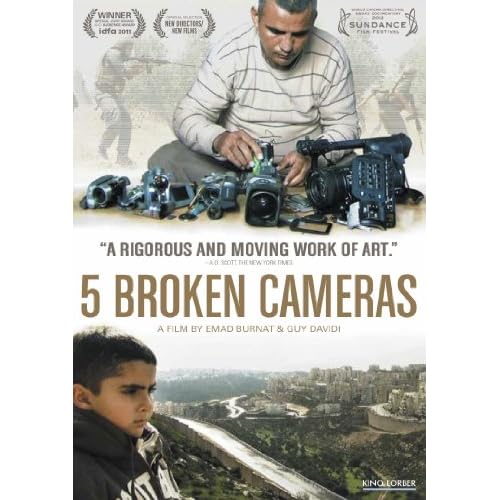
“5 Broken Cameras” Documentary Review
Labels:
five broken cameras,
movie review,
Palestine,
peter miller
Peter Miller
Ever since the latest assault by Israel on Gaza, which resulted in over 130 Palestinian deaths, and displayed the terror used by the Israeli Government in order to perpetuate the colonization of Palestine, more and more Canadians have started to question Canada’s unconditional support of Israel.
Now two documentaries critical of Israel, “5 Broken Cameras” and “The Gatekeepers” are nominated for the Academy Awards as best documentary film.
“5 Brocken Cameras” follows the story of Emad Burnat as he films his village’s resistance to a separation fence implemented by Israel that expropriated Palestinian agricultural land. The film is structured around the destruction of Burnat’s 5 cameras that occur between 2005 and 2009. At one point, Burnat’s camera saves his life when a bullet is fired into it as he is filming.
The documentary displays an inspiring, non-violent resistance from villagers in Bil’in, who received solidarity from around the world as they protested the occupation of their agricultural land. Emad Burnat and many of the villagers are unemployed and live off the land, harvesting olive trees. Therefore, losing their land brings great hardship to the people in Bil’in. The documentary shows the tremendous courage of the Palestinian protestors, who face relentless repression by Israeli solders as they take part in weekly protests and direct action in order to get their land back.
Two of Burnat’s best friends are leaders of the resistance, and particularly inspiring. Bassem Abu Rahmah who also goes by Phil in the film, is loved by all the children in the village. Burnat’s filming reveals Phil’s kind-heartedness as he plays with children and jokes with his friends. It is amazing to see Phil act as such a strong, loving spirit encouraging fellow villagers to take part in the struggle, despite all of the hardship that has occurred.
Burnat’s other close friend is Adeeb Abu Rahmah. His bravery is shown many times. At one point he hugs an olive tree, demanding the soldiers turn around and leave the land. At another time he falls purposefully on the ground while in confrontation with Israeli Soldiers during a protest. He spreads his arms out and dares the soldiers to shoot him. Soon after while still on the ground, he again begins demanding them to leave.
The inspiring film can also be hard to watch. Terrifying examples of Israel’s repression of Palestian protest are caught on Burnat’s camera. In nightly raids, Israeli soldiers arrest children in the village and take them away for the night in order to make them afraid of ever protesting again. During protests, shots are fired, and tear gas is always used. One of Burnat’s friends dies from a gunshot wound, 2 of his brothers are arrested, and at one point, Burnat’s camera captures a soldier shooting his brother at point blank in the leg, as other soldiers hold his brother down.
Burnat is targeted because his videography is documenting the gruesome repression of his villagers, and helping motivate solidarity around the world for Palestinian people. At one point he captures soldiers coming to his door in order to arrest him during a nightly raid. He is placed in house arrest at one point, and films himself during it because he has hardly anything else to do.
The film’s nomination in the Academy Awards is a positive development. Let’s hope that it’s nomination will cause more people to see it, and become witnesses to the colonization of Palestinian land by Israel. Let’s also hope that as more and more people watch this film they not only witness the repression of Palestinian people, but also are galvanized to take action against Canada’s unrelenting support of Israel’s crimes. Let’s keep our fingers crossed that that film wins at the Academy Awards and sends a message to Canadian and American people that our governments are on the wrong side of history when it comes to this conflict.
December 5, 2012
Which way forward for campus mobilizing in Ontario?
Labels:
cfs,
guelph,
ontario,
peter miller,
students,
the cannon,
YCL
Peter Miller is a student activist in Guelph, Ontario, and a former Board Member of the Guelph student union – the Central Student Association. He is active in a local grass-roots mobilization committee and currently works as a reporter for the online student newspaper, The Cannon. Peter is also the club organizer of YCL Guelph and a member of the YCL Ontario provincial committee. Rebel Youth caught up with him after a presentation about student politics to young workers and students at a meeting of the Toronto YCL.
Subscribe to:
Posts (Atom)
Popular stories
-
Rebel Youth is looking for hitchhiking stories, and also experiences with the challenges faced by women, trans people, hitchhickers facing ...
-
The real abuse taking place in Cuba is the crippling and inhumane American blockade Rob Miller The Guardian, Thursday 26 November 2009 Your ...
-
Special to RY Tyson Strandlund is the Communist Party of BC’s candidate in the upcoming election in Esquimalt-Metchosin, British Columbi...
-
A very important meeting for labour and social movements is taking place from August 21-24th in Ottawa. The People’s Social Forum (PS...
-
J. Boyden Yesterday, January 18 th , was the 24 th anniversary of the death of Renato Guttuso. Renato Guttuso (1911-1987) was a com...
-
Jay Watts In 1995, a report issued as part of the Royal Commission on Aboriginal Peoples called suicide “one of the most urgent problems ...
-
World Federation of Democratic Youth (WFDY) would like to express its deepest condolences and sympathy to all those affected by the mu...
-
Adrien Welsh On April 23rd, the French people were called to chose two out of the eleven candidates running for the Presidential e...
-
This article is part of an seven-part series of short quotes Rebel Youth is issuing about class struggle, revolution, civil-war, and par...
-
Ajit Singh A couple weeks ago, a Palestinian child was beheaded by the "moderate rebels" in Syria, created, funded, and backe...