Showing posts with label movie review. Show all posts

December 17, 2015

Review: 'Wolf of Wall Street'

Sofia Champion

About two years late to the party, I decided to finally sit down and have a go at watching Martin Scorsese’s Wolf of Wall Street (2013). The film is famous for several reasons – for example, putting Tarantino to shame with its usage of the word “fuck” – but what most lingers in the memory of viewers is the amount of time devoted in the film to the conspicuous consumption indulged in by the protagonist of the film (if you could call him that, God help him) throughout his rise and fall from glory.

February 20, 2015

Film Review: "Pride" (2014)

by Róisín Lyder

Pride is a dramatized version of a series of events that took place in England and Wales during the 1983-5 miner’s strike, which was brutally crushed by Margaret Thatcher and her Tory government as part of their efforts to break the British trade union movement. The movie opens with the song ‘Solidarity Forever’ playing overtop of historical images of the strike and the song punctuates the rest of the film. Indeed solidarity is the real theme of Pride, a film that is a light-hearted meditation on the possibilities created when members of the working class overcome what may seem like insurmountable differences.

At the 1984 gay pride march in London we are introduced to Mark Ashton as he begins taking up a collection for the striking miners. It is at this march that the group Lesbians and Gays Support the Miners (LGSM) is formed. Ashton persuades the others to join by asking: “Who hates miners? Thatcher, the police, the public and the tabloids. Sound familiar?” The young queer people see the parallels; one suggests that the usual police harassers have been absent from the gay nightclubs lately because they have been too busy harassing the miners. The group sets about fundraising and eventually finds a mining town reluctantly willing to accept the cash. Following the usual practice of thanking solidarity groups, the LGSM are invited to the small Welsh town of Onllwyn where they meet an assorted cast of characters ranging from those who effortlessly lack prejudice, to the mildly uncomfortable, to the outright and staunchly homophobic. A series of predictable yet entertaining moments of bigotry and acceptance ensue.

September 12, 2014

The Lego People Unite and Defeat Lord Business! (Review)

By Peter Miller


My crusty side tells me “The Lego Movie” is just a 100 minute long commercial. My crusty side is right. It is a very successful commercial for LEGO that grossed $468,009,556 worldwide.

But The Lego Movie isn’t just a commercial. It's also a movie leftists can enjoy. I sat in the movie theatre with friends laughing, excited, and high on life when I watched the movie in theatres. I was the opposite of crusty.

The villain in the film is “Lord Business”, played by Will Ferrell. He’s a capitalist dictator who wants total control. He doesn’t want the ruled to be creative at all.

Fox News took note that a capitalist was the villain for this film. Business host Charles Payne said the film attacked big business, and Lord Business “looks a little bit like Mitt Romney.” Fox’s Monica Crowly even said “Hollywood has long been dominated by the far left, which is very anti-capitalist.” Payne worried the film was indoctrinating young children.

January 25, 2013

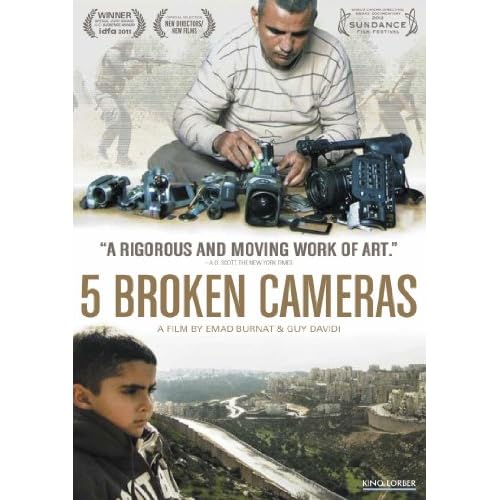
“5 Broken Cameras” Documentary Review


Peter Miller

Ever since the latest assault by Israel on Gaza, which resulted in over 130 Palestinian deaths, and displayed the terror used by the Israeli Government in order to perpetuate the colonization of Palestine, more and more Canadians have started to question Canada’s unconditional support of Israel.

Now two documentaries critical of Israel, “5 Broken Cameras” and “The Gatekeepers” are nominated for the Academy Awards as best documentary film.

“5 Brocken Cameras” follows the story of Emad Burnat as he films his village’s resistance to a separation fence implemented by Israel that expropriated Palestinian agricultural land. The film is structured around the destruction of Burnat’s 5 cameras that occur between 2005 and 2009. At one point, Burnat’s camera saves his life when a bullet is fired into it as he is filming.

The documentary displays an inspiring, non-violent resistance from villagers in Bil’in, who received solidarity from around the world as they protested the occupation of their agricultural land. Emad Burnat and many of the villagers are unemployed and live off the land, harvesting olive trees. Therefore, losing their land brings great hardship to the people in Bil’in.  The documentary shows the tremendous courage of the Palestinian protestors, who face relentless repression by Israeli solders as they take part in weekly protests and direct action in order to get their land back.

Two of Burnat’s best friends are leaders of the resistance, and particularly inspiring. Bassem Abu Rahmah who also goes by Phil in the film, is loved by all the children in the village. Burnat’s filming reveals Phil’s kind-heartedness as he plays with children and jokes with his friends. It is amazing to see Phil act as such a strong, loving spirit encouraging fellow villagers to take part in the struggle, despite all of the hardship that has occurred.

Burnat’s other close friend is Adeeb Abu Rahmah. His bravery is shown many times. At one point he hugs an olive tree, demanding the soldiers turn around and leave the land. At another time he falls purposefully on the ground while in confrontation with Israeli Soldiers during a protest. He spreads his arms out and dares the soldiers to shoot him.  Soon after while still on the ground, he again begins demanding them to leave.

The inspiring film can also be hard to watch. Terrifying examples of Israel’s repression of Palestian protest are caught on Burnat’s camera. In nightly raids, Israeli soldiers arrest children in the village and take them away for the night in order to make them afraid of ever protesting again. During protests, shots are fired, and tear gas is always used. One of Burnat’s friends dies from a gunshot wound, 2 of his brothers are arrested, and at one point, Burnat’s camera captures a soldier shooting his brother at point blank in the leg, as other soldiers hold his brother down.

Burnat is targeted because his videography is documenting the gruesome repression of his villagers, and helping motivate solidarity around the world for Palestinian people. At one point he captures soldiers coming to his door in order to arrest him during a nightly raid. He is placed in house arrest at one point, and films himself during it because he has hardly anything else to do.

The film’s nomination in the Academy Awards is a positive development. Let’s hope that it’s nomination will cause more people to see it, and become witnesses to the colonization of Palestinian land by Israel. Let’s also hope that as more and more people watch this film they not only witness the repression of Palestinian people, but also are galvanized to take action against Canada’s unrelenting support of Israel’s crimes. Let’s keep our fingers crossed that that film wins at the Academy Awards and sends a message to Canadian and American people that our governments are on the wrong side of history when it comes to this conflict.

January 10, 2013

Movie review: Skyfall

Directed by Sam Mendes, cast including Albert Finney, Ben Whishaw, Berenice Marlohe, Daniel Craig, Helen McCrory, Javier Bardem, Judi Dench, Naomie Harris, Ola Rapace, Ralph Fiennes, Rory Kinnear, 143 minutes

Review by Glen Truax

Yes, I watched Skyfall. No, I didn’t pay for it.

The Bond film series that appears to be bulletproof, a franchise that has been running strong for decades (despite the glitch caused by Timothy Dalton in the eighties), continues to draw in boatloads of money at the box office. Every trope remains in place: gambling, oceans of alcohol consumption, beautiful women who show up only to get killed 20 minutes later – the template set by Connery back in the halcyon days of the sixties.

This doesn’t mean that Skyfall is terrible. It’s slick, it’s easy to forget that the film is over two hours long. There’s very little in the way of padding; in every other Bond film, there are at least 30 minutes of flab, and that doesn’t seem to be the case here. There are few moments of wasted screen time.

It’s still a little hard to take Skyfall at face value however. It’s difficult to forget the ludicrous opening ceremonies of the London 2012 Olympics, in which Daniel Craig personally parachutes his way into the thick of things. (It’s also hard to believe that the director of 28 Days Later and Trainspotting directed the opening sequence, but that’s another matter.). Also, viewers know in their hearts that life will eventually return to a state of grace, with James and Company alive and well to do battle with “evil” in the next episode, so emotional stakes are rather low.

What’s more important is the subtext in every James Bond film, where villainy is always cast in a very zeitgeist-y way. Whatever happens to be grabbing headlines during the course of shooting the film can be expected to rear its ugly head in the finished product. In Skyfall, the bogeyman is the grim spectre of WikiLeaks, which the film takes pains to explain is entirely evil (along with Julian Assange and the Anonymous internet collective). These entities exist to blow the cover of good, hard-working spooks all over the world, seemingly without any purpose other than petty warfare with power structures.  This is completely unambiguous – ratting on agents is evil, pure and simple, with Javier Bardem stepping up to the plate as the face of pesky civilians who actually want transparency.

There are certainly worse ways to while away an afternoon. Anti-WikiLeaks undertone aside, the film delivers relentless action, with little CGI or noticeable electronic gimmickry getting in the way of a good punch up. It’s pure entertainment, not enlightenment, and the cast is uniformly strong. The viewer may want to wait until it comes to cable however – dropping 15 dollars minimum on a suspect action flick seems a little steep.

September 10, 2012

Focus on First Nation’s culture and language at Montreal First People’s Festival


Adrien Welsh

Can the Canadian state really call itself a positive example when it comes to the national question and self-determination?

Just talking about the situation of the First People, there’s a lot to say. For example, the Harper Conservative government waited until 2010 to simply consent to sign the Declaration on the Rights of Indigenous Peoples -- almost three years after it was adopted by the UN’s General Assembly.  And First People’s communities are still subject to an obsolete law, The Indian Act, which was used as a model by the South African Afrikaner’s ruling class to inspire the apartheid regime!

These facts are generally not mentioned, even in Canadian school history textbooks -- which, of course, does not help resolve the tense situation that Aboriginal People experience.  Here in Québec, these tensions reached a climax in 1990 with the "Oka Crisis," during which a lot of racist prejudices were expressed against Kanesatake Mohawks because they stood up against policies of genocide and assimilation and to defend their traditional territories.

In reaction to the racism at Oka, Innu cinematographer André Dudemaine helped create the Montreal First People’s Festival in 1991. The event has kept growing ever since. Today it acts as an important forum for the promotion and better understanding of First Nations’ culture, as well as a place where Montreal’s public can learn more about the struggles and challenges of Indigenious Peoples all around the world.

This year, the First People’s Festival celebrated its 22nd edition which took place from July 31st to August 8th. More than 50 films were screened (including documentaries, short footage and long footage, motion pictures as well as animation movies) for the modest sum of 2$ per screening!

The struggle for language

The importance of language-related films has to be underlined as one of the major themes of the movies screened. Two documentaries featuring Noam Chomsky were show as well as the first movie (an animation) in the Mohawk language ever produced. The animation explains in a funny tone why, in Iroquoian tradition, beans, corn and squash are called the «three sisters», and why they grow together.

Viewers also had a chance to hear the Pirahã language, spoken by the Hyponym indigenious people from Brazil (the language that, according to Dan Everette who deeply studied  Pirahã, presents some features contradicting Chomsky’s theory of recursivity, which until now had been considered the central paradigm of modern linguistics).

Another documentary told the story of the outstanding work achieved by Jessie Little Doe Baird since 1993. Baird helped revive the Algonquian Wampanoag language among her community, a language that was almost dead.  Both Dan Everett and Jessie Little Doe Baird attended the festival, discussing their work openly with festival goers.

The importance of language for First People is not accidental. Language is one of the main characteristics describing a nation. Language evolves along with the awakening of national consciousness, and against national and linguistic oppression. After all, the case of Wampanoag is not isolated. The same is true for Huron-Wendat or Abenakis, languages which tragically count less than ten fluent speakers right now.

Reintegrating languages in all spheres of society, including cinema or just everyday life, shows us how determined Aboriginal peoples are to rectify the national and linguistic oppression they have suffered.

Untold stories

Many of the documentaries screened this year were highly social or political in concern. In Smoke Traders, by Jeff Dorn, the question of the cigarette "business" in Mohawk territories is presented from a Native point of view. The audience comes to understand how this trade, perceived as contraband, is actually an economic backbone of life on impoverished reserves.

In her film Granito: How to Nail a Dictator Pamela Yates (winner of the Festival’s Rigoberta Menchú award) performs a flash-back on the Guatemalan civil war and especially on her well known documentary When the Mountains Tremble. According to a Spanish lawyer trying to accuse former General Efraín Rios Montt for this genocide of 20 000 Mayan people, Yates' footage may contain information that could help charge those responsible.

More than just films

While cinematography used to be the Festival's principal aim, today it has a multi-disciplinarity approach, including literature (people could attend readings by Native poets or writers), as well as music, dance and craft work.  Probably one of the most notable achievements made by the Festival team is the outdoor site at Montreal’s Place des festivals.

For a weekend the space is covered by native craftspeople, tipis, and much more. Despite being in downtown Montreal, festival goers could enjoy the smell of pine trees and goose cooked on an open fire, and talk with all the attending craftspeople giving workshops about their work, usually strongly linked to their culture. As well, every day different outstanding performances were held in the area, including Florent Vollant, an Innu from Northern Québec and an electro music show by the group A Tribe Called Red, a collaboration with Berber musicians from Morocco.
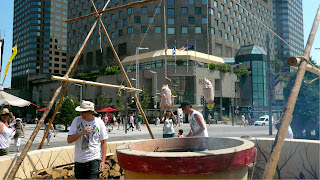
One of the highlights of the Festival is the traditional «Boréades de la danse», a dance performance by troops representing nations from all over the Americas. This year, it was followed by the Nuestro América Friendship Parade, which for the first time saw participation of delegations representing Bulgaria and the Philipines. The parade ended at Place des festivals, they were welcomed by the Mohawk drum troop Keepers of the Eastern Door before a talk in French, Spanish, English and Bulgarian about the UN’s Charter for Indigenous Rights.

A national awakening

While the First People’s Festival can be a little too folkloric, it is one of the very few large events in Québec, and Canada, prioritizing a truly broad perspective on First People’s culture and struggles all around the world. It challenges festival goers to try to understanding the problematics First People's face on a daily basis. The Festival is also a place to build bridges between different cultures, and to try counteract the many prejudices that First Nations people combat.

The fact that there is more than enough material to organize such an event - which, as said previously, keeps growing since its first edition - is a testimony of the important national awakening among Aboriginal People. This is something that progressive people should fully support. Afterall, the rights of First Peoples inseparably goes together with respecting and defending their culture and language, milestones on which any nation is built.

Adrien Welsh is a student and activist in Montreal and has worked at the First People's Festival for several years.

November 7, 2009

movie review- Capitalism: A Love Story

It came in a white cardboard courier envelope.

It was addressed to the YOUNG COMMUNIST LEAGUE. I was curious as to who would have sent it. Alliance films, Toronto, the return address stated.

I understood the moment I opened the package and several tickets fell out. They were tickets to an advanced screening of the latest Micheal Moore movie.

With a title of Capitalism: A Love Story, having a communist see the movie is a sure bet that they will like the movie and give positive reviews. Darn tooting. I liked the movie. And so sure enough here is that positive review.

You know what the movie is about by the title. Micheal Moore has his sites set on the economic crisis and the system that created it.

The movie starts with clips from many old corporate films. You hear the audio track from a school film that narrates reasons for the fall of the Roman Empire. While you hear the track you see images of examples from modern day America. It really does hit home that the Capitalist system is screwed up and ready for downfall itself. It's one of the best scenes in the movie.

Micheal Moore talks about growing up in Flint Michigan in a middle class family, living the American Dream in the Industrial Mid-West during a post-war economic boom. He asks after this scene about the current crisis, what the hell happened?

Later scenes will invoke various emotions: disbelief, heartfelt empathy, rage, and as you leave the theatre, hope.

Some topics covered are:

  • a bank internal memo that declared the U.S. a plutonomy/plutocracy.
  • an example of "dead peasant insurance"
  • Airline pilots that are in fact in poverty because of the low wages they receive.
  • mortgage foreclosures, evictions, and bottom feeder buyers.
It's not all bad news however:

  • the premiere of a long lost film showing FDR outlining a second bill of rights-including the right to health care, a job, an education, etc. It shows what could have been. How close it can be. And still able to fight for.
  • interviews of priests who say capitalism is evil.
  • a sheriff who declares a moratorium on enforcing home evictions.
  • a congresswoman, while speaking in the house of representatives, calls for people to revolt against foreclosures by squatting in their own homes.
  • American examples of worker co-operatives.
  • the sit down strike at Republic Windows.
It's like a movie adaptation of a chapter out of Marx's Capital. Or Lenin's Imperialism for that matter. As the end credits role you hear a jazzed up rendition of the Internationale. It's pretty obvious people power and socialism are implied.

You may know the movie's subject, but to see these scenes still leaves you reeling at the times we are now living.

Notice I did not say this is a documentary. Not in the objective sense anyway. Objectivity is pointless if one is to make a point of view known in dialogue or a debate. This is not the "objective" six o'clock news. But then again neither is Fox. It is a Micheal Moore film. And it argues a point. Effectively.

Moore says the Emperor has no clothes. Because the CEOs stole them.

watch the preview for yourself.

Popular stories