Showing posts with label police. Show all posts

August 17, 2013

Stop the Killings! Legislate Police to De-escalate Conflict – Put Police Under Strict Civilian Control

August 13, 2013
The killing of young Sammy Yatim with 9 police bullets followed by a Taser, is the latest in at least 20 police killings in Toronto where the first and only response was shoot to kill.

Numerous coroners’ inquests since 1994 have unanimously recommended that police be trained in, and apply de-escalation in situations such as the confrontation with Sammy Yatim on July 27th.

This could be done at the Ontario Police College, operated by the Ontario government.

But police services and governments at all levels have ignored these inquest recommendations, and as a result 20 people have died – many of them young, most suffering from mental health issues, a majority from racialized communities.

Now that the Ontario Ombudsman has announced a systemic investigation into the direction provided to police by the Ministry of Community Safety and Correctional Services for de-escalating conflict, police have reacted with open hostility, and in at least one case, threats. A Durham police officer was caught comparing the Ombudsman to Al-Qaeda on twitter, while Toronto Police Association President Mike McCormack (son of a former Toronto Police Chief) has led the way with public attacks on both the Ombudsman and the Ontario Federation of Labour which supports the investigation.

Toronto Police Chief Bill Blair meantime has tried to by-pass both the Toronto Police Service Board – a civilian agency, and the Provincial Ombudsman’s investigation, by proposing retired Justice Dennis O’Connor to review use of force practices in the Toronto Police Service. But the Police Chief has no authority to jump over the civilian board, or the Ombudsman, and surely no authority to pick his own investigator.

All of this begs the question: Are police above the law? Who are police accountable to? And who should hold them to account?

July also marked the 3rd anniversary of the largest mass arrest in Canadian history, with the arrest, detention, kettling and ‘caging’ of 1,100 demonstrators at the G20 protests in Toronto, during 3 days of martial law in the city.

The common thread is that police appear to be above the law – or outside of it; while the provincial government stands by, willfully oblivious. This is a threat to our civil and democratic rights, and to the well-being of each and all of us.

The Communist Party of Canada (Ontario) extends its sympathy to the family of Sammy Yatim, whose young life was tragically cut so short by lethal police action, and government inaction.

We call on all those concerned about police killings and violence to demand that governments and civilian boards must hold police accountable, individually and collectively, for their actions; and must regulate police services to uniformly and consistently de-escalate conflict situations

We demand the Toronto Police Services Board:

  • hold police to account for the killing of Sammy Yatim by demanding that Constable James Forcillo be charged in his death
  • demand implementation of the recommendations of the “Saving Lives: Alternatives to the Use of Lethal Force by Police” report published in 2000 by the Urban Alliance on Race Relations, which Toronto Police Services declared it would implement more than 10 years ago.
  • oppose Chief Blair’s attempt to by-pass the Toronto Police Services Board by appointing a retired judge to review police practices in Toronto

We further demand the Provincial Government:

  • introduce a consistent and standardized set of regulations governing police forces across the province, to de-escalate conflict situations using the recommendations of the “Saving Lives: Alternatives to the Use of Lethal Force by Police” Report
  • enact legislation to put police under public civilian control in every Ontario jurisdiction, and provide these bodies with the teeth to enforce real civilian controls in Ontario

Ontario Executive
Communist Party of Canada (Ontario)

February 14, 2013

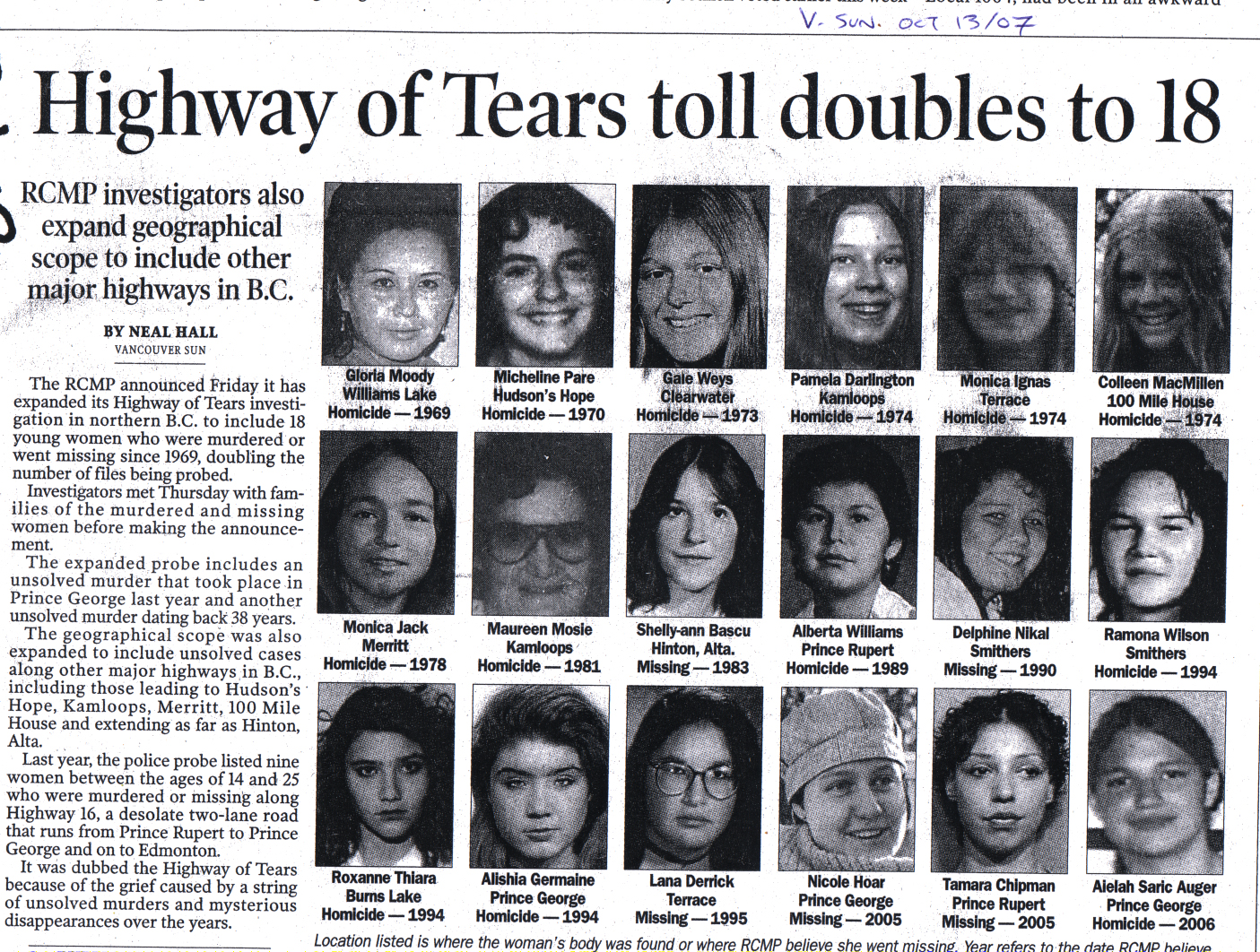
Canada: Abusive Policing, Neglect Along "Highway of Tears"

Media report on the Highway of Tears

Human Rights Watch yesterday joined calls for the establishment of a Cross-Canada inquiry into the murders and disappearances of Indigenous women and girls. Their full release is below. Rebel Youth reprints this also as part of a series of articles we are running in the lead-up to International Women's Day.

The Royal Canadian Mounted Police in northern British Columbia has failed to protect indigenous women and girls from violence, Human Rights Watch said in a report released today. Women and girls Human Rights Watch interviewed also described abusive treatment by police officers, including excessive use of force, and physical and sexual assault.

July 25, 2011

Tories escalate First Nation's surveillance

See also a summary report by PEOPLE'S VOICE NEWSPAPER

First Nations Under Surveillance
Harper Government Prepares for First Nations “Unrest"
Russell Diabo and Shiri Pasternak
June 7, 2011
THE MEDIA CO-OP


Internal documents from Indian Affairs and the RCMP show that shortly after forming government in January of 2006, Prime Minister Stephen Harper had the federal government tighten up on gathering and sharing intelligence on First Nations to anticipate and manage potential First Nation unrest across Canada.


Information obtained by Access to Information requests reveals that almost immediately upon taking power in 2006, the Department of Indian and Northern Affairs Canada (INAC) was given the lead role to spy on First Nations. The goal was to identify the First Nation leaders, participants and outside supporters of First Nation occupations and protests, and to closely monitor their actions.


To accomplish this task, INAC established a “Hot Spot Reporting System.” These weekly reports highlight all those communities across the country that engage in direct action to protect their lands and communities. They include Tobique First Nation, Tsartlip First Nation, the Algonquins of Barriere Lake, Teztan Biny (Fish Lake) First Nation, Six Nations, Grassy Narrows, Stz’uminous First Nation, the Likhts’amsiyu Clan of the Wet’suwet’en First Nation, Gitxaala First Nation, Wagmatcook First Nation, Innu of Labrador, Pikangikum First Nation, and many more. They include bands from the coast of Vancouver Island to the shores of the Atlantic Ocean.


What we see in these documents – from the hot spot reports themselves, to the intelligence-sharing between government and security forces – is a closely monitored population of First Nations, who clearly are causing a panic at the highest levels of Canadian bureaucracy and political office.


Fear of Aboriginal "Hotspots"


In 2006, INAC gave the name “hot spots” to those First Nations conflicts of “growing concern” due to “unrest” and increasing “militancy.” In a briefing presentation that INAC gave the RCMP that year, they identified certain communities as hotspots: Caledonia, Ontario (Douglas Creek Estates occupation); Belleville, Ontario (Montreal/Toronto Rail Blockade in sympathy to Caledonia); Brantford, Ontario (Grand River Conservation Authority Lands); Desoronto, Ontario (Occupation of Quarry); Grassy Narrows (Blockade of Trans Canada Hwy by environmentalists); and Maniwaki, Quebec (Blockade of Route 117).


But the “hot spot binder” prepared each week by INAC officials closely monitors any and all action taking place across the country and names dozens more communities as sources of potential unrest. A particular concern of the federal government is that these “hotspots” are unpredictable protests because they are led by what the federal government labels as “splinter groups” of “Aboriginal Extremists.” As INAC describes in the same presentation to the RCMP:


“Incidents led by splinter groups are arguably harder to manage as they exist outside negotiation processes to resolve recognized grievances with duly elected leaders. We seek to avoid giving standing to such splinter groups so as not to debase the legally recognized government. Incidents are also complicated by external groups such as Warrior Societies or non-Aboriginal counter-protest groups.”


Telling in the INAC statement above is that the identified protests are “outside of negotiation processes” with elected councils. Canada is clearly spooked by the spectre of First Nations demanding Crown recognition of Indigenous sovereignty and self-determination, as well as Aboriginal and Treaty Rights, beyond the narrow confines of Crown land claims and self-government policies. These so-called “splinter” groups also threaten the status quo by demanding their own First Nation leaders, staff and advisors to pull out of the compromising negotiations.


Also telling here is the cozy cooperative relationship between INAC and the RCMP. The INAC briefing to the RCMP is almost indistinguishable from a presentation one would expect to see from security forces, rather than from a government ministry. Contrary to their claims, Indian Affairs is not an institution of reconciliation and negotiation, but rather appears to be a management office to control the costs of Native unrest, and they are willing to work closely with law enforcement to accomplish this task.


In addition to the hotspot reporting, the Deputy Ministers of Public Safety Emergency Preparedness Canada and INAC directed that a summer operational plan be prepared in 2006 to deal with Aboriginal occupations and protests. A progress report on the operational plan reveals the blueprint for security integration on First Nations issues.


The “Standing Information Sharing Forum,” for example, is Chaired by the RCMP and includes as its members the Canadian Security Intelligence Service (CSIS), the Department of Fisheries, Government of Canada, Natural Resources Canada, Transportation Canada, and involves weekly conference calls and continuous information dissemination by INAC to its partners.


Harper is moving towards a security paradigm familiar since the War on Terror was launched in 2001. The inclusion of Transportation Canada at the Information Sharing Forum should also alert us to the commercial threat of blockades to the free trade agenda.


Aboriginal people who are defending their lands are now treated on a spectrum from criminals to terrorists. On either side, under Harper, an intensification of intelligence gathering and surveillance procedures now govern the new regime.


Haudenosaunee/Six Nations Iroquois Confederacy


It is also clear from INAC’s presentation to the RCMP that they are particularly worried about the Haudenosaunee/Six Nations Iroquois Confederacy. They mention “Warrior Societies” and an “illicit agenda,” referring at several points to concerns around smuggling. The federal government deems the tobacco/cigarette trade as “illicit” because Canada is not getting paid taxes by the Mohawks who are operating the businesses.


However, the 1995 federal Aboriginal Self-Government policy, which was developed unilaterally by the federal government, does not allow for sharing jurisdiction with First Nations for real powers over trade and commerce matters. The federal self-government policy only allows small business operations on-reserve. Historically, the federal government has used the Indian Act to control and manage on-reserve economic development so there was no real competition with surrounding non-Indian businesses and towns. On the prairies, First Nations agriculture was undermined and led to the failure of farming on-reserve because of complaints from non-Indians. This policy of non-competition is still the reality today.


The federal government is particularly concerned about the Haudenosaunee/Six Nations Iroquois Confederacy actions at Caledonia, as the INAC 2006 report describes it: “Caledonia was and remains a significant event in risk management.”


The RCMP agree. In a 2007 report to CSIS, they state: “Caledonia continues to serve as a beacon on land claims and Aboriginal rights issues across Canada.”


Canada is extremely worried about First Nations taking back lands and resources outside the scope of their one-sided land claims and self-government “negotiation processes,” as was done at Kanenhstaton/Caledonia.


In order to contain the situation, the Crown governments have dispatched hard-nosed, experienced negotiators who have presented unmovable positions from the Harper government, which is likely why there hasn’t been any negotiated resolution of the situation at Kanenhstaton/Caledonia to this date. The Crown government obviously remain worried more lands will be “occupied” by the Six Nations “extremist” “splinter groups.”


Ever since the 1990 stand-off in Kanesatake and Kahnawake, the federal government, the security and police agencies, and the Canadian army have been worried about a repeat of coordinated First Nation political actions across Canada.


The 2007 National Day Of Action


Specific information about policing First Nations was obtained in a series of Access to Information requests about the AFN National Day of Action that took place on June 29th, 2007. A 2007 RCMP brief to CSIS lays out a number of concerns regarding the National Day of Action.


First of all, the RCMP is mainly concerned about protecting their men and women in uniform, both from the perspective of First Nations confronting the police on front lines, and from the perspective of negative public sentiment for their potential handling of the event: “The often disparate and fractured nature of these events can lead the police to become the proverbial ‘meat in the sandwich’ and the subject of negative public sentiment.”


The RCMP also show concern that a lack of coordination, or “a fractured and inconsistent approach” by police forces, could “galvanize Nations throughout Canada.” Is this to say that violence instigated by police could lead to solidarity actions by First Nations across the country? Or that perceived weakness in policing could lead other First Nations to take a stand? Either way, in response, cooperation between departments, security forces, and ministries are deemed to be necessary to provide a strong united front against First Nations protest.


The RCMP also caution that, “Aboriginal and non-Aboriginal extremists often see these events as an opportunity to escalate or agitate the conflict.” By inference, we can guess that they may be referring to groups unaffiliated with the Assembly of First Nations (AFN), unwilling to negotiate under Crown policies, or prepared to engage in tactics not sanctioned by the official leadership, such as property destruction and armed conflict. Non-Aboriginal groups are also cited here as potentially threatening, giving credence to recent targeting of G20 “ringleaders” who feel their Indigenous solidarity work has made them targets of the Crown and police forces.


Cost is a serious concern to the RCMP, as well. Not only is the price tag for policing these nation-wide events “exorbitant,” and therefore can lead to rash policing decisions to use force in order to bring a quick end to conflicts, but the economic risks of blockades are themselves potentially catastrophic. As the RCMP warn, “The recent CN strike represents the extent in which a national railway blockade could effect the economy of Canada.”


The RCMP also express this curious concern: “The police role may be complicated by the conventional and sometimes political view that there is a clear distinction between policy and police operations.” Clearly, where the distinction slips between police and policy roles, the RCMP become simply Indian Agents, carrying out the colonial work of the department. Given the information disclosed here, this distinction is impossible to maintain. Where police intimidate and arrest Indigenous peoples on their own lands, there is no law on the police’s side.


There is also a considerable public relations issue at stake here. The RCMP displayed concern at the potential fall-out of a number of “perception” problems that could befall the forces:


“Perception of a two-tiered approach to enforcement can generate significant criticism and motivate non-Aboriginal activists.”


“An intense and protracted event may lead to long-standing erosion of relationships for the police and the community – they are usually always the victims.”


“Because there are limitations on what the police can negotiate and success often depends on others, the role of the police can become frustrating.”


The RCMP realize to some extent that they must choose between First Nations approval of their policing tactics and the wrath of a public convinced that blockades are criminal, rather than political acts. The police, however, contrary to their assertions, are not the victims here. They are just the dupes in a much older game of cowboys and Indians.


The above RCMP statements show that even with all of the federal financial and managerial control over First Nation Chiefs and Leaders, except, apparently for the former AFN National Chief, Phil Fontaine, the Chiefs and Leaders were still not entirely trusted by the federal government and that a large concern in 2007 was the potential for a broad national coordinated series of local and regional political actions by First Nations.


One insight emerges strongly here: most threatening of all to security and government forces is coordinated First Nations action. This can be seen clearly from the reports. At one point in the 2007 INAC to RCMP briefing, concern is expressed about a First Nations conference because, “The 2006 Numbered Treaty Conference proposed a ‘national’ movement of independent actions to express discontent.”


Their fear is palpable where they follow the trajectory of the Day of Action. It was first proposed by Chief Terrance Nelson at the Assembly of First Nations' general assembly, where the motion carried. The nation-wide event was later confirmed in a personal meeting between the RCMP Commissioner and then-National Chief Phil Fontaine. “Mr. Fontaine expressed his concern over the sense of frustration that seems to exist among First Nation leaders and the growing resolve to support a June 29th blockade,” a memo states.


The growing unrest, of course, cannot be resolved through greater coordination of security and government forces. First Nation frustration with this strategy will only continue to mount.


Crown Reward-Punishment System Divides Leaders and People


If coordinated action gets the goods, special attention must be paid to the government’s particular interest in “splinter” groups.


Under Canada’s colonial system, the struggle for Indigenous sovereignty, self-determination, Aboriginal and Treaty rights has historically been undermined by First Nations who cooperated with the Crown government turning in those First Nations who were resisting the Crown’s colonial system.


Over time this evolved into the Crown dividing First Nations into the “progressive” Indian Bands and the backward or “traditional” Indian Bands. The federal government through the various Indian Affairs departments, developed an approach to reward the “progressive” Indians and punish the “traditional” Indians.


This federal reward-punishment approach still exists, though the “Indian Agents” have been replaced by the Band Councils who now deliver Crown programs and services to their community members. The Band Councils and other First Nation organizations’ formula-funding are controlled by a system of legislation, policies, terms and conditions – all designed, controlled and managed largely by the federal Crown bureaucracy and politicians in Ottawa.


The First Nations Chiefs and Leaders who become more known and prominent are largely the individuals who have been trained and supported by federal bureaucrats. These individuals become known for their seeming ability to get federal capital dollars to build new houses, schools and other community infrastructure, or additional program dollars for enhancing Band programs.


However, the point is, none of these individuals would have gotten anywhere without federal support to advance their political careers. This is the reward system at work. For those Chiefs and Leaders who don not cooperate with the federal government, they can be ignored and/or stalled on funding requests. In some circumstances the federal government will even support “splinter groups” to take out the offending Chief or Leader. A current prominent example of this is the Algonquins of Barriere Lake in Western Quebec, but this also occurred historically at the Six Nations Grand River Territory.


The INAC and RCMP documents make it clear that while the Canadian State Security Apparatus is concerned about “splinter groups,” they also are somewhat concerned about Chiefs and Leaders from Indian Act Band Councils and First Nation establishment organizations like AFN and their Provincial/Territorial Organizations becoming Aboriginal “extremists.”


What the INAC and RCMP briefings show is that there needs to be unity on the ground with coordinated political actions between First Nations Peoples in order to protect, defend and advance First Nation pre-existing sovereignty, and First Nation Aboriginal and Treaty rights to lands and resources. Divide and conquer tactics can only be met with new strategies of alliance-building, and by bringing the leadership back down to the land.

June 26, 2010

The Knocks in the Night: beaten in beds - then dragged off as political prisoners


press release by Toronto Community Mobilization Network

June 26, 2010

For Immediate Release:

Press Release At least 4 community organizers currently being held as
political prisoners as G20 related police repression continues to
increase.

As the G20 meetings happen behind fortified fences, numerous long-time
community organizers working on issues ranging from migrant justice to
climate change to indigenous sovereignty are being targeted and arrested
by police.

At approximately 4:45 a.m., June 26, about 20 police officers raided a
Toronto home. They entered the house without consent through the back
door, aggressively dragging unclothed people from their beds, kicking
others who were asleep on the floor.

Police demanded that everyone provide names and identification. A number
of people repeatedly requested to view the warrant before complying with
police demands.

“I requested a warrant at least five times from the cop who refused to
show me his badge number, to which he said they have every legal right to
do what they’re doing and they didn’t have to show us anything,” said
Tammy Kovich, a resident of the raided house.

Police forcibly detained and cuffed a number of people, and refused to
allow those in the house to call for legal advice. Without showing
warrants, asking consent, or giving notice, police did an illegal cursory
search of some of the people on the premises as well as the house itself.

“I went out the front door to get a signal so that I could call for legal
advice, and a cop grabbed me and pushed me back towards the house. A
minute later, I was on the phone with the G20 legal people, and he grabbed
my phone away from me and smashed it onto the front porch,” stated another
resident, Renee Henderson.

One arrest was made at this house: an organizer of G20 Childcare as well
as other community projects. A warrant was not shown for their arrest.
This individual was also detained and harassed by police earlier this week
while walking on in Toronto, and was searched without credible legal
rationale.

Across town, the door to another house was kicked in and three long time
community organizers Leah Henderson, Alex Hundert and Mandy Hiscocks were
placed under arrest. Warrants have also been issued for the arrest of
other community organizers. These politically motivated raids and arrests
of community members are just some of the tactics the police have been
using to intimidate and silence those who have voiced their concern about
the illegitimate and undemocratic institutions of the G8/G20.

-30-

November 12, 2009

from People's Voice: WHO ARE THE HATEMONGERS IN CALGARY?


(The following article is from the November 16-30, 2009, issue of People's Voice, Canada's leading communist newspaper. Articles can be reprinted free if the source is credited. Subscription rates in Canada: $30/year, or $15 low income rate; for U.S. readers - $45 US per year; other overseas readers - $45 US or $50 CDN per year. Send to: People's Voice, c/o PV Business Manager, 133 Herkimer St., Unit 502, Hamilton, ON, L8P 2H3.)

A recent report for the Southern Poverty Law Centre sheds important light on the hate group which is spreading its violent message in southern Alberta. The Intelligence Report by Sonia Scherr begins with a brief account of a clash last March 21, the International Day for the Elimination of Racism:

"Wielding `White Pride Worldwide' flags and wearing black combat boots, about 40 members of the Aryan Guard and their supporters strode through the heart of Calgary... to broadcast their message of hate at City Hall. But they never got there. Instead, they encountered several hundred anti-racist protesters, some of whom threw rocks, water bottles and even cans of vegetables at the group as traffic came to a halt and police called for backup. Police eventually herded the neo-Nazis onto a bus that returned them to their vehicles on Calgary's outskirts. Though no serious injuries were reported, the melee snared headlines across Canada and prompted Aryan Guard spokesman Kyle McKee - who has `Kill Jews' tattooed on his shins - to declare victory."

The Aryan Guard have spread fear and anger among Calgary's 250,000 immigrant and minority populations.

"Essentially a racist gang," writes Scherr, "the Aryan Guard is the most public hate group to appear in Calgary - which, like much of western Canada, has a history of such activity going back to the Klan of the 1920s - in the past two decades. These Nazi look-alikes have clashed with counter-protesters at rallies in the city's downtown, handed out white-power music CDs to teenagers in an attempt to bolster their membership, and perpetrated attacks on minorities despite espousing non-violence."

The Aryan Guard was founded in late 2006 with help from two former teachers: Paul Fromm of the Canadian Association for Free Expression, who lost his teaching certificate because of his white supremacist activities, and National Socialist Party of Canada leader Terry Tremaine, a former part-time university lecturer who in 2007 was fined $4,000 by the Canadian Human Rights Tribunal because of his racist and anti-Semitic Internet postings.

"They were the main catalysts behind bringing these young fellows here," said Constable Lynn MacDonald, hate crimes coordinator for the Calgary Police Service.

MacDonald says the Aryan Guard now has roughly 20 full-fledged members, and another 20 to 30 supporters, including those belonging to the Valkyrian Legion, or woman's wing of the Aryan Guard, which consists mostly of the girlfriends of male members. The majority are in their early 20s.

The group began to draw attention in 2007, when members began distributing hate literature in Calgary and Lethbridge.

In August 2007, the Aryan Guard began disrupting anti-racism rallies. Two months later, they rallied outside City Hall to denounce Muslim women who wear burkas while voting. Since then, they have conducted sporadic demonstrations, including "White Pride Day" rallies held on the International Day for the Elimination of Racism.

As Scherr notes, "the Aryan Guard has found itself vastly outnumbered by anti-racist protesters, including members of Anti-Racist Action Calgary." While police say both Aryan Guard members and counter-protesters have been arrested for assaults, ARA spokesperson Jason Devine says no member has been charged in connection with any incident at an Aryan Guard rally.

Meanwhile, the Calgary Police Service admits that Aryan Guard members have been linked to several assaults, including one against a cab driver from North Africa.

Writing about this attack on the neo-Nazi Stormfront website, McKee boasted about getting the case dismissed: "The reason being was that they couldn't make a positive ID because apparently everyone there was all dressed in combat boots with white laces [and] black flight jackets and all had shaved heads. So let this be a lesson to anyone who wonders why on earth all us skinheads dress so similarly. [T]his is another great reason. lol [laughing out loud]".

In July 2008, a 17-year-old Aryan Guard member who had been making anti-Asian remarks followed a young Japanese woman as she left a bar and kicked her in the back of the head with steel-toed boots. He was wearing red laces - a skinhead symbol indicating he'd spilled blood for the movement.

ARA members believe that the Aryan Guard is responsible for the violent attacks against Jason and Bonnie Devine's home. Aryan Guard members have taunted the couple about the firebomb attack. "Is it hot in there?" they have asked during protests, according to Devine. "How are the kids? How's the house?"

And in yet another ugly case, four Aryan Guard members were charged with disturbing the peace after vandalizing a shopping mall and using racial slurs on a First Nations reserve near Calgary.

Scherr reports that two of the group's most prominent members, McKee and Dallas Price, faced assault and weapons charges in connection with a September 2006 confrontation in which one victim was hit with a wooden club and another was stabbed with a knife. Guard member Robert Reitmeier was charged with attempted murder in connection with a November 2006 assault on a man who suffered skull and facial fractures. Member Bill Noble was convicted in 2008 of posting hate material on the Internet that primarily targeted non-whites, Jews and gays. A judge sentenced him to four months in jail and imposed limits on his computer use for three years, though Noble continues to post frequently on Stormfront.

COMMUNIST PARTY CONDEMNS CALGARY POLICE INACTION

The failure by the Calgary Police Service to seriously investigate neo-Nazi violence against anti-racist activists is a reckless and shocking dereliction of duty which endangers lives. On October 3, the family home of Jason and Bonnie Devine and their four young children was the target of yet another such attack, in which windows were smashed and Neo-nazi graffiti was spray-painted on the front door: a swastika and "C-18", an obvious reference to the violent British fascist organization known as "Combat 18." In February 2009, the house was firebombed with molotov cocktails.

Fortunately, nobody was hurt in either incident, but the long history of email and telephone threats against the Devine family is ample warning that they remain in serious danger. The most likely suspects are in plain view - the Aryan Guard group which has been actively promoting racism and neo-Nazi ideology in Calgary for several years. Jason and Bonnie Devine have been in the forefront of community activists calling attention to the Aryan Guard. Both have campaigned as candidates for the Communist Party, and their courage has clearly angered the local fascists.

Despite its motto, "To maximize public safety in Calgary with vigilance, courage, and pride," the Calgary Police Service has ignored repeated public appeals to take action. Aryan Guard members are suspects in various other crimes, including the beatings of a homeless man, a gay community member, and a cab driver from North Africa, but no arrests have resulted. In the view of the Communist Party of Canada, this pattern has gone beyond neglect, into the territory of tacit encouragement of criminal activity. If serious injury or death results from further attacks, innocent blood will not only be on the hands of the perpetrators, but also on the hands of the Calgary Police Service which hides behind the feeble claim that "both sides are equally responsible" and that the Aryan Guard is simply "exercising its right to free speech."

The time has come for the City of Calgary and the Alberta provincial government to intervene in this crisis situation. Strong political leadership is required to replace Chief Rick Hanson with a police chief who is willing and capable of ensuring that swift action is taken to bring an end to these racist attacks. In the meantime, we extend our ongoing full solidarity to anti-racist activists and all democratic-minded citizens of Calgary who are standing up to the violent neo-Nazis in their community.

It should be noted that a redwatch* style website targeting communists, anarchists and jews in Canada has a link to the recent violent attacks.

* [from wikipedia]...Redwatch is a British neo-Nazi website that publishes photographs and personal information of alleged left-wing and anti-fascist activists. There also used to be a British magazine of the same name, and with similar subject matter. The website's slogan is "Remember places, traitors' faces, they'll all pay for their crimes", a quote from neo-Nazi musician Ian Stuart Donaldson.

The information gathered by Redwatch is indexed by cities or regions. Many of the people listed are members of the Anti-Nazi League or other anti-racist or left-wing groups...

January 9, 2009

police: crime containment crew

PART ONE: Winnipeg, 1968

This commentary is the first of a series on Winnipeg's (in)justice system and is posted as an exclusive to the Rebel Youth blog. Part 2 will quote some testimonies from the Manitoba Human Rights Commission report and focus on the issues of police and crime in Winnipeg's inner city. It will be printed in the next issue of Rebel Youth magazine, you'll have to get yourself a copy to read it. But to begin, part 1 goes back over 40 years ago, starting with a reprint from the People's Voice predecessor newspaper, Canadian Tribune from the spring of 1968.
---
WHO SAYS “THE LAW IS AN ASS” ?

By Tom Morris

When Charles Dickens said, “the law is an ass”, he could have been standing on the windy corner of Winnipeg’s Portage and Main streets, or reading the morning paper’s account of police strong-arming another citizen in Toronto.
George Paulowich arrived in Winnipeg from Toronto on Jan 11, checked into a hotel and discovered his wallet had been stolen. Innocently believing that the thing to do was call the police, Mr. Paulowich did just that. What followed was a piece of impressive public relations work by the Winnipeg Police Department.
Detectives arrived at the hotel and arrested George Paulowich. He was jailed for 30 days pending completion of investigation and preliminary hearing of two men charged with the robbery. When finally released, he was told not to leave town and to report each Friday until a trial date had been fixed- which turned out to be on April 26-105 days after his arrest.
Judge C. I. Keith, in dismissing the robbery charge against the two men, condemned the treatment of Paulowich and suggested the crown pay him a witness fee for the time spent in jail as well as for attendance at the trial. Winnipeg director of prosecution, A. A. Sarchuk, has called for reports of the case. Great move, Mr. Director of Prosecutions, but where in hell have you been for 105 days?

Mr. Paulowich, having lived in Toronto, might think that his experience is simply a dose of Western hospitality. He could exchange notes with Mr. Kenneth Bruton, who is trying to get his house fixed up following a visit by Toronto’s finest.
The damage was caused when police arrived to arrest Mr. Bruton’s brother-in-law April 29. To apprehend the slightly built 17-year-old youth, police ripped off a door, tore a wooden fireplace from the wall, twisted the suspect’s arms and pushed Mrs. Bruton against a wall. Now there seems to a question about who is going to put the house back together. “They told us to get it fixed and they’d pay for it,” said Mr. Bruton. “I guess that is an admission of liability,” Police Chief James Mackey, with an eye on the taxpayer’s dollar, says. “It doesn’t mean we’ll pay for it at all. It isn’t any kind of an admission.”
By all means, nothing should be admitted. When a 15-year-old boy is shot in the leg by police is there any admission? It was “an accident.” This police officer, in the performance of his duty, don’t you understand, slipped, fell, found his holstered revolver in his hand which went off and shot the boy.
The sad chronology could go on and on. For every case reported, there are hundreds of cases where the citizen is so damn happy just to get home that he doesn’t say a word. “I don’t want any trouble,” says he.
Countless men and women file into Canadian courtrooms, only to have their case remanded over and over again, and are sent back to the cells to await their time.-Most of them young, none of them rich.
Canadian police chiefs raised a storm last year by asking for greater powers. Some of them called for a return to flogging, arrest without charges, wiretapping, the right to enter homes without a warrant and a “detention law” which would take care of ‘rabble-rousers’ and ‘trouble-makers.’ The hue and cry raised by the community prevented such laws and a return to the Middle Ages.
And so, Mr. Paulowich, there isn’t any law under which you can be arrested without charges. Maybe it was all a bad dream. In any case, you should feel good because there isn’t a flogging law either. Had there been, you might have “confessed” stealing your own wallet.
---

As much as we think we have progressed from 1968, we have fallen more and more behind as you'll find in part 2. When the Federal Conservatives made law and order an issue in the election in 2008, it would do good to look at the above article with that in mind. Whose Law and Whose Order? Hindsight is 20/20 but we don't have 40 years to fix an issue that affects youth today. Police continue to screw up: in February 2000 Corinne McKeowen and Doreen Leclair were stabbed to death while the 911 operator listened to their fifth call for help. William John Dunlop murdered them in their Winnipeg home. The Fort Garry Women's Center published a study report showing police response times are less for poor callers and in poor neighbourhoods.

Beyond incompetence, outright malice and cold blooded murder occur. The Saskatoon "Moonlight tours" where police drove homeless men to the city limits to freeze to death. Eventually, one made it back to uncover the crimes. Trigger happy police shootings and taser deaths (almost on par with actual non-police murders in Winnipeg briefly this past summer), in parallel with poor response times show a pattern of two class justice. There are 40 years between the Newark Riots of 1967 and the Riots in Paris in 2007. Riots occurred in Montreal during the summer of 2008. Now Greece. All followed from acts of police brutality.

There is a pattern. Social condition. And racism.

Popular stories