Showing posts with label diversity of tactics. Show all posts

October 21, 2011

CP of Greece, Article of the International Relations Section of the CC of the KKE in relation to the statements of the international Media on the murderous attack on the large demonstration of PAME

The people’s-labour movement has the strength to face the provocateur mechanisms of the bourgeois system

http://inter.kke.gr , mailto: cpg@int.kke.gr

The murderous attack unleashed by anarcho-fascist groups against the enormous rally which was organized by the class-oriented trade unions, rallied in the All-workers’ Militant Front (PAME) in opposition to the new anti-people measures of the government, made the news on a global scale. Nevertheless, there were many attempts by the bourgeois media to distort the facts.
Indeed in this effort they use as arguments fabrications and lie drawn from the opportunist forces and the Trotskyist websites.
As is well-known on the 19-20 October hundreds of thousands of workers participated in the big strike mobilisation, in which the class-oriented trade unions of PAME played the leading role, together with other forces of the social alliance (MAS,PASEVE,PASY,OGE). The success of the 1st day of the strike and the massive demonstration in the central square of Athens, outside Parliament, where PAME was predominant, sent a strong message to the government, the EU, capital: No sacrifice for the plutocracy! The workers are not responsible for the capitalist crisis! The fight for goals of struggle which are connected to the contemporary needs, in rupture with the capitalist system, the concentration of forces for the people’s power and economy!
The fake-incidents, the “hide and seek” with the riot police, the damage to shops and buildings, which small provocateur groups organized, could not extinguish the message of the huge popular demonstration of PAME. Certain international media, in an attempt to mislead the workers in their countries spoke of an attack and attempt of the demonstrators to occupy the parliament. Something which of course had no relation to reality.
On the 2nd day the forces of capital sought to suppress the strong political message of the workers. PAME had announced the encirclement of the Parliament for the time when the anti-worker measures were to be discussed and voted on by article with a roll call vote, at the request of the KKE. For this reason they mobilised and unleashed in a planned way organized groups with specific instructions and anarcho-fascists who with Molotov cocktails, stones, and other weapons which are used by the police, such as teargas and stun grenades, attempted to disperse the majestic rally of the workers and people in Syntagma and especially the part where PAME was concentrated. The assault took place on the edges of the demonstration and had as a result the injury of 80 PAME demonstrators and the death of the construction worker-trade unionist of PAME, Dimitris Kotzaridis. Nevertheless, their goal, which was to disperse the rally of PAME, to intimidate and suppress the working class and popular torrent for counterattack which came onto the streets for the 48 hr general strike, failed! The forces of the protection of the rally successfully repelled the murderous assault! 
alt
(Picture. The hooded ones, the mechanisms set up by the bourgeois system against the labour-popular movement, attempted to disperse this enormous demonstration) 
alt
(Picture: the deceased Dimitris Kotzaridis, construction worker, trade unionist of PAME. The suffocating atmosphere which was caused by the use of smoke bombs and fire extinguishers by the provocateurs against demonstrators had as a result the tragic death of Dimitris Kotzaridis. The demonstrator felt dizzy and collapsed. His comrades took hold of him and carried out first aid procedures and moved him out of Syntagma Square. “The suffocation from the teargas could have led to respiratory failure and constitute a cause of death.” Ilias Sioras, cardiologist and President of the union of workers in “Evanggelismos” hospital denounced to the media. “the final findings will be made by the investigation of the coroners.” Concluded Ilias Sioras.) 
alt
(Picture: The attack of the provocateurs against the protection teams of PAME) 
alt
(Picture: PAME demonstrator injured by stones. At least 80 demonstrators were injured, mainly by stones and broken marble which the provocateurs threw into the crowd of the demonstrators) 
alt
(Picture: Protection team of PAME repelled the assault of the provocateur mechanisms) 
alt
(Picture: the head of the demonstration of PAME. Solid protection everywhere) 
alt
(Picture: The image of PAME’s demonstration after the murderous attack of the provocateurs) 
alt
(Picture. The forces of PAME have withdrawn from Syntagma to Omonoia. A picture the moment the news of the death of the trade unionist of PAME, when a minute’s silence was observed)
Certain international bourgeois media sought to present the aforementioned incidents as a conflict between two ideological-political currents inside the people’s movement. This approach has nothing to do with reality since in Greece it is well-known that these groups which appear under the cover of the black colour, the hood, “anarchism” are organized and staffed by the forces of the bourgeois system and include everything from organized hooligans of football teams, to hired thugs from night clubs, members of neo-Nazi organizations and forces of security services. There is a lot of evidence from the recent past (photographs and videos) that show the relations of these groups with the mechanisms of the system. They are murderous groups which serve the bourgeois system and have no relation with the people’s movement. They are unleashed by the system itself in order to organize provocations (like the burning of the bank on 5/5/2010 where three employees died) and provide a pretext to the security forces so as to use the equipment they possess in order to disperse the mass people’s demonstrations.
Even more dangerous and dirty is the slander that PAME protected the parliament from the protesters, an allegation reproduced by bourgeois and opportunist mass media - domestic and international ones. This dirty allegation seeks to portrait PAME as a support of the bourgeois system and the KKE as a “systemic force”, as a party of the bourgeois system. It emanates from those forces which praise the “spontaneous” movement and present it in opposition to the organized class-oriented workers’ movement. It is they who misleadingly identify the revolution and the people’s uprising with the burning of rubbish bins and the breaking of shop windows and not with the organized political struggle of the workers’ movement which has roots in the factories, in workplaces, in people’s neighbourhoods and will dispute the bourgeois power leading to a conflict with the imperialist organizations of NATO and the EU, to the establishment of people’s power. The KKE and PAME do not need any “credentials” for their militancy which the bourgeois media hand over to the hooded provocateurs, to the anarcho-fascist groups. Our history and activity has the appreciation of hundred of thousands of working people who take part in the people’s demonstrations, of millions of workers who appreciate the consistent, unwavering struggle of our party, the firmness of its goals for the overthrow of the capitalist barbarity and the militancy of its members and cadre in the places where they work and live. This slander that PAME allegedly “protected the bourgeois parliament from the rebels” has nothing to do with reality and moreover it seeks to conceal the truth, namely the fact that PAME managed, thanks to its strong vigilance, to defend the demonstration and prevent the plans for its dissolution.
As we say in Greece “lies have short legs”… On Friday morning hundreds of cadre and members of the KKE, numerous forces of the class-oriented movement visited many workplaces informing the working people and preparing new mobilizations. This mass political work among the people which will continue on a daily basis constitutes a decisive response to every kind of anarcho-fascist, to the police informers, to the bourgeois state, to the government and the parties of capital, the opportunist formations.
21/10/2011
Last Updated on Friday, 21 October 2011 17:42 

August 9, 2011

WFDY on riots in Britian


WFDY condemns the reckless violence and widespread criminality of recent nights, however we understand it as a direct product of the capitalist system and of the resulting dangerous lack of stability and rights for the youth of today, accompanied by disenfranchisement and exacerbated by unprecedented levels of alienation.

It is clear that the anger of the youth is derived from a number of factors including police brutality, the massive reduction in public spending on youth and other services, and a general frustration at a future with little prospects.

Furthermore, WFDY notes that the cuts in public spending have had a disproportionate impacton both the youth and ethnic minority groups. The first and main responsible for the wave of violence that now is taking place is the system under which the British people live, responsible for massive unemployment, huge rates of precarity, extremely expensiveaccess to the higher levels of education and almost impossible access to proper housing, mainly for the young generations.

It is also important to remind that it is this system that engages the British youth in wars just to satisfy the greed for profit of the big national and international monopolies. We admit these concerns along with our member organizations in Britain, especially with comrades of YCL Britain, demanding to address the root causes of unrest and violence and by supporting the genuine concernsof young people in the street and their frustration while outright rejecting their way of vandalizing, looting andcreating chaos without certain goal of socio-economic transformation.

In this extremely sensitive moment, WFDY calls upon all the young people in Britain to organize themselves and find the best ways to revolutionary transform their country, which will surely be through the overthrown of this dominant order and not through the destruction of public or private goods, for a Britain and a world of peace, solidarity and social transformation.

December 6, 2010

Making the case for Mass Action

By Johan Boyden and Drew Garvie
Rebel Youth, Issue 10, Summer-Fall 2010

In the context of the continuing debate about strategy and tactics in the Canadian youth and student movement, activists and organizations need to ask “what kind of youth movement are we building?"

We have now had several months to reflect on the events that unfolded when the G20 occupied Toronto, and also last winter’s 2010 Olympic demos in Vancouver. These events continue to be discussed within the youth and student movement, across English-speaking Canada and Quebec. The debate occurs at a time when there is a widespread critique of diversity of tactics post-G20.

Many are asking: what are other more effective, united and militant alternatives?

G20 Redux by Garvie


Rebel Youth Magazine
Issue 10, Summer-Fall 2010

For the thousands that participated in the marches, the victims of arrest, and the many at home, the G20 police riot exposed the brutal and dirty methods of Capital. It demonstrated the shallowness and ugly underbelly of bourgeois “democracy.” As the Canadian Civil Liberties Association has said, the police response was “unprecedented, disproportionate and, [even] unconstitutional.”

Why were such brutal means used? The answer can only be intimidation. The ruling class thought they could get away with a more aggressive approach.

But whether Harper and his thugs in blue “won-out” that weekend remains to be seen. Many people still face charges. A movement united around a call for an inquiry is still battling it out with the police’s PR machine. And if events leading up to the G8 and G20 demonstrations are an indicator, there is reason to believe that Harper’s intimidation and attempt at criminalizing dissent will not have its desired effects.

Drew Garvie, YCL Ontario organizer, identifies six-points

1. Stay home

Months prior to the G20 visit, the corporate media and the “Integrated Security Unit” (headed up by the RCMP) tried to desperately intimidate potential protesters. This included tough talk about the “fence”, “protest zones”, new weapons such as the sound cannon, warnings that parents should keep their kids at home, and continual talk about the largest police/military presence assembled on Canadian soil. The security budget scandalized the public when it was announced to be over $1 billion dollars (approx. 7 times that of Pittsburgh’s G20 security costs last year).

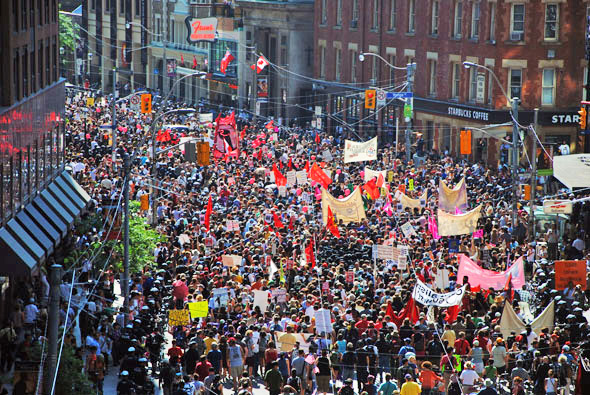
The message was clear: “if you don’t want trouble, stay home.” Despite the scare-tactics, almost 40 000 people turned up to protest against the G20. These were the biggest protests in Toronto in many years, and importantly, the largest in Ontario since the economic crisis.

2. “People First”

The week was characterized by lively, creative and democratic resistance. Marches raised many demands: Indigenous sovereignty, climate justice, (im)migrant justice, LGBITQ rights, women’s rights, labour movement struggles like anti-scab legislation, and student’s issues such as accessible education. For example, the Canadian Federation of Students outreached on an international level to the Asian, All-African, Latin American and Caribbean, General Union of Arab, European and United States’ Students organizations, who together issued a joint statement condemning the G20.

The main march took place under the broad “people first” slogan against the Harper Conservative’s pro-corporate attack of working families during the economic crisis. The crowds on the streets also showed that the youth and students’ movement overwhelmingly chose the people’s side of the barricades. The demonstrations became a flashpoint, highlighting the glaring problems of corporate power and capitalism.
Most demonstrators were able to participate from start to finish united, without any incident or attacks. This democratic right and necessity to protest should have been enjoyed by all demonstrators. However in the last few days peaceful protesters as well as journalists, legal observers, and by-standers who had no involvement in the protests, were subjected to a police riot.

3. Saving capitalism

These events happened outside “the fence.” But without drawing the connection to what was happening inside the “G20 perimeter” we are left with an incomplete picture.
This set of G summits was particularly important because global capitalism continues to be mired in a profound economic and structural crisis, notwithstanding the soothing media reports that the ‘worst is behind us’ and that recovery is well under way.

In reality, there is no recovery for most working people. Unemployment and job insecurity remain high, with over 1.5 million out of work. Soon EI benefits will be running out for hundreds of thousands of these unemployed workers. Nor is there any recovery for young workers suffering 14.6% unemployment, for women still earning unequal pay, for students trying to finish their education, for Aboriginal peoples facing systemic joblessness and grinding poverty, for new immigrants and their families trying to build a better life, or for pensioners and others on fixed income.

So what kind of recovery is this? It’s a recovery for the profits of the biggest banks and corporations, and for those who own and control them. Saving capitalism and restoring profit margins were the main concerns of the ‘leaders’, rather than solving the burning problems afflicting the world today.

At the Summit itself, Harper and the rest of the world’s leading criminals agreed to halve deficits by 2013. This translates into drastically increasing the burden on working people globally and locally and gutting public services. (Solutions such as corporate profits being taxed more equitably or cutting military spending on wars and occupations are other options, but they are not in the capitalist’s playbook.)

4. Largest mass arrests in Canadian history

By the end of the weekend, over one thousand and ninety people – mainly youths – had been jailed: the largest mass arrest in Canadian history. Protesters, journalists and passer-by’s were subject to illegal searches, illegal detention, police brutality, harassment, sexual assaults, and detention in cells nick-named “Guantanamo North” where civil liberties were systematically violated and detainees had little access to food and water (see our first-hand account in this issue).

“For the first time ever visiting Toronto I felt unsafe speaking French on the street” one young Montreal activists told RY about police targeting Québécois youth and cars with Québec licence plates. Another activist we spoke to said they met people in the cells “scooped right off the street, randomly, who didn’t even know what ‘G20’ meant.”

And in this ominous direction lies a threat – fascism: the open, terrorist dictatorship of the most reactionary sections of the ruling class, no longer cloaked with limited electoral rights and constitutional protections.

5. The role corporate media

This message was not reinforced by the corporate media, however, which largely ignored the massive peaceful protests. Instead, the news decided to focus on the small-scale property destruction that took place at the G20.

It is mistaken to think that the people’s movement scored a significant victory by attacking the attention of the big business media, which reported on the burning police cars because of the magnitude of that event. Rather, they chose to intensively cover that issue, just as they ignore other protests. To put things in perspective, the amount of G20 “property damage” was comparable to the sixteen police cruisers and numerous buildings damaged in Montreal’s 2008 hockey riot when the Habs eliminated the Bruins. (Less than twenty people were arrested.)

6. The real criminals

However, the main argument used to justify the police riot continues to be that a “Black Bloc” riot precipitated it. “Criminal elements were mixed in with the peaceful protestors.” Five police cars were allowed to burn for hours in front of TV crews. After the G20 the newspapers published front-page photos of the police’s “G20 most wanted list” featuring young people. There is overwhelming evidence, however, that police allowed a small group of protesters a free-hand in engaging in petty property destruction.

As journalist and film director Paul Jay said: “At some point over the weekend the Operational Commander of the Integrated Security Unit watched the action unfold and made two fateful decisions [...] not to immediately move some of the thousands of available police officers into position to stop a hundred or so people from breaking store windows [... and then] to order the arrests of around nine hundred peaceful protestors.” (see “Who Commanded the G20 Commander?” on YouTube).

The police ‘riot’ and the mass arrests did not come about spontaneously, or result from the overzealous behaviour of individual officers. They were carefully worked out well in advance, provided with legal ‘cover’ by Ontario premier Dalton McGinty’s secretive Order-in-Council measure, and vetted by the Office of Prime Minister Stephen Harper. All three – Harper, McGinty and Toronto Police Chief Blair – are culpable for this ‘reign of terror’ on the streets of Toronto.

June 2, 2009

What way forward for the student movement now?


J. Boyden
From Peoples Voice newspaper

One of the contentious resolutions at last month’s Canadian Federation of Students general meeting condemned the recent massacre of the Tamil people in Sri Lanka. After this debate, what is new and significant in the Canadian student movement?

Of course, context is needed. The CFS is the most numerically significant component of the Canadian student movement, although it excludes the two militant student organizations in Quebec with tens of thousands of members. It also excludes the Canadian Alliance of Student Associations (CASA), deliberately engineered as right-wing split over a decade ago.

The CFS is, potentially, the ‘tip of the spear’ of the student fight back in English-speaking Canada. The CFS meeting therefore had some significance, not least with today’s Harper Tory government attacking public funding public post-secondary education.

Popular stories