Showing posts with label classe. Show all posts

January 2, 2013

Call-out to the second-annual YCL-LJC student conference


Saturday, January 12, 2013
Open only to members of the YCL-LJC or by invitation

1. We believe in the principle that the student movement is one of the most radical, dynamic and progressive forces for change in society and the future.

2. The uprisings of students in the Middle East and North Africa, the brave united battles of the Chilean students, and the massive struggle in Quebec last winter and spring have shown the validity of the optimistic claim that the young people, united with the working class, are continuously an important catalytic force for social transformation, overthrow and revolution.

3. At the same time, new, contradictory and even confusing developments are taking place internationally and locally. We believe that the student movements in Quebec and English-speaking Canada are at a difficult but significant and even historic juncture.  At stake is our basic access to education.

November 13, 2012

Quebec news and updates


Labour opposes Harper’s EI reforms
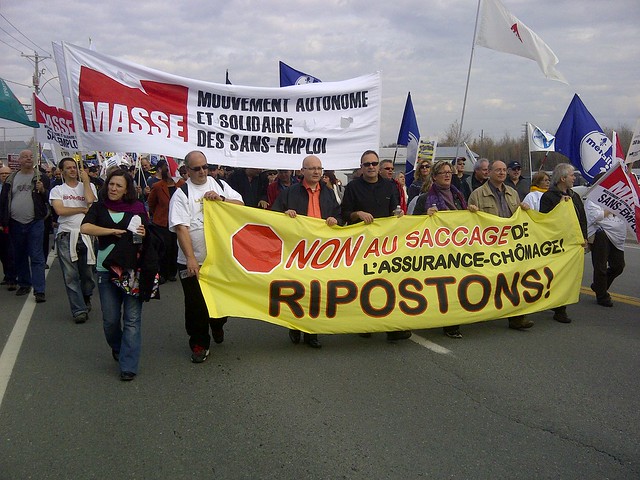
The major trade union centrals of Quebec and the MASSE coalition, a group formed in solidarity with the unemployed, held a series of mass rallies with the biggest one in the town of Thetford Mines in late October. Over 3,000 people from about twelve towns and cities from across Quebec marched to the offices of Christian Paradis, MP for Mégantic-L'Érable (and Stephen Harper's Quebec lieutenant).  Coordinator of MASSE Marie-Hélène Arruda told the rally that "The Conservatives, with their ideology [...] will define by regulation what is a decent job, that is to say a position that an unemployed person cannot refuse for fear of losing their benefits.”

Student legal struggle continues
Drawing attention to the hundreds of students still facing charges from the Quebec student uprising last fall, former spokesperson of the CLASSE, Gabriel Nadeau-Dubois, was convicted November 1 of contempt of court because he publicly criticized a court injunction ordering picket-lines to disperse during the student strike. The judge (who has been linked as a donor to the former Charest Liberal government) based his ruling on a 1972 court decision which tried to smash the Common Front of public sector unions. A support campaign has been launched at www.appelatous.org to fundraise for an appeal.  Meanwhile, the PQ government have announced an education summit to take place in mid-February, with preparatory meetings and consultations starting at the end of November, about the question of post-secondary education funding.

Corruption inquiry exposes P3s
More revelations have been coming forward at the Charbonneau Commission, especially the testimony of ex-construction boss Lino Zambito which has implicated the Liberal party, as well as their political machines on the municipal level and construction firms, into a web of graft with the Mafia.  Media headlines have focused on Montreal mayor Gérald Tremblay’s resignation, the implosion of his Union Montreal party, and now the Mayor of Laval quitting. But the Montreal Gazette has also said that Zambito reported “Public-private partnerships, the sort that are blooming in Quebec to yield hospitals, roads and cultural facilities, are fertile ground for corruption and collusion” because, once big consortiums are ‘awarded’ the contract, the only risk is held by the public sector. One of the biggest P3 projects in Quebec, the McGill University Health Centre, has long been a target of criticism by labour and is currently under police investigation.

QS co-spokesperson steps down
The long standing co-spokesperson of the left-wing political party Quebec Solidaire has stepped down. Amir Khadir was the first “Solidaire” elected to the Quebec National Assembly and the founding leader of the predecessor of QS, the Union of Progressive Forces – which was formed as a federation of left groups including the Communist Party of Quebec.  Khadir will maintain his seat in the National Assembly. Québec solidaire's constitution requires two national spokespersons: one from the legislature and a second from outside it, called a "porte-parole extra-parlementaire", who is not an MNA. The latter also assumes the role of president of the party. A young person is expected to be chosen.

October 11, 2012

Approach with caution: CLASSE on upcoming education summit

Camille Robert speaks at a press conference

Montreal, 20 September 2012

Following the announcement of the cancelling of the tuition fee increase and the abrogation of the Law 12 (formerly Bill 78), the CLASSE (the Coalition large de l’Association pour une solidarité syndicale étudiante / Broad Coalition of the Association for Student Union Solidarity) wishes to salute the courage and determination of all those who were active over the last few months.

The organisation wishes, at the same time, to recall that this victory is not the end of the struggle, and that the student and popular mobilization must continue.

“If the Parti Québécois is passing today a series of measures which answer to our demands, it is because we have held to our principles, and have defended them with an approach that was combative, yet unifying,” said Camille Robert, co-spokesperson for the CLASSE. “In the future, our approach will win out over any regressive measure.” The CLASSE therefore notes that it remains opposed to any increase in tuition fees, including indexing to inflation. “Education is a public service, which must remain accessible; not a commodity, with a price that varies with the market,” said Jeanne Reynolds, co-spokesperson of the organisation.

In this sense, the CLASSE is approaching the upcoming summit on education with caution.  ”The PQ deputies are arguing for the indexing of tuition fees to inflation. Until the results of this summit emerge, the cancelling of the tuition hike is, in a way, a temporary victory. The improvements to the student aid system [of loans and bursaries] must also be maintained beyond the current academic year. It is for this reason that we will remain mobilized”, explained Mme Reynolds. Beyond a summit on the financing [of higher education], the CLASSE insists that there be held an “Estates-General” (Etats-Généraux) which will allow collective reflection on the mission of post-secondary education.

Finally, the CLASSE invites once again the population to join them in the streets of Montreal and Quebec on Saturday the 22 September. “We can be proud of what we have accomplished, but we must bear in mind that the battle for access to education does not end today. In this sense, we continue to defend the idea of free education as a project of society”, concluded Camille Robert.

For more information:
Ludvic Moquin-Beaudry, press attaché for the CLASSE:  514-835-2444
Email: communication@asse-solidarite.qc.ca
web: www.bloquonslahausse.com

August 21, 2012

Quebec heads to crucial vote

Marianne Breton Fontaine, leader of the
Young Communist League of Quebec,
is running for Quebec Solidaire

A shorter version of this article by J. Boyden will be published in the September issue of People's Voice newspaper.

As Québec approaches a crucial election on September 4, the majority of students have decided to halt their long‑lasting strike mobilization that helped trigger the vote.

     About 60,000 students remain on strike according to the militant student union la CLASSE (as of Aug. 21). Most strike votes saw long and intense debates about strategy and tactics. On most campuses, between twenty and forty per cent of students supported continued strike action.  The student's are expected to come back to the question after the election.

     In explaining the vote, the CLASSE pointed to the intense pressure faced by students. Repressive Bill 78 is now Law 12, which bans any kind of strike action (even symbolic) imposing harsh fines both on students, their unions, teachers, and post‑secondary institutions that don't obey the law. Many schools told students that if they voted for a continued strike everyone would receive a failing grade for the semester.

And it seems that this threat is now very real. The 60,000 students who have voted to continue the strike may have their session canceled.

Election battle in full swing

     There is also concern that continued strike action might backfire and actually help the Charest Liberals' "law and order" platform. Polls indicate the Liberals' major challenge is from the pro‑business Parti Québécois (PQ) headed by Pauline Marois. In third place is Francois Legault's ultra‑right Coalition for Québec's Future (CAQ). The main idea of that party is to put the national question on hold for ten years, and create an alliance of the right to attack labour, social movements, environmentalists and Quebec's social programmes in general.  (You can read more about these political parties on RY blog here).

     The big parties have tried to focus on economic development with Plan Nord, and the continued debate about secularism and "reasonable accommodation" (with Quebec culture and immigration) and corruption. But the pressure of the spring's massive popular student struggle refuses to go away.

QS stands out

     The progressive party most strongly identified with the cause of the students, labour and social movements is Québec Solidaire (QS). As one of its star ideas, QS would "eliminate all fees charged to students and their parents when attending any public or parapublic institutions from preschool to university" as part of social project for a progressive and more democratic Quebec.  In election debate, QS was the only party to wear the Red Square symbol of the students.

     Led by co‑spokespeople Dr. Amir Khadir (its one MNA, elected provincially in the Motnreal riding of Mercier) and feminist activist Francoise David, QS hopes to pick up seats in the vote and elect a strong block in the National Assembly. Québec Solidaire is the party with the most women candidates (62 female and 62 male; only 28.1% of all candidates in this election are women), and the party's website lists fourteen candidates who are trade unionists.

Time to stand-up!

     Their campaign slogan roughly translates as 'stand up.' The QS platform advocates many immediate demands that are similar to the policies of the Communist Party of Canada, including:

  • Create a universal public drug insurance plan and "Pharma-Québec", a public pharmaceutical acquisition and production centre, and stopping privatization of health care;
  • Amend anti‑scab legislation to prevent all indirect use of employees by the employer involved in a labour dispute as well as the use of production by alleged volunteers, and ban both lockouts and recourse to injunctions against picketing;
  • Plant‑closure legislation, including financial penalties, forced payment of pensions, and the nationalization of solvent companies converting them to workers' cooperatives.
  • Opposition to the Comprehensive Economic Trade Agreement (CETA) and the North American Free Trade Agreement;
  • Reinforce and re‑establish a progressive tax system, with exceptions for the lowest income brackets, and introducing tax brackets for corporations, as well as reducing tax incentives and eliminating tax loop‑holes.
  • Nationalize the strategic resources for which Québec has extraction and exploitation technical expertise, especially certain raw materials and energy‑related resources.
  • Electoral reform including mixed‑member proportional representation.

     Broad but consistent emphasis is put on social justice and equity issues. The QS platform calls to create 40,000 new childcare spaces, shifting private facilities into the public sector, and expanding the hours during which childcare centres operate, to support parents working in non‑standard jobs.

     QS calls for the Québec National Assembly to pass and apply, without conditions, the United Nations Declaration on the Rights of Indigenous Peoples.

     The platform proposes 50,000 new universally accessible social housing units (public, cooperative, or communal), a guaranteed minimum income starting at $12,000 a year, and a universal Québec pension plan.

     A Québec Solidaire government would advocate reducing greenhouse gas emissions by at least 40% compared to 1990 levels by 2020 and by 95% by 2050. Proposals in this direction include nationalizing wind power, expanding public transit and electrifying transit, banning the exploration and production of fossil fuels (oil, shale gas) and working towards the abandonment of fossil energy consumption by 2030.

     The party calls for a food sovereignty policy that will favour sustainable development of resources, and protect access to clean water as a social right.

Star candidates
   
    The party has attracted some controversy throughout the campaign. Former Federal Bloc leader Gilles Ducept launched into a vicious personal attack at co-leader Amir Khadir early in the campaign.  Corporate media commentators have also seized on the fact that in downtown Montreal the roster of QS candidates includes long-time Queer activist Manon Masse, whose poster was not air-brushed to obscure her facial hair.

   In the north of Montreal, anti-police brutality campaigner Will Prosper is also running for QS, who has attracted attention beyond Quebec for his outspoken criticism of racial profiling and the police murder of unarmed Honduran-Quebec youth Fredy Villanueva.

   Other star candidates in Montreal include Alexandre Leduc in Hochelaga-Maisonneuve, a former student activist and organizer with the FTQ trade union central, and leftist anti-poverty activist and Chilean-Quebeker Andrés Fontecilla who is runing in Laurier-Dorion.

QS, the PCQ and the future of Quebec

    Like the Communist Party, the QS calls to strengthen enforcement of the Charter of the French Language (Loi 101) in all work environments, countering the current direction of increasing exceptions to this law that have allowed a growing number of workplace orders to be again given in English.

     QS has a somewhat concurrent but different emphasis and vision from the CPC when it comes to the question of Québec's future.  The relationship between the two parties goes back to the ancestor of QS, the Union of Progressive Forces (UFP). The UFP was formed following the major anti-globalization protests in Quebec City, as a coalition of several left groups including the PCQ.

     In the long-term, QS calls for a society that moves 'beyond capitalism.'  While this ambiguous phrase is not prominent on the QS website, the campaign is talking about the current experience of Bolivia, Venezuela and Latin America in general as an example of social transformation for Quebec.

    In its interventions about this question, the Communist Party of Quebec (PCQ) has similarly called for QS to develop further towards a united front of labour and social movements around the most advanced and broad left-progressive basis of unity possible -- ie. a democratic, anti-monopoly and anti-imperialist platform, rather than socialism.  The clear orientation of the PCQ is towards socialism and it supports QS as the most helpful within the current context.

   As a founding member of the UFP and QS, the PCQ's approach is also not the same as so-called "enterism" where a radical left group (especially a Trotskist grouping) will join a social democratic political party in order to split that formation and win a large pro-socialist organization. The PCQ views QS in a very different strategic framework of a united front at the present juncture, based on its evaluation of the class struggle in Quebec.

Quebec independence

     The Communist Party of Quebec also has a long history of defending Québec's right, as a nation in Canada, to sovereignty and self‑determination, up to and including the right of separation. (You can read the programme of the Communist Party here). The PCQ proposes a new equal partnership of the Aboriginal peoples, Québec and English-speaking Canada in a confederal republic, with a new constitution enshrining the right to sovereignty.

     Like the PCQ, Quebec Solidaire also rejects the status‑quo of federalism and proposes a strategy that is more or less complimentary: an elected constituent assembly to be convened so that Québec would democratically decide its own future and draft a new constitution:

Québec solidaire recognizes the Quebecers’ right to choose its institutions and its political status. [...] The Constituent Assembly will: be elected by universal franchise, made up of an equal number of women and men and representative of tendencies, different socio-economic backgrounds, and the cultural diversity present in Québec society; conduct a far-reaching, participatory democratic process to consult the population of Québec on: the values, rights, and principles upon which community life should be based; the political status of Québec; the definition of its institutions; heir delegated powers, responsibilities, and resources; develop, from the outcome of the consultation, one or more proposals which will be put to the population in a referendum.

     However, like the majority of the left in Québec (but not the PCQ), QS sees the process of sovereignty as a road to independence. It's platform makes it clear that "Throughout the process, Québec solidaire will advocate for creating a sovereign Quebec state, without assuming what the outcome of the debates will be."

    The line between these two formulations -- summarized by leader Amir Khadir in a phrase that translates as "[QS thinks] indepedance is necessary, but [the result of the process we propose will] not necessarily [be] independence" -- may seem very thin or academic to out-of-province political observers. But within Quebec, this issue is explosive. The fact that QS claims to be a pro-sovereignty party and yet also wants to initiate a process that might not lead to separation (and instead a fundamentally different yet united relationship with Canada) has resulted in polemical denunciations from other nationalist forces like L'Aut' Journal.

     More than in previous campaigns, QS sometimes comes close to putting independence as an objective in itself, which is the approach of the Parti Québécois -- demanding seperation not as a way to social progress (which is the QS' stated policy) but as a means to an end. The platform says QS "will set in motion from the day it takes office a constituent assembly process" and in the televised debates, Françoise David tried to put the leader of the PQ on the spot, asking her when a referendum would take place. QS is clear, she said, that the ball will be set into motion within their first year.

     But is that the main priority task? The PCQ positively views the continued split of the nationalist camp away from the big business PQ and behind a sort of people's agenda of social demands. Placing greater emphasis on such struggle will help develop class consciousnesses that could convince people to understand the national project in a different framework of class solidarity and unity.

    While agreeing that the sovereignty of Quebec is a fundamental question that must be addressed and solved, the PCQ puts much greater immediate priority on uniting all the people of Quebec to confront and reverse the "class war" being waged by the capitalists against the people.  The PCQ also points out the serious danger to both Québec and English-speaking Canada from US imperialism that comes with the path of recognizing sovereignty through Independence, and instead calls for an equal and voluntary partnership of the working class and its allies in both Québec and English‑speaking Canada, united in the struggle for social transformation against our common enemy -- big business.

    Despite this difference, the choice for those looking for a strong left party is clear. (The QS program is available in English here.)


Option nationale

     Another party presenting a left-sounding platform is Option nationale (ON), which currently holds one seat in the Quebec National Assembly. ON is a dissident split from the PQ, and likely believes that PQ is on the edge of break-up -- which could be true if that party fails again to win another election. ON broke from the PQ in order to advance a more immediate and assertive trajectory towards Quebec independence than the PQ is currently prepared to take, and waits in the wings to succeed as the true party of separation.

     ON's platform is arguably a cheap copy and paste job from Quebec Solidaire, hoping to attract young voters who are pro-independence. The party is calling for nationalization of natural resources, free education (from kindergarten to PhD), abolition of nuclear energy in Quebec, a moratorium on shale gas operations, Pharma Quebec (a new crown corporation which will aim to reduce pharmaceutical costs in Quebec), construction of a monorail electric suspended between cities, and implementation of proportional representation in Quebec.

     ON's generally progressive rhetoric most likely reflects an opportunist sentiment. The main social basis of support for a "fast-lane" strategy of independence is from left-leaning voters.  While ON advocates for a pro-independence coalition government, it has vigorously attacked QS at the same time for its strategy stating that "All political programmes corresponding with the interests of Quebec will never be fully realized in the Canadian context. For us, independence is not maybe necessary, it is essential."

    This has left more than a few political observers wondering that if the ruling class had wanted to invent a rival party to split the QS vote, could they have done better? In fact, ON is headed by Jean-Martin Aussant a former PQ Member of the National Assembly (MNA) who is worked as a vice-president of Morgan Stanley Capital International in London, England. As an PQ MNA, Aussant was finance critic  -- a difficult position from which to jump into "left field."


Restrictions on "Third Parties"

     Québec`s election law severely restricts interventions by organizations not officially registered as so-called "third parties." The Liberals have demanded investigation of student groups. One blogger has been forced to take down her site because it was critical of the ruling party, and a labour union central has removed videos critical of the Liberals.

     The Communist Party of Québec (PCQ) is also in this position. The PCQ has issued a statement critically examining the flaws of strategic voting and the connection between electoral struggle and struggle on the streets.

     Marianne Breton Fontaine, who ran for the Communist Party of Canada in the last federal election, is a candidate under the Québec Solidaire banner in Acadie. This riding is currently held by the Liberal Minister of Culture who waded into the student struggle last spring, accusing a famous soft‑spoken Québec storyteller of endorsing "violence and terrorism" by wearing the red square.

July 13, 2012

Share Our Future – The CLASSE Manifesto

For months now, all over Quebec, the streets have vibrated to the rhythm of hundreds of thousands of marching feet. What started out as a movement under the earth, still stiff with the winter consensus, gathered new strength in the spring and flowed freely, energizing students, parents, grandparents, children, and people with and without jobs. The initial student strike grew into a people’s struggle, while the problem of tuition fees opened the door to a much deeper malaise – we now face a political problem that truly affects us all. To find its remedy and give substance to our vision, let us cast our minds back to the root of the problem.

The way we see it, direct democracy should be experienced, every moment of every day. Our own voices ought to be heard in assemblies in schools, at work, in our neighbourhoods. Our concept of democracy places the people in permanent charge of politics, and by « the people » we mean those of us at the base of the pyramid – the foundation of political legitimacy. This becomes an opportunity for all those who are never heard. It is a time for women to speak up as equals and to raise issues that are too often ignored or simply forgotten about. The democracy we see does not make promises: it goes into action. Our democracy banishes cynicism, instead of fuelling it. As we have shown many times over, our democracy brings people together. Each time we take to the streets and set up picket lines, it is this kind of democracy that at last breathes free. We are talking about shared, participatory democracy.

Democracy, as viewed by the other side, is tagged as « representative » – and we wonder just what it represents. This brand of  « democracy » comes up for air once every four years, for a game of musical chairs. While elections come and go, decisions remain unchanged, serving the same interests: those of leaders who prefer the murmurs of lobbyists to the clanging of pots and pans.  Each time the people raises its voice in discontent, on comes the answer:  emergency laws, with riot sticks, pepper spray, tear gas. When the elite feels threatened, no principle is sacred, not even those principles they preach: for them, democracy works only when we, the people keep our mouths shut.

Our view is that truly democratic decisions arise from a shared space, where men and women are valued. As equals, in these spaces, women and men can work together to build a society that is dedicated to the public good.

We now know that equal access to public services is vital to the common good. And access can only be equal if it is free.

Free access does more than simply banish prices: it tears down the economic barriers to what we hold most dear.  Free access removes the stumbling-blocks to the full flowering of our status as humans. Where there is free access, we share payment for shared services.

By contrast, the concept of price determination – the so-called « fair share » – is in truth no more than veiled discrimination. Under the supposedly consensual « user-payer » principle, a surtax is in fact charged to people whose needs are already at the bottom of the heap. Where is justice, when a hospital can charge the exact same fee from a lawyer as from a bag clerk? For the lawyer, the amount is minimal; for the bag clerk, it is a back-breaking burden.

This burden is one that we all shoulder, each and every one of us, whether we are students or not: this is one lesson our strike has taught us. For we, students, are also renters and employees; we are international students, pushed aside by discriminating public services. We come from many backgrounds, and, until the colour of our skin goes as unnoticed as our eye colour, we will keep on facing everyday racism, contempt and ignorance.  We are women, and if we are feminists it is because we face daily sexism and roadblocks set for us by the patriarchal system; we constantly fight deep-rooted prejudice. We are gay, straight, bisexual, and proud to be. We have never been a separate level of society. Our strike is not directed against the people.

We are the people.

Our strike goes beyond the $1625 tuition-fee hike. If, by throwing our educational institutions into the marketplace, our most basic rights are being taken from us, we can say the same for hospitals, Hydro-Québec, our forests, and the soil beneath our feet. We share so much more than public services: we share our living spaces, spaces that were here before we were born. We want them to survive us.

Yet a handful of greedy persons, answering to no one, is hard at work devastating these spaces – and they are getting away with it, with projects such as Plan Nord, shale gas, and more. For these few, who view the future in terms of the next quarter’s profit, nature has value only when measured in economic spin-offs. Blind to the beauty of the common good, this clique is avid and unpredictable, with eyes only for its faraway stockholders. It caters to those stockholders’ whims in colonial style, with no consultation. The primary victims of this wholesale sell-off are Native women, far from the media, poor and easily ignored.

Fortunately, though our Native peoples are displaced each and every time wealth is found under or on their land, they have kept up the fight. Some of these ruthless exploitation projects have been put on ice due to the women and men who have dared to defy them. These men and women have stood their ground against this plunder of resources, despite dire warnings that our economic survival depends on the speedy exploitation of our underground wealth, whatever the price.

Together, each and every one of us will be affected by the waste of our resources, because we are concerned, not only for those who will come after us, but also for the people with whom we now share these spaces – we want to think better thoughts: we want to think ahead.

This is the meaning of our vision, and the essence of our strike: it is a shared, collective action whose scope lies well beyond student interests. We are daring to call for a different world, one far removed from the blind submission our present commodity-based system requires. Individuals, nature, our public services, these are being seen as commodities: the same tiny elite is busy selling everything that belongs to us. And yet we know that public services are not useless expenditures, nor are they consumer goods.

Together we have realized that our underground wealth cannot be measured in tons of metal, and that a woman’s body is not a selling point. In the same way, education cannot be sold; it ought to be provided to each and every one of us, without regard to our immigration status or our condition. Our aim is for an educational system that is for us, that we will share together.

Because education is a training ground for humanity, and because humanity does not bow to economic competitiveness, we refuse to allow our schools to bend under the weight of well-stocked portfolios. Together, we call for an egalitarian school system that will break down hierarchies, one that will pose a threat to all those men and women who still think they can rule over us with a free hand.

In providing everyone with the resources they need to develop their full capacities, we will succeed in creating a society where decision-making and the ways in which we organize our lives with one another are shared. This is the heart of our vision. Education is not a branch of the economy, nor is it a short-term training service. Our educational system, which is at the root of all knowledge, can allow us to pave the way towards freeing society as a whole; it can provide a liberating education that will lay the foundation for self-determination.

We believe that if our educational system is to be seen as a space where universal knowledge is shared, it must banish all forms of gender-based discrimination and domination. And yet a woman in the current educational system walks a path just as difficult as the one she walks in today’s society. It is futile to believe that unequal status is no longer reproduced in the halls of academe: we are disgusted to see that the professions traditionally associated with women are still undervalued, and that it is still mostly women who study for these professions. We women are numerous in Bachelor’s-level classrooms, but how many of us climb to the highest rungs of the academic ladder?

We are against prolonging this discrimination against women as well as against people who are in any way shunted aside by society. Our aim is to make our educational system well and truly a space where equality reigns and differences are respected. Our fervent wish is for an educational system that allows each and every one of us to blossom.

In choosing to strike, we have chosen to fight for these ideas. We have chosen to create a power relationship, the only mechanism that will allow us to tip the scales. Sharing this responsibility together, we can accomplish a great deal: but in order to do this we have to speak up, and speak up forcefully. History has shown us eloquently that if we do choose hope, solidarity and equality, we must not beg for them: we must take them. This is what we mean by combative syndicalism. Now, at a time when new democratic spaces are springing up all around us, we must make use of these to create a new world. Now is no time for mere declarations of intent: we must act. In calling for a social strike today, we will be marching alongside you, people of Quebec, in the street tomorrow. In calling for a social strike today, we hope that tomorrow, we will be marching, together, alongside the whole of Quebec society.


Together, we can rebuild

Share our future

June 10, 2012

Part 2 - The ideological choice of the government is for increased tuition fees


This is Part 2 of the CLASSE negotiating committee`s report on the break-down in talks with the Quebec government. Check out Part 1 of this report to see the earlier description of the participants in the negotiation, the first days, as well as links to the French-language original. Please note that this document has been edited and with some explanatory notes. The headings and translation are by RY magazine with special thanks to Roxanne Bélanger.

Back to the table, back to tax-talk

Wednesday at 3h30 pm we go back in our beige room with the government. Michelle [Courchesne, Minister of Education] tells us again that an increase of $0.00 is impossible. Instead, there is a proposal for a kind of tuition hike freeze. This means keeping the 2007 hike, with a further increase of $100.00 per year.

CLASSE states that we didn`t agree with this increase back in 2007 and our position hasn't changed.  [The Minister of Education] also refuses to make any changes to the IQEE (Incitatif Québécois d'Épargne-Études or in English, Québec education savings incentive]

June 8, 2012

Part 1: How the Quebec government ripped up the student's proposals and walked away from the negotiating table


This document reprints part one of an assessment and summary of the recent negotiations and has been widely circulated among students in Quebec. An important read also for students outside of Quebec, it shows the clash of ideas that is taking place at the negotiation table and major issues of the strike. Written the CLASSE negotiating committee and typed by Carl Oullette last night, the original text is available in French here and, again in French, in PDF here.  RY magazine apologizes for any errors in our rapid translation. The document has been edited and explanations added. We repeat again that this crisis has been created by the government's intransigence, which is shown in black and white in the comments of Quebec Premier Jean Charest below.  Part two is coming soon.


Student leaders from the three main student centrals speak to the press after negotiations
again broke down with the government yesterday following four days of talks in Quebec City.

Assessment and summary of the CLASSE after four days of negotiations.

by Carl Ouellette 
Thursday, 31 May

The CLASSE returns to Quebec for Round 4


For the fourth time, the CLASS was invited back to the negotiation table. On Thursday we recieved a call from Pierre Pilote to tell us that we would meet again after our Congress. On Sunday we had confirmation that the meeting will be held in Quebec City at 14:00. Monday morning we get on board the Justin-négo-mobile. Direction: Quebec City.

June 3, 2012

What to do if you are arrested - Quebec students make plans


A student protester is arrested by riot police
Students across Quebec are preparing for arrest, as the major student association la CLASSE has come out in defiance of notorious Law 78, which limits freedom of speech and assembly. Already, over 1600 students have been arrested since the law came into effect last week.

Exactly how the movement will response has become a major debate, with the Federations of university and college students, as well as the Quebec Federation of Labour, openly calling for the defeat of the government through elections. Both the FEUQ and FEUC have pledged to combat the government in the summer by knocking on hundreds of thousands of doors in ridings where the Quebec Liberal Party is weak.

A more radical path, supported by la CLASSE and more progressive and militant students, has been the question of a continued mobilization and escalation and a general social and political strike.

This strategy of a general strike is supported by la CLASSE as well as other left voices. The LJC-Q and the PCQ (Young Communist League and Communist Party of Quebec).  The LJC-Q has also stated that is is against the law and is calling on youth to maintain the defense of their rights and to continue to exercise them.

Popular stories