Showing posts with label chile. Show all posts

May 22, 2015

Communist Youth of Chile demand justice for murdered students

Special to RY

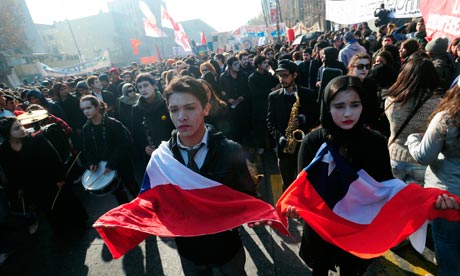
On Thursday, May 14th, two Chilean students were shot dead in the city of Valparaiso. The two students, Exequiel Borbaran, 18, and Diego Guzman, 24, were participating along with 160 000 others in mobilizations across the country. Students were demanding the fulfillment of the government of Chile's promise to deliver free, quality, accessible public education at all levels.

Exequiel and Diego were shot by a store owner after attempting to hang a banner at the end of the march. Diego was a member and activist of the Communist Youth of Chile (JJCC), which has a long and proud history of resisting fascism and violence and fighting for a socialist Chile.

November 23, 2014

From Ayotzinapa to Montreal: Overview of the Global Student Struggle

Special to RY

Student struggle week of action underway

Every November 17th, International Students’ Day, is commemorated by remembering the important role of students in fighting for a better world. In honour of this day, the World Federation of Democratic Youth’s Commission on Europe and North America has called for a student week of action against the current attacks on our education system taking place across the region. The week of action runs from November 17th-23rd.

In Canada, students are facing skyrocketing tuition fees, mounting debt, the privatization of education, cuts to student services, attacks on the living and working conditions of campus workers, the elimination of programs and classes, and the corporatization of research. More and more students now graduate without a future: either unemployment, or work in precarious, part-time, low-paid, non-unionized jobs. Students in Canada are fighting for free, accessible, quality and emancipatory education. They are fighting for a future!

Canada is not alone in this fight. The attack from governments and corporations is being resisted, at home and internationally. In recognition of this week of action, Rebel Youth Magazine takes a look at ongoing international student struggles:

September 11, 2013

The Chilean 9/11

Stamp honoring Allende from the German
Democratic Republic
by School Of the Americas Watch

September 11, 2013 marks the 40th anniversary of the U.S.-backed military coup in Chile, in which General Augusto Pinochet ousted the democratically elected president, Salvador Allende. The coup began a 17-year repressive dictatorship during which thousands of people were murdered, disappeared and tortured by Chilean security forces. High-ranking Chilean military officers, trained at the School of the Americas, perpetrated these crimes, and some have now been charged.

As a symbol of our solidarity with the Chilean people, we call on all activists to support the campaign, “Justice for Victor Jara.” The Chilean folksinger was the voice of his country's dispossessed, an internationally admired songwriter, and one of the founders of a new genre of Latin American song. He was killed on September 16, 1973, in the Estadio Chile. His body was dumped in the street, and found riddled with 44 bullets and signs of torture.

December 30, 2012

Victor Jara: "With that same strength our collective fist / Will strike again some day."


According to the New York Times, eight retired army officers were charged this Friday with the murder of famous communist musician Víctor Jara.

Just days after a 1973 CIA-supported coup overthrew the democratically elected socialist coalition government of Salvador Allende with the brutual dictatorship of Augusto Pinochet, Jara was tortured and killed in a football stadium which had been turned into a detention centre.

The NYT reports:

Judge Miguel Vásquez charged two of the former officers, Pedro Barrientos and Hugo Sánchez, with committing the murder and six others as accomplices. Mr. Sánchez, a lieutenant colonel, was second in command at the stadium. Mr. Barrientos, a lieutenant from a Tejas Verdes army unit, currently lives in Deltona, a city southwest of Daytona Beach, Fla., and was interrogated by the F.B.I. earlier this year at the request of a Chilean court. Attempts to reach Mr. Barrientos for comment were unsuccessful; his two listed telephone numbers had been disconnected. Judge Vásquez issued an international arrest warrant against Mr. Barrientos through Interpol Santiago and ordered the arrest of the other seven, who were in Chile. Those charged as accomplices are Roberto Souper, Raúl Jofré, Edwin Dimter, Nelson Hasse, Luis Bethke and Jorge Smith. (...)  Judge Vásquez established that Mr. Jara was recognized by military officers, separated from the rest of the detainees and taken to the basement dressing rooms, which were being used to question prisoners. There, he was interrogated, beaten and tortured by several officers, according to the court.
Victor Jara grew up in a poor family near Santiago -- his father began working by the age of six. As a student in Catholic seminar Jara came in contact with the popular social struggles and movements of his times.

Jara became involved first in theatre and then folk music, inspired by the artistic and cultural vibrancy of contemporary Chile with progressive artists like Violeta Parra, Atahualpa Yupanqui and the red poet Pablo Neruda. Jara became one of the leaders of the Nueva Canción (Spanish for ‘New Song’) movement – a movement based around “socially committed” music that takes a clear stand for freedom, against poverty, against imperialism and against human rights abuses.

Nueva Canción gave voice to the millions of peasants, workers and indigenous peoples of Latin America who were being crushed under the weight of US economic and political dominance.

Jara also joined the Communist Party of Chile, becoming an outspoken leftist in his country as well as an internationally famous artist. Like modern-day troubadour, he travelled across Latin America including Cuba, as well as Europe and the Soviet Union. Jara strongly supported the "Popular Unity" government of Allende, in which the Communist Party of Chile was an active participant. The social reforms enacted by the Allende government brought it friendship from the socialist world including Cuba and the USSR but the wrath of imperialism.

Soon after the election, the CIA stepped-up its work with ultra-right and neo-fascist forces inside Chile to overthrow the people's government. The CIA paid between $6.8 to $8 million USD to right-wing opposition groups to "create pressures, exploit weaknesses, magnify obstacles" against the elected government.  It is not well known but the Canadian government also supported the US actions against Allende’s Chile, like the pre-coup embargo attempting to destabilize the country.

(In a sad chapter of history, China under Mao's leadership actually lined-up with the CIA and actually recognized Pinochet's Chile after the coup).

As for Jara, he was quickly arrested in the early days of the fascist junta by the military -- captured, along with hundreds of students, teachers and staff members, at the Santiago Technical University where he was a professor and researcher.

The detainees were bused to Chile Stadium, since then renamed Víctor Jara Stadium, and held in the bleachers for long days with thousands of other prisoners, in the custody of army units brought in from various parts of the country.

The soldiers tortured and electrocuted him, breaking his wrists and the bones of his musicians hands. They then reportedly taunted him to play the guitar. Instead, Jara played the anthem of the Allende's coalition -- Venceremos or We Will Win. In this spirit of resistance, Jara wrote his very last song while held in the stadium:
We are five thousand
Confined in this little part of town
We are five thousand
How many of us are there throughout the country?
Such a large portion of humanity
With hunger, cold, horror and pain
Six among us have already been lost
And have joined the stars in the sky.
One killed, another beaten
As I never imagined a human being
could be beaten
The other four just wanted to put an end
To their fears
One by jumping down to his death
The other smashing his head against a wall
But all of them
Looking straight into the eyes of death.
We are ten thousand hands
That can no longer work
How many of us are there
Throughout the country?
The blood shed by our comrade President
Has more power than bombs and machine guns
With that same strength our collective fist
Will strike again some day.
Song, How imperfect you are!
When I most need to sing, I cannot
I cannot because I am still alive
I cannot because I am dying
It terrifies me to find myself
Lost in infinite moments
On which silence and shouts
Are the objectives of my song
What I now see, I have never seen
What I feel and what I have felt
Will make the moment spring again.
On 16 September, Victor Jara was machine-gunned to death. His body, and four other victims, were later found dumped near a railroad track outside a cemetery (one of the victims remains unidentified).

According to the autopsy report, he had been shot 44 times.

The special military unit who massacred Jara and many other political activists became known as the "Caravan of Death" and flew across the country in helicopters executing trade unionists, leftists and members of the Communist Party of Chile, and many other progressives like liberation theology priests.  More than 3,000 people were killed or went missing during the US-supported military dictatorship in Chile, from 1973 to 1990.

(While the Canadian government welcomed tens of thousands of families fleeing socialist governments from Europe and South-East Asia, only two thousand political prisoners were accepted from Chile. You can read more about that story in an review we ran earlier in the year, here.)

While Jara's bones may now be dust, his memory is alive in well in the hearts and minds of the Chilean people and progressives around the world. An official investigation into Victor Jara's death began in 2008 when army conscript José Paredes Marquez was charged with the killing.  In 2009 his remains were reburied in a massive public funeral.

Rebel Youth notes that article has combined reports previously published on the New York Times, The Gaurdian, Wikipedia, Beatknowledge.org and other websites.

May 16, 2012

Quebec struggle receives international support

Student associations from Chile, who are in a major struggle for almost a year now, wrote this week to Quebec CEGEP students and academics. Chilean students are critical of the "neoliberal policies" of the government of Jean Charest. Camila Vallejo, one of the leaders of the Chilean student movement, encourages students from Quebec. "When we defend the right to free public education to serve the people and their needs, we confront the big fish that refuse to let us go in that direction. And this is where we must be smarter, more intelligent, more committed, more so, to avoid falling into the game and the strategy of those who would divide us, frighten us... I invite you to continue with strength, "she said. A representative of the Continental Organization of Latin American and Caribbean students said for his part, about "Maple Spring", nickname of Quebec movement: "They can cut the leaves, they will not stop the spring. " 

February 23, 2012

Student actions a step ahead, but not enough


by Johan Boyden

The Feb. 1 cross‑Canada day of action by the Canadian Federation of Students was an important step towards the kind of broad, united fight for accessible education that is urgently needed right now.

Students are facing a powerful opponent - the agenda of big business. That means higher and higher tuition fees. Heavier student debt. Increased privatization. The corporate engines seem to be running on nitrous with the economic crisis these days.

If we agree on that, then the February 1st demonstrations should act as a wake‑up call for students in English‑speaking Canada, not just because of the scale of the protests. Crowds of a few thousand marched in several cities - below potential, but a good start. What was lacking was a clear, militant action plan to return to the streets, draw in a much stronger range of forces, and keep up the pressure.

Something fierce - memoirs of a revolutionary daughter

On September 11th, 1973 a CIA-supported coup smashed the socialist and democratically elected Allende government of Chile. By the end of the day, Chile had taken a rapid descent into fascism and the dictatorship of General Pinochet had begun, as well as and the murder or persecution of hundreds of thousands of labour, left-wing, socialist and communist activists had begun – including women like Carmen Aguirre's mother.

Something Fierce is Carmen Aguirre's memoir of a young woman growing up in a Chilean-Canadian family that heads back to fight the Pinochet regime. The book was published just last spring, and has already garnered rave reviews and been named to the longlist of the B.C. National Award for Canadian Non-Fiction and the CBCs Canada Reads contest.

It is not well known but the Canadian government also supported the US actions against Allende’s Chile, like the pre-coup embargo attempting to destabilize the country.

The Globe and Mail welcomed the Pinochet regime two days the coup and, commenting on events at the time, Canadian Ambassador to Chile Andrew Ross stated, "You have to remember, this is South America," as if that somehow justified Canadian support of a fascist dictatorship.

This makes Carmen’s story doubly interesting.  While the Canadian government welcomed tens of thousands of families fleeing socialist governments from Europe and South-East Asia, only two thousand political prisoners were accepted from Chile.

Here, as part of a series of articles leading-up to International Women's Day 2012, Rebel Youth presents an excerpt from the book and what a young feminist reviewer is saying about it.

January 29, 2012

Student protests shake Chile

Chilean students march in the streets of Santiago

From People's Voice newspaper

The past year and a half has seen significant student resistance in the streets in Britain and Ireland, across Europe and the US, as well as North Africa and the Middle East. But one of the most significant struggles over education is in Chile, against the right‑wing government of billionaire president Sebastian Pinera.

     Most basic and secondary schools, and most universities in Chile have been privatised. Even public universities charge large fees. The state dedicates less than 5% of Chile's GDP to education, leaving students and families to pay 75% of education costs.

January 23, 2012

Chilean student leader launches book and considers entering electoral politics

Camila Vallejo and the struggle of Chilean students
will be the subject of an  article in February's People's Voice

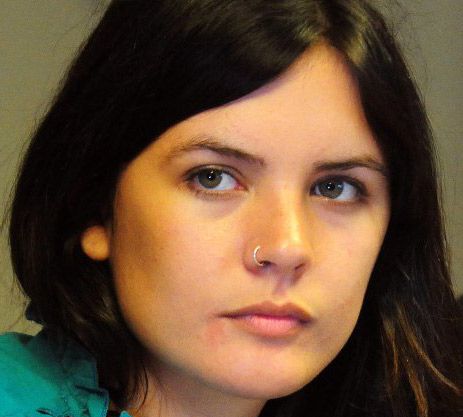
The popular student leader and vice president of the University of Chile’s Student Federation (FECh), Camila Vallejo launched her new book “Podemos cambiar el mundo” or “We can change the world” at a central park in the capital Santiago de Chile on the second day of the centenary celebration of the Communist Party, Fiesta de los Abrazos.

On the stage Camila stressed the idea that the struggle for deep structural changes in the education system is a response to the demand from the public and urged the social movement “to come out of marginality” and said it is “not enough to make suggestions for others to carry out.”

The book consists of collected texts written by Camila in 2011, including opinion articles and an unedited interview with Vallejo by Francisco Herreros, a Chilean journalist. Subjects within the texts include the discrepancies within Student Confederation of Chile (CONFECH), the fall of former Minster of Education Joaquín Lavín and the relation between the students’ movement with political parties.

Popular stories