Showing posts with label Winnipeg. Show all posts

October 13, 2012

Ukrainian Labour Temple plaque unveiled.

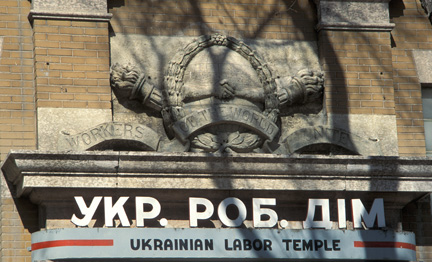
Workers of the World Unite says the main sign

On September 29, Winnipeg's Ukrainian Labour Temple finally received a plaque marking it as a National Historic Site. Close to one hundred people attended the unveiling ceremony which included performances by the hall's orchestra and choir.

The ULT and its manor continue to play an active role in Winnipeg's progressive community, including as a venue for meetings of the Communist Party's Mathew Popowich Club. (On this point, the plaque has an error.)

The ceremony was postponed for a year after Parks Canada officials received a communication from Ottawa forbidding the choir from singing the Internationale as part of the program.

The text of the plaque is:

"Constructed in 1918‑1919, this imposing building was at the centre of a radical left‑wing movement committed to improving the lot of Ukrainian workers and farmers. Housing a printing shop and the headquarters of several national organizations devoted to education and mutual aid, it also served as a base for the promotion of Ukrainian performing arts. It was a gathering place for strikers during the Winnipeg General Strike of 1919 and for the Communist Party of Canada until the 1950s. Continuing to serve a cultural function, this neoclassical building is one of the grandest and largest labour temples in Canada."


The Temple was built primarily by volunteer labour and financed by donations and served as a key hub for Ukrainian culture and political activism at the time. The Ukrainian Labor News and other Ukrainian language publications were prepared and distributed from the temple.

In addition to being an important gathering place for the CPC, the building holds an especially historic place in the Canadian labour movement, having served as a rallying centre for trade unionists during the 1919 Winnipeg General Strike. The temple was raided by authorities searching for evidence of alleged sedition and conspiracy.

The structure was designated a provincial heritage site in 1995 and it remains the only surviving labour hall associated with the turbulent events of the general strike. To this day it serves as national headquarters for the Workers Benevolent Association, established within its walls in 1922.

"I believe that proclaiming the Winnipeg Ukrainian Labour Temple a national historic site also quite rightly pays tribute to the founding members," says Myron Shatulsky, a member of the Association of United Ukrainian Canadians and chair of the board of directors of the Ukrainian Labour Temple Foundation.

"These socialist-minded Ukrainian immigrants, some of whom had yet to receive their naturalization papers, and facing the possibility of arrest and deportation, sought and established a path along which they could achieve a better life for themselves, their children, their descendants, and for all Canadians. It is truly a historic event."


With files from the Peoples Voice Manitoba Bureau and the National Union of Public and General Employees (NUPGE)


July 18, 2010

photo essay: Winnipeg sidewalks - signs


Above: the infamous rail yards of the Canadian Pacific Railway Co. The yards mark the historic line between poor and rich neighborhoods. Winnipeg's North End is to the left of the tracks.

Below: one of the few career choices for Winnipeg youth.


Above: a sign of the times, cameras are seen as a force multiplier for the police and a way to be omnipresent in the minds of common people. In plain english it helps the police do more with less and scares the oppressed minorities when needed. All to make upper classes feel safe.

Below: another sign of the times, Mathew Dumas was shot down by Winnipeg Police. This protest sign mocks the cops claim that Dumas had a screwdriver for a weapon.


Above: while bank branches continue to close, the vacuum in poorer districts is filled by payday loan outfits. They are commonly known as predatory lenders due to astronomical interest rates they charge the working poor that use them.

Below: the brightest lights on West Broadway...


Above: ...turns out to be a pawnbroker. This is the other method of obtaining funds in Winnipeg short of black market activities, such as the drug trade.

Below: truth in advertising. Manure for sale sign has different meaning when,
at Portage and Main, the CanWest corporate headquarters looms in the background. Among the posters: the occupation will not be televised, modern life is war, just got paid; all seem to be an unintended working class collage.


Above: rental housing on St. Mathews Avenue. The porch enclosures have now been removed.

Below: one way workers fight back is by forming unions and striking for better working conditions when they have jobs, for the existence of jobs in Winnipeg, for fair pay and benefits, and in solidarity of other workers. These workers are on strike at New Flyer's Winnipeg bus factory.


Above: another way of fighting back is to vote with one's feet. This is happens to be the Mayday march.
\
Below: Election poster in North End long after the election. The Communist Party has one of the more visible campaigns in poor areas of Winnipeg. This area has sent communist MLAs and city councilors to office over a period of decades.

Many who are able to vote often don't because of a first past the post system, which seems rigged in light of today. Smaller parties are seen as unwinable and therefore are passed over for large business parties or as the majority does, don't vote at all. Those that remain to vote are the wealthy classes who want the status quo and surprise, the big parties all sell the status quo or some cosmetic tinkering.


click on above images for closer view

October 30, 2009

November 5th Day of Action to Target Poverty

The month of October was a busy one. One day alone had:

  • the NDP choosing the next leader, and Premier of Manitoba.
  • The irony being that it was the International Day for the Eradication of Poverty.
  • CFS-MB activists protesting at the NDP convention.
  • The second annual Four Directions walk ( <= PDF link ) happening simultaneously with the CFS protest, culminating with a rally at the legislature later that day. (see the justice charter PDF here)
It was a busy October 17th.

BUT ON NOVEMBER 5th, the DAY OF ACTION, the issues of poverty and the need for education to eliminate it will be made known even further.


video from one campus.

Wow, epic.
But isn't poverty of epic proportion?


another video from another campus.

Event Details (from target poverty website)

Venue: Manitoba Legislature; Brandon University
City: Winnipeg and Brandon
Starting: Thursday, November 05, 2009 (12:00 pm)
Ending: Thursday, November 05, 2009 (2:00 pm)
Cost: Just bring your noisemaker and dress for the weather!

The Target Poverty campaign culminates in a November 5 day of action.

Contact us if you want to organise an event for November 5 in your community or at your school.

And don't forget to sign up here for regular campaign updates:

http://www.targetpoverty.ca/index.php?section_id=7

Contact: Jonny Sopotiuk
|
targetpoverty (AT) targetpoverty.ca
|
(204) 783-0787

August 9, 2009

Kangaroo session at Winnipeg's city hall


note: this report by freelance reporter Michael Welch of the proceedings at Winnipeg's City Hall over the P-3 option for the waterworks was originally circulated by e-mail and later rewritten for the newspaper People's Voice. Another PV article gives an analysis of the issue. Rebel Youth presents the article here as we feel this issue is relevant to youth and students as well. Why? The same forces at work here attack any ideal of univeral post-secondary education. And it goes without saying that this issue is important since water is one of life's basic necessities, not a commodity. Increased water rates can affect services like laundromats and housing rental costs for students. The Canadian Federation of Students made a presentation at city hall urging that the water supply remains public.


Right: cartoon poking fun at people who make shortsighted decisions.


"Let's not throw the word "privatization" around the way Joe Mccarthy threw the word Communist around!"
- Councillor Justin Swandel


Mayor Katz got his way.

At the end of the day (literally) Council voted 10-6 to approve of the new Utility and strategic partnership model.

This is a disappointing but not entirely unexpected development.

There were about 200 people at the rally the previous night along with excellent speeches, music and a big white elephant!

On the day of the vote, almost as many people showed up and packed both galleries.
outside, a camera was set up to allow critics of the Utility P3 to have their say. It was a kind of "speaker's corner."

At the outset, one of the Councilors, Justin Swandel, did attempt to limit the number of speakers to four, but Council ultimately agreed to hear the 20 speakers who signed up to speak.

At the outset, there were three or four people who spoke out in favour of the water utility, one arguing that further delay would cost the taxpayers money.

THEN THE DELEGATIONS SPOKE OUT AGAINST THE UTILITY. One of the people who had signed up to speak did not show up, so the next speaker, Phyllis Watson of the Council of Women of Winnipeg spoke on the flawed consultation process.

Following Phyllis were the following presentations all approximately 5 minutes long:

John Loxley (Danger of P3s with Examples); Jesse Hajer, CCPA-MB ( Poor Cost Saving Predictions in Business Plan ); Mike Davidson, CUPE MB (Distinction between Upgrades and Utility Model) ;Chris Leo (Urban Sprawl); Alana Makinson, CFS-MB (Youth Perspective); David Cavett-Goodwin, Wolseley Residents Association (Lack of Accountability and Public Control)

Around 11:30 there was a break to allow a different subject to be debated, that over the removal of a heritage building.

Then there was lunch. Over the lunch hour, CKUW helpfully covered the Utility proceedings which included interviews and colour commentary by Tony Clarke, Maude Barlow and Jenny Gerbasi. An Archive of that broadcast can be found at http://ckuw.ca/24/20090722.13.00-14.01.mp3 .

After lunch, Robert Chernomas presented his talk based on the most recent Fast Facts by Maude Barlow and Meera Karunananthan which can be found at the website for the Centre for Policy Alternatives (policyalternatives.ca)


The remaining delegations included the following...

Tom Simms (Charleswood Bridge comparator); Christine Bennett-Clarke; Kevin Rebeck, CUPE MB (Labour Perspective); Sandy Gessler, SPC Board President (Health); GReen Party Leader James Beddome; Larry Klippenstein

Following the delegations, Council deliberated for about three hours. Predictably, the Councilors in opposition to the water corporatization plan raised our major concerns and showed that they had done their homework. Councilors Gerbasi and Orlikow were particularly notable in this regard.

Most of the rest of the Councilors betrayed through their comments that they were largely oblivious to the concerns being raised by opponents of this plan.. Councilor Swandel accused the opponents of "cherry-picking" and not being particularly honest in their appraisal of P3s. He of course ignored Jesse Hajer's devastating critique of the cherry-picking in the Utility Business Plan!

Councilor Steeves insisted that something has to change. That the current system wasn't working, and that something had to be done! If this writer hadn't been familiar with the documentary information indicating that the current system was working fine, he would probably have been impressed by the Councilor's presentation. Even the Deloitte and Touche report which has been used by Council and the Mayor to justify this new Utility has been clear that there was "nothing to suggest that current regulatory requirements and services were not being met" by the current Department of Water and Waste. Therefore, nothing to justify the creation of this highly controversial proposal.

And they call us fear-mongers!

Of course, Councilors Swandel and Steeves sounded like thoughtful and enlightened statesmen compared to most of the other proponents in Council. Councilors Browaty and Fielding clearly had not heard a word that had been said from the delegations. They repeated the canards about how increased involvement from the private sector would reduce costs to the public, reduce cost over-runs, etc.

One pleasant surprise, however was Russ Wyatt's change of heart. He sits on the EPC (Executive Policy Committee) and formerly voted with his colleagues to approve this proposal. Yesterday, he spoke eloquently on the need to engage the public in a proper consultation. At one point he noted that the site of the consultations, the Masonic Temple on Osborne, was not easily accessible to people in his community (Transcona). It bares noting that Russ Wyatt's constituents waged a major campaign against the proposed Olywest pork processing facility a few years ago.

A low point was struck by Mr. Harry Lazaranko who threw a tantrum criticizing the opponents of the Utility plan of "grandstanding" in front of the press and capitalizing on the ignorance of concerned citizens who were expressing concerns about privatization. He even suggested at one point that the presence of children and a man in a wheelchair was part of some kind of PR stunt! He maintained that the Utility plan was so clear and plain to read that "even a twelve year old child could understand it!"

Mr. Lazarenko was the author of an amendment which would call for a mandatory referendum before "Privatization of our water" could happen. By this he appears to mean a shift of ownership from the public to the private sector.

This amendment is a red herring. As Council of Canadians reps Maude Barlow and Meera Karunananthan explained in a recent release...

"Councillor Harry Lazarenko’s motion to ensure that privatization is not sought without a referendum does not allay concerns about the loss of public control over water services, hikes in water rates and the global impacts of creating a for-profit utility."

Of course, the Mayor in the end demonstrated his dismissal of the opponents' arguments, continuing the meme of how the opponents were fear-mongering and lying.

The heart of the opponents' arguments was that there was inadequate consultation and no real opportunity for the public to engage decision-makers. Critics were arguing that they have not gotten adequate answers to their questions!

By the end, there were around 40 of us trying to make sense of what happened. We mostly wandered off dejected and tired.

However, as has been pointed out both within Water Watch and within the Council of Canadians, we really didn't expect this Council to vote against the proposal even if the media ended up giving more coverage to the issue than we dared to dream for!

The next stage of the battle in the opinion of this writer, would involve the province's approval process.

If nothing else critics of the Mayor's plan have public opinion onside. According to a recent poll, nearly 2/3s of Winnipeggers oppose approval of this Utility without proper public consultation.

Michael A Welch

January 9, 2009

police: crime containment crew

PART ONE: Winnipeg, 1968

This commentary is the first of a series on Winnipeg's (in)justice system and is posted as an exclusive to the Rebel Youth blog. Part 2 will quote some testimonies from the Manitoba Human Rights Commission report and focus on the issues of police and crime in Winnipeg's inner city. It will be printed in the next issue of Rebel Youth magazine, you'll have to get yourself a copy to read it. But to begin, part 1 goes back over 40 years ago, starting with a reprint from the People's Voice predecessor newspaper, Canadian Tribune from the spring of 1968.
---
WHO SAYS “THE LAW IS AN ASS” ?

By Tom Morris

When Charles Dickens said, “the law is an ass”, he could have been standing on the windy corner of Winnipeg’s Portage and Main streets, or reading the morning paper’s account of police strong-arming another citizen in Toronto.
George Paulowich arrived in Winnipeg from Toronto on Jan 11, checked into a hotel and discovered his wallet had been stolen. Innocently believing that the thing to do was call the police, Mr. Paulowich did just that. What followed was a piece of impressive public relations work by the Winnipeg Police Department.
Detectives arrived at the hotel and arrested George Paulowich. He was jailed for 30 days pending completion of investigation and preliminary hearing of two men charged with the robbery. When finally released, he was told not to leave town and to report each Friday until a trial date had been fixed- which turned out to be on April 26-105 days after his arrest.
Judge C. I. Keith, in dismissing the robbery charge against the two men, condemned the treatment of Paulowich and suggested the crown pay him a witness fee for the time spent in jail as well as for attendance at the trial. Winnipeg director of prosecution, A. A. Sarchuk, has called for reports of the case. Great move, Mr. Director of Prosecutions, but where in hell have you been for 105 days?

Mr. Paulowich, having lived in Toronto, might think that his experience is simply a dose of Western hospitality. He could exchange notes with Mr. Kenneth Bruton, who is trying to get his house fixed up following a visit by Toronto’s finest.
The damage was caused when police arrived to arrest Mr. Bruton’s brother-in-law April 29. To apprehend the slightly built 17-year-old youth, police ripped off a door, tore a wooden fireplace from the wall, twisted the suspect’s arms and pushed Mrs. Bruton against a wall. Now there seems to a question about who is going to put the house back together. “They told us to get it fixed and they’d pay for it,” said Mr. Bruton. “I guess that is an admission of liability,” Police Chief James Mackey, with an eye on the taxpayer’s dollar, says. “It doesn’t mean we’ll pay for it at all. It isn’t any kind of an admission.”
By all means, nothing should be admitted. When a 15-year-old boy is shot in the leg by police is there any admission? It was “an accident.” This police officer, in the performance of his duty, don’t you understand, slipped, fell, found his holstered revolver in his hand which went off and shot the boy.
The sad chronology could go on and on. For every case reported, there are hundreds of cases where the citizen is so damn happy just to get home that he doesn’t say a word. “I don’t want any trouble,” says he.
Countless men and women file into Canadian courtrooms, only to have their case remanded over and over again, and are sent back to the cells to await their time.-Most of them young, none of them rich.
Canadian police chiefs raised a storm last year by asking for greater powers. Some of them called for a return to flogging, arrest without charges, wiretapping, the right to enter homes without a warrant and a “detention law” which would take care of ‘rabble-rousers’ and ‘trouble-makers.’ The hue and cry raised by the community prevented such laws and a return to the Middle Ages.
And so, Mr. Paulowich, there isn’t any law under which you can be arrested without charges. Maybe it was all a bad dream. In any case, you should feel good because there isn’t a flogging law either. Had there been, you might have “confessed” stealing your own wallet.
---

As much as we think we have progressed from 1968, we have fallen more and more behind as you'll find in part 2. When the Federal Conservatives made law and order an issue in the election in 2008, it would do good to look at the above article with that in mind. Whose Law and Whose Order? Hindsight is 20/20 but we don't have 40 years to fix an issue that affects youth today. Police continue to screw up: in February 2000 Corinne McKeowen and Doreen Leclair were stabbed to death while the 911 operator listened to their fifth call for help. William John Dunlop murdered them in their Winnipeg home. The Fort Garry Women's Center published a study report showing police response times are less for poor callers and in poor neighbourhoods.

Beyond incompetence, outright malice and cold blooded murder occur. The Saskatoon "Moonlight tours" where police drove homeless men to the city limits to freeze to death. Eventually, one made it back to uncover the crimes. Trigger happy police shootings and taser deaths (almost on par with actual non-police murders in Winnipeg briefly this past summer), in parallel with poor response times show a pattern of two class justice. There are 40 years between the Newark Riots of 1967 and the Riots in Paris in 2007. Riots occurred in Montreal during the summer of 2008. Now Greece. All followed from acts of police brutality.

There is a pattern. Social condition. And racism.

Popular stories