Showing posts with label latin america. Show all posts

November 25, 2019

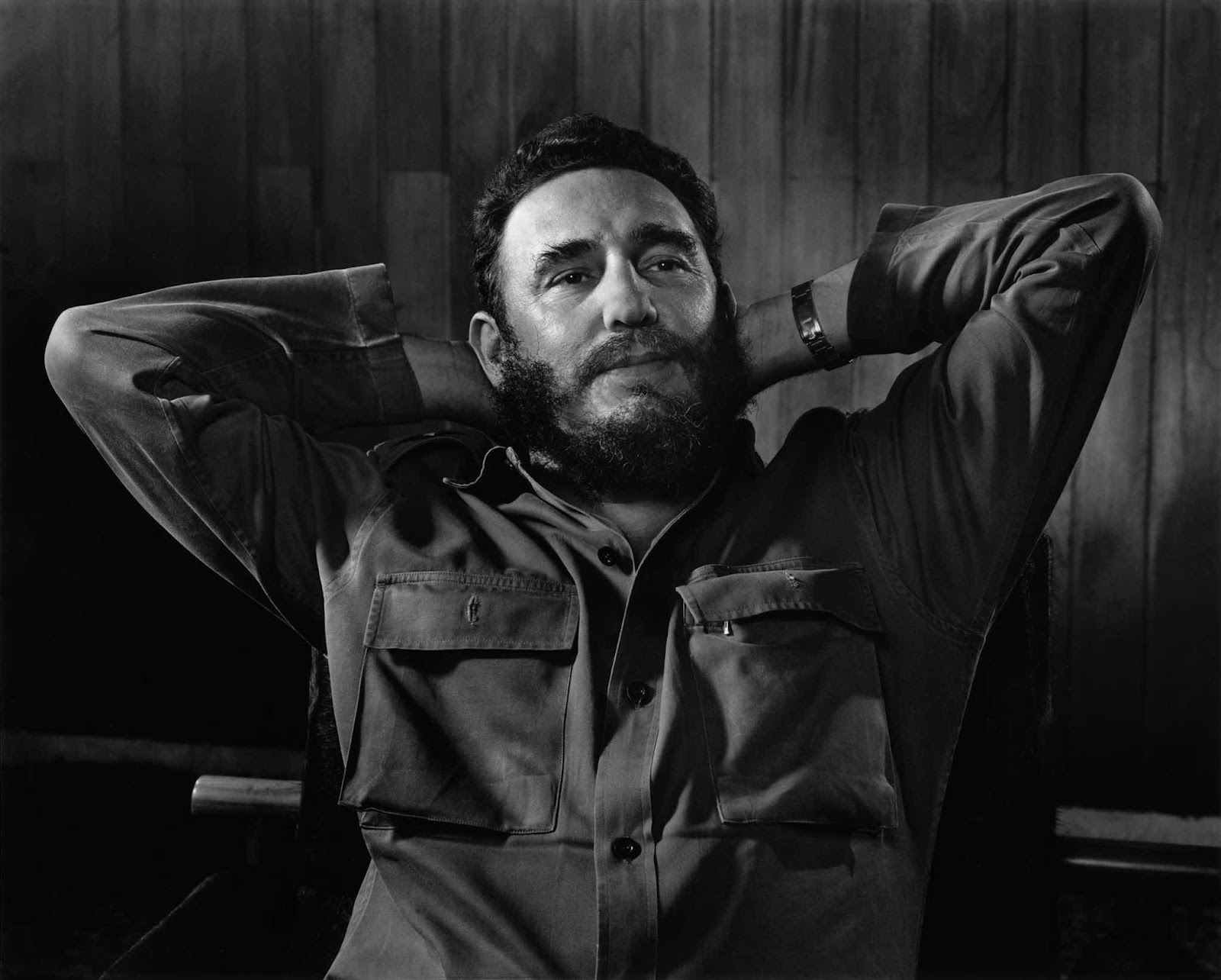
Two Degrees between Me and Fidel


By Abram Lutes 

History is not made by individuals, but sometimes history places individuals at the heart of momentous events. The leadership and moral character of these individuals can thus, sometimes, change the world.

Fidel Alejandro Castro Ruz is one such individual, also known simply as “Castro”, or affectionately just “Fidel” in much of Latin America. Having spent some time in Latin America, I too think of him as Fidel.


July 31, 2019

Canadian Network on Cuba’s campaign to reopen IRCC office in Havana well underway

Special to RY

Coming out of its last biennial Convention held this past June in Toronto, the Canadian Network on Cuba resolved to continue a major campaign to reopen Canada’s Visa office in Havana.

For this purpose, activists in solidarity with Cuba have begun gathering signatures for a petition addressed to the Prime Minister Justin Trudeau, the Minister of Immigration, Refugees and Citizenship Ahmed D. Hussen, and Chrystia Freeland, Minister of Foreign affairs. It states that “on May 8th, 2019, the Government of Canada made the abrupt decision to shut down the section of its Immigration, Refugee and Citizenship (IRCC) Office in Havana.”

June 14, 2019

Anti-imperialist youth of the world says, “imperialists, hands off Venezuela!”

Special to RY

To mark the anniversary of Cuban-Argentinian revolutionary Ernesto Che Guevara, the anti-imperialist youth of the world launches a solidarity campaign with the Bolivarian Republic of Venezuela. Is there any better way to celebrate Che than by showing that young people are determined to fulfill their objective of seeing a free and sovereign Latin America?

The decision to initiate this campaign on June 14 was made by the General Council of the World Federation of Democratic Youth, which met last April in Caracas during a solidarity mission with Bolivarian Venezuela. Around thirty organizations from all over the world have unanimously endorsed this call for mobilization, a timely one considering the growing aggressiveness of Western imperialism against Venezuela and Latin America.

May 7, 2019

The people of Venezuela reiterated, "Guaido is not our President"

Brief note by Adrien Welsh 

Let's salute the courage, determination and reactivity of the Venezuelan people, its youth, its institutions and organizations that represent them for their mobilisation in the face of the new destabilizing action of criminal, usurper and fascist Juan Guaidó and convicted Leopoldo López.

Thanks to people’s mobilization, Venezuelans have prevented this manoeuvre from ending in a coup perpetrated by the proxies of imperialism in Venezuela who have eyes only for the oil and natural resources of this country and wish for larger profits for western shareholders.

January 16, 2019

The Challenge of Socialism: Cuba and the new Constitution

By Eric Galeano, YCL-LJC Vancouver

On December 24, 2018, we sat down with Yamil Marero to discuss Cuba’s ongoing process of writing a new Constitution. Yamil is a Senior Officer with the Cuban Institute for Friendship with the Peoples, or ICAP. Created in December 1960, this public organization promotes and cultivates friendship among nations. It is a place where friends of different cultures come to discuss and reflect on the situation in Cuba and the rest of the world. Yamil spoke to us about how the new Constitution is being drafted and its main implications for Cuba’s future.Why is Cuba updating its Constitution?

This is a completely new constitution that comes at a moment, not only in Cuba but in the whole world, in which many important changes are occurring. We are updating many things, not only economically speaking, but also politically speaking, and it is an ideal moment for that to take place.

Why? First of all, we are trying to maintain a continuity in the legacy of Fidel and Raul and other important figures in the Cuban leadership. These are not only Fidel and Raul, but also Marti, Agramonte, and many other figures in our history. Also, the previous Constitution was from 1976. We needed to do something new. For instance, the private sector has increased in number. There are many laws targeting that sector. We need to support that in the Constitution.

The issue of same-sex marriage is one of the things that has raised the most discussion in Cuba. Some think that we are Latinos and we have a macho approach to the issue, but I must admit that with time people have started to change their perspective towards that. Although this is still something that should be discussed and better discussed with people.

All of these things are happening at the same time, so that’s why we need to update the Constitution. Especially for the future generations.
The Popular Assembly for People's Power debating the new Constitution's project


In relation to the 1976 Constitution, the new draft only maintains 11 articles, modifies 113 articles, and deletes 13 articles and then adds 87 new articles. The government has discussed this process as a constitutional ‘reform’, but is it not a replacement? Is it not creating a new constitution entirely?

First of all, it’s important to clarify one thing that you mentioned: when you say ‘government’ in Cuba, you mean people. When you refer to ‘government’, and you say the Cuban ‘government’ is doing this and that, for those who don’t have the experience of how it works in Cuba, they would say it’s the political party deciding X, Y, Z… but it’s not like that. It’s different from what happens in many countries in the world. And yes, this is a project that we ourselves say is a new Constitution, because of what you have mentioned. All the new changes that have taken place. All the new articles that we are proposing to add.

As I said earlier, there was a constitutional commission convened that was entitled to present a draft in July. This draft was present for popular discussion and consultation from August 13 to November 15, 2018.

Can you explain the process of popular consultation? How did it operate?

Cuba is a very institutionalized country. What I mean is, through the different institutions, mass institutions, political institutions, all institutions in Cuba, you structure and organize the way in which these discussions are going to take place.

At the level of the communities, in the neighborhoods, through the C.D.R.s, the Committees for the Defense of the Revolution, which is the biggest and the oldest mass organization in Cuba, that gathers all the neighbors in a community. So, at that level, you organize different meetings for the people to express their opinions. You also organize discussions in workplaces. But for a person who is retired, or a person who is a housewife, if that person doesn’t work, they won’t be able to express their opinion at the workplace. So we organize these discussions at the neighborhood level too. We also discuss it in the different cells of the Cuban Communist Party, where people freely expressed their opinion.

Over 9 million people, from all different institutions, in the big sense of the word “institution”, were able to discuss the Constitution. So the Constitution is going to be the will of the Cuban people, of the grassroots level. Now, every single one of these opinions was considered and analyzed by the commission when revising the draft and preparing the second version. This second version which incorporated the popular input is now under discussion at the National Assembly, our parliament.

Previously, in the 1976 Constitution, marriage was defined as a union between a man and a woman. In terms of the same-sex marriage provision you were talking about, the original draft prepared in July, had Article 60a, specified that marriage is between two persons. My understanding is that after the popular constitution, the revised draft has dropped the definition of marriage altogether. What does that mean for the possibility of same-sex marriage in Cuba?

What I understand according to the discussions I was able to watch – because all discussions are made public, but I was not able to see them all – is that Article 60a was eliminated, but somehow, part of the letter or the intention that this article expressed is reflected in many other articles. It’s not explicitly stated as it was in Article 60a, but the intention is reflected in other areas of the draft Constitution.

So, it doesn’t guarantee same-sex marriage, but it leaves the door open for it to be established in law in the future?
Gay Pride in Havana
As part of the ongoing legal updating process, which goes beyond approving a new Constitution, we have a Family Code. One of the things that the National Assembly has to approve, in addition to the new Constitution, is a new Family Code. This issue will probably be clearly stated in this Code, that is, what the definitions of family and marriage are. But it’s something that definitely needs more discussion with people.

Despite the level of the education of the Cuban people, it is very difficult to change people’s perception of an issue just by approving or not approving one law. That needs to change little by little in the consciousness of people for them to understand.

The new Constitution is seen as an attempt to learn from past experiences of socialism in power, to adapt to the post-Soviet reality, and modernize the Cuban state. This is especially relevant given the discussion of the state’s economic structure in the Constitution, and in particular, Article 21, which recognizes private property. Article 21 specifically refers to private ownership of the means of production and is distinguished from personal property in Article 22, which is just property for satisfying a person’s own individual needs. Of course, this has led to certain alarmist interpretations about the ‘restoration of capitalism’, while Raul Castro, who has been involved with the constitutional commission, has clarified that private property will be merely a complementary aspect of the economy that is limited by law. But if this is going to be part of the new Constitution, how do you see it affecting the legal system and the economy? Do you see it as recognizing something that already exists, or opening the door for something new?

It’s legalizing, or recognizing, as you say, something that already exists. In this regard, I must express two main ideas. On the one hand, the main means of production in Cuba will continue to be socialist. On the other hand, we have clearly stated that in Cuba what we are going to avoid is the concentration of wealth that is in the end what brings about individualism rather than collectivism.

Right, Article 22 states that there shall be no concentration of wealth.

Yes. And we are recognizing that there is private property, but that it is never going to be the most important branch of our economy, because as I said earlier, the main means of production will remain in the hands of the people. One of the main things that we have realized is that the government was focused on so many things that it was a burden for the budget, for the good development of the country’s economy. What we’ve decided is that those sectors that are not key for our economy can be left in the hands of the private sector. This is logical, and accurate, I think. For instance, why should the government be worried about a beauty parlor, paying the salaries every month, creating a whole structure for probably two or three people that are working there? Same with a small restaurant. That’s something that can be handled by people themselves.

Do you anticipate that this will lead to increased economic growth?

Well, it’s another way of helping our economy. It’s not the most important way, but we are talking about over half a million who are involved in the private sector in Cuba, and that’s a growing figure. In the beginning, many people started getting enthusiastic about it. But little by little, when people realized their objective capacities to realize their business, people have retreated. Yes, it is growing, but I don’t see it as a threat. We have clearly stated that Cuba will remain socialist because the main means of production are going to be owned by the people, owned socially.

As the Constitution was drafted, both by the commission and then by popular consultation, did Cuba look to the Constitutions of other progressive states in the region or around the world?

Yes. Actually, one of the things that the commission explained when they presented their first draft, and has been explained in many other moments during the discussion, is that this draft was presented having in mind other experiences. Not only those from China and Vietnam, but also many other examples. That is one important thing. We are not copying and pasting everything, but copying, analyzing, saying, this might not be suited for us, this might be. We make something with a little bit from everybody and try to create something our own, adjusted to the characteristics of our economy, of our idiosyncrasies, of our people, and especially, foreseeing the future.

It’s curious. In Cuba, whether we recognized it or not, we did have a sort of private sector in Cuba. Agricultural cooperatives are a sort of private property. The means of production were granted by the state, but the land was owned by the cooperative, the neighborhood. They had to give a part of their production to the government, for the people, but it was sort of private. And that was not recognized by our previous Constitution. Now, with the creation of non-agricultural cooperatives and private property, that has to be recognized in these two Articles. We are recognizing them. They feel recognized in this Constitution. Our intention is to have everyone on board in working for a better country.

One of the other changes in the new Constitution relates to local governance. The Provincial Assemblies are being replaced by Governors and Councils, and my understanding is that municipal bodies are going to become more autonomous. Why are these changes being made?

Because, in the end, we realized that in many aspects, the Provincial Assembly was not the correct linkage between the municipality, or the grassroots level, and the national level. So that intermediate structure was not as functional as it should be. I think that the way we are presenting it now is more accurate. For each of the 168 municipalities that we have in Cuba, we have at least one representative in the National Assembly. The Provincial government, in trying to solve their own problems in the province, tried to address issues that could only be solved at the national level. And so the solution never came. This change is based on the exercise we had with the creation of the new provinces of Artemisa and Mayabeque in 2010. With this new structure, we are trying to split the administrative aspect from the political aspect of the government.

The original draft prepared by the commission dropped the reference to the goal of the “advancement towards a communist society.” During the popular consultation, I understand that this received a lot of opposition, and the Cuban people expressed their demand that the new Constitution, like the old one, would include the goal of the “advancement towards a communist society.” What’s your interpretation of this?

This issue is not about whether we should strive to achieve a communist society. It is instead about clarifying the role of the Cuban Communist Party in building that new society, which is something different. We clearly stated in our previous Constitution that the Cuban Communist Party was the leading force of the Cuban society. Many people wanted to clarify, OK, what is the role of that leading force?

If we are readjusting our Constitution, we need to clarify this for the future generations. The discussion was more focused on, let’s define clearly what the leading force of the Cuban society. What is that? How do you understand that? I think it was a proper and accurate question. It’s similar to the article that says that the government will aim to provide decent housing for every Cuban person. The discussion was then, what is decent? Because what is decent for you is probably not decent for me. The concept of decent for you is not the same as for me. That brought about a lot of discussion. And this issue was addressed, and more clearly stated in the new draft. That is what happened here too.

When Fidel was in power, we expressed that if it is for the benefit of the people, or the interest of mankind, Latin America, we will do anything in Cuba. The term is not important. If it is socialist, communist, capitalist, or whatever, a new term, it doesn’t matter. What matters is the essence, what is behind it. If it is for the benefit of mankind, if it is for the benefit of the Cuban people, we are more than willing to change one term. The term is not important. What matters is what you are seeking in the end. That’s the way it should be.

Let’s turn back to the economy. In terms of analyzing the current global situation and the potential for increased economic growth in Cuba, we are faced with ambiguity. On the one hand, the US is maintaining its criminal blockade on Cuba, imperialist countries are encircling progressive forces in Latin America and conducting color revolutions in Nicaragua and Venezuela, we see the re-emergence of the far right, with Argentina and especially Brazil, with the election of the fascist Jair Bolsonaro.

On the other hand, we see the re-emergence of Russia and China, which offers greater trading opportunities, there was a recent meeting between representatives of Cuba and the DPRK, we’re seeing a decline in the power of the US dollar as the global reserve currency, known as de-dollarization, which is weakening the effect of sanctions, and finally we see the construction of a new canal in Nicaragua as an alternative to the US-dominated Panama canal.

So we see positives and negatives. Do you see that there is an opening, a greater potential for economic growth, or do you think because of regionally what’s happening, especially in Brazil, which is so important in Latin America, do you think that there will be an intensified struggle in the near future?


Definitely. I don’t want to sound chauvinistic here, but all of those processes that imperialism is focused on right now, in the end, in my perspective, what they’re thinking about goes back to the original sin. By that I mean Cuba. They are targeting Cuba.

Because if Cuba cannot provide the medical doctors that Brazil needs, because Brazil can’t – Cuba had some agreements in that regard with Brazil, same with Nicaragua and Venezuela, through ALBA – if all of these countries are having economic problems which are not the main, but an important support for the Cuban economy, it will lead to problems. Imagine a building. If you start removing the bases of that building, in the end, what you achieve is to have the building fall down.

Cuba has been a bad example for the big companies, for capitalism. We have proved with little, and I mean “we” not Cuba but we the world, we can do a lot of things if we have the political will. If we want to do it, it can be done.

We have proven that there are things more important than money. That example is a bad example for big companies. That’s why I think what they are seeking not only to suffocate those revolutions or those progressive movements but also, in the long term, to suffocate the Cuban revolution.

In that context, all the help that we can get must be welcome. Despite what many people think, the first country that Fidel visited after the revolution triumphed was not the Soviet Union. It was precisely the United States. We understood that we didn’t want to have such a powerful enemy. But in the end, everybody knows what happened and what all of that brought about. Today, we have China and Russia. We understand also that they are seeking opportunities. Not only because they want to help Cuba, but also because they will benefit from us as well. There is a lot of collaboration and benefits from each other, as with any other business. We will do anything that we can do to prevent our people from continue suffering the impact of the cruel policy of blockade.


Two or three years ago we approved a new investment law encouraging foreign investment. This was discussed in the guidelines for socialism in Cuba and is also projected in the Agenda for 2030, our plan for our economy. That foreign investment, different from what happens in many other parts of the world, is going to be directed to those branches of the economy where we don’t have the expertise or infrastructure to develop. That means that I don’t foresee a KFC, or a Dominos, or anything like that, in Cuba, at least for a long period of time. I know that has been in the news: “Little by little, Cuba is going back to capitalism.” But it’s nothing like that. We do need foreign investment because we don’t have the possibility of developing those branches of the economy.

We will give people an opportunity to invest in Cuba. But we will always preserve and maintain our sovereignty. That is something that will never be put into danger. With that clear in our minds, we will do everything that we can do for the benefit of our people, despite the challenges that this will, of course, bring about. What cannot happen is that we continue suffering the way we are suffering.

October 30, 2018

The world votes on the UN's resolution to lift US blockade on Cuba


On Wednesday, October 31st, the General Assembly of the UN will be called to vote on a resolution condemning the US criminal blockade imposed to the Cuban people since 1961. Since 1992, the vast majority of the world’s countries votes in favour of the resolution calling to end this blockade, the longest one in contemporary history. The two countries voting against the motion are the US and Israel, although in 2016, in an effort of rapprochement between the two countries, the US abstained. With Trump in office since 2017, Washington is back to its old practice.

April 18, 2017

Lenin Moreno's victory in Ecuador: Solidarity with the Citizen's Revolution


Clara Sorrenti

On April 2nd 2017 the political landscape of Ecuador was shaken as Lenín Moreno was named President-Elect of Ecuador. Moreno garnered 51.16 percent of valid votes while opposition and ex-banker Guillermo Lasso garnered 48.84 percent, with 99.65 percent of votes counted, National Electoral Council President Juan Pablo Pozo said at a press conference. Due to Moreno’s victory, right-wing reactionary groups rioted in the streets. Lasso made fraudulent claims that the election was rigged and asked his supporters to riot in the streets demanding a recount. All this, despite the fact that Organization of American States election observers found "no discrepancies between the observed records and the official data" from the National Electoral Council.

October 9, 2016

Che Guevara & the struggle of young Communists in Canada

Today, October 9th, marks the 49th anniversary of Che Guevara's assassination by the CIA. The following is an interview conducted by TeleSur with the Young Communist League of Canada's General Secretary Drew Garvie about what Che's legacy means for young Communists today. The written interview was conducted in June of 2016 and contributed to the article Beyond the T-Shirt: What Che Actually Stood For.

Can you tell me about your experience going to Cuba on the Che Guevara Work Brigade? Why did you decide to go, what did you you there and what did you think of your overall experience?

The Che Guevara Volunteer Work Brigade has been running annually for 24 years. It is a solidarity Brigade where between 30-50 people of all ages, from across Canada, visit and tour Cuba for a couple weeks.

July 6, 2015

Ecuador: between "The Matrix" and "Utopia"

Diego Bastidas

“The Matrix is a prison for your mind”
(Morpheus, The Matrix I)

“[…]From Cairo to Quito a new world is forming[…]”
(“Multiviral”, Calle 13)

“Utopia lies at the horizon.
When I draw nearer by two steps,
it retreats two steps.
If I proceed ten steps forward, it
swiftly slips ten steps ahead.
No matter how far I go, I can never reach it.
What, then, is the purpose of utopia?
It is to cause us to advance.”
(About Utopia, Eduardo Galeano)

Over the last two weeks we have been observing how the political situation in Ecuador has been changing as a consequence of the proposal of two Acts (click here for an accurate brief overview). The first Act is called the “Act for the Distribution of Wealth”, which aims to widen wealth distribution through a progressive tax aimed at the biggest fortunes in the country. Serious analysis shows that this is Act only going to affect  2% percent of the population, in other words, those with net worths over 2 million dollars. The working class will not be affected. The second Act aims to stop speculation on land prices, especially when the increase in price is caused by any kind of state action. For example, if the government builds a highway the owners of the land cannot obtain any profit from this decision, because that would be an unjustified enrichment at the public’s expense. The leaders of the opposition have kicked off a strong campaign against these two government initiatives, which have combined protest on the street, a  mass media strategy, threats from  corporations to divest and leave the country, violent acts against supporters of President Correa’s government, blockades of airports on Galapagos Island, and finally, the intention to  blockade Quito´s airport when President Correa arrived home from Europe last month.

June 15, 2015

The Ecuadorian people mobilize against latest coup attempt in South America

Rally welcoming Correa on June 15th
Drew Garvie


On June 15th, thousands of supporters of Ecuador’s “Citizens’ Revolution” convened outside the Plaza Grande in Quito to welcome Ecuadorian President Rafael Correa back to the country. The night before right-wing opponents of the Ecuadorian government made some attempts to block traffic from the airport to prevent Correa’s arrival in Quito. The President was returning from CELAC-EU meetings in Belgium.

Last week, a series of demonstrations occurred, spurred on by support from opposition politicians with ties to Ecuador’s old neo-liberal regime friendly to US interests. The initial pretenses for the protests, was a newly tabled “Wealth Redistribution Law”. The corporate media in the country claimed that the new taxes would negatively impact working class families and small businesses, however the new inheritance taxes being introduced will only have an effect on the wealthiest 2 percent of the population. Telesur has reported on the details of the proposed laws:

November 6, 2014

The world denounces the US's illegal blockade against Cuba... once again

The Cuban people on the march in Havana - May 1st, 2014
By Adrien Welsh, Chair of the YCL-LJC International Commission

"Cuba no está sola, todo el mundo está con Cuba socialista, Cuba vencerá"

Last Wednesday, for the 23rd time, the world rejected the criminal blockade imposed on Cuba in 1962. The outcome of the vote during the session of the United Nations on this topic couldnt have been more clear: out of the 193 member countries of the United Nations, 188 voted in favour of the abolition of the blockade, and only 2 voted against the motion (not surprisingly the US and Israel). Since the first vote in 1992, a majority of the member countries have supported this motion. The change is that the support has become increasingly unanimous: in 1992, while only 3 countries voted against the end of the embargo, there were still 46 countries that abstained.

Despite all this, this criminal blockade keeps being imposed on the Cuban people, causing a loss of over 3.9 billion dollars this year, and 1.1 trillion since the beginning of the blockade. As a consequence, not only can Cuba not trade with the US, but also it cannot use US dollars in its international financial transactions, nor can it access bank credits from US institutions or their subsidiaries. Moreover, since 2004, fines to both US-based and foreign entities who have traded with Cuba, total over 11 billion dollars.

June 26, 2014

The Human Cost of FIFA


By TJ Petrowski - Manitoba


As the world watches the 2014 FIFA World Cup over one million people are protesting the cost and the human rights violations being committed by police and security forces to protect this corporate investment.

Working people in Brazil are understandably frustrated with the public cost of the World Cup, an estimated $14 billion. When compared to spending on social services, the cost of the World Cup is the equivalent of 61% of funding for education, or 30% of the funding for healthcare. Private companies, including those in the services and construction industries, will be the main beneficiaries of this public money. Adding to this cost is the forced evictions of the poor living in the favelas (slums) and the dispossession of indigenous people from their lands to build stadiums and parking lots.

November 12, 2013

Ecuador's Citizen's Revolution

J. Boyden,
Rebel Youth Magazine


Delegates headed to the 18th World Festival of Youth and Students in Quito, Ecuador this December are being invited to learn about a “Citizen’s Revolution” in motion throughout the country.

At the centre of these major transformations are a comprehensive series of anti-poverty, pro-democratic, and pro-environmental measures which have not only begun to re-assert the Republic Ecuador’s sovereignty but also put the country on the map internationally as a key player in the struggle between the United States and the new Latin America.

If the motor of these changes has been the active support of a broad sweep of progressive Ecuadorian society especially the rural poor, urban workers, labour movement, and indigenous communities, the driver has come from perhaps an unlikely source, the “PAIS alliance” lead by an economist educated at an US Ivy-League school who speaks four languages including indigenous Quichua.

July 4, 2013

UNASUR and ALBA hold emergency meetings

by Juan Valencia

The Bolivian presidential plane finally left Vienna Airport July 3, 2013, at 5:30 a.m. (Bolivian time), after 14 hours during which President Evo Morales was literally kidnapped and his plane interrupted in mid-flight without explanation, putting Bolivian president’s life in danger.

Four countries – France, Spain, Italy and Portugal – revoked flight permission while the plane was taking Morales and other officials home from an energy conference in Moscow.

The original route was Moscow, Lisbon (Portugal) to refuel, Guyana, and then La Paz. With no explanation, a few hours before departure time from Moscow, Portugal revoked the landing permit.

Therefore a second route was chosen going from Moscow to the Canary Islands (Spain), to refuel then to Guyana, and La Paz. With this route the plane had to fly over France then Spain, but one hour before crossing into French airspace, and while the plane was in the air, French authorities denied the use of its airspace, and Italian authorities did likewise.

Too low on fuel to continue on its journey, the plane and the entire crew was put into danger. Finally it got permission for an emergency landing in Vienna.

Bolivian diplomats accused France, Portugal, and Spain on Tuesday of acting under American pressure to revoke permission for President Evo Morales’s plane to traverse their airspace or land on their airports on the way back to Bolivia.

President Evo Morales refused to give permission to have the Bolivian Presidential aircraft searched, because this would violate international law and diplomatic immunity. Morales stated “I am not a delinquent so they can inspect the Bolivian Presidential plane. I am a president and I learned to know and respect international law. It seems that other presidents don’t do so.” Therefore he categorically refused to allow the request of Spain authorities to inspect his plane.

A country of dignity

From Vienna Airport Morales said, “We won’t be threatened. We are a small country but with dignity. I tell the European countries, we are not in times of colonization and we won’t be intimidated. This is the time of the peoples.”

On Wednesday, July 3, Alvaro Garcia Linera, Vice-president of Bolivia, said, “Yesterday we saw the most shameful page of the political history of some European countries, not only because they violated international agreements but also because they have violated their own dignity as countries.” He added that “it was verified that the colonies are not in America and Africa rather, sadly, in Europe.”

Bolivian representative to the United Nations Sacha Llorenti said there was no doubt that this was an order from the White House. "By no means should a diplomatic plane with the president aboard be diverted from its route and forced to land in another country."

The Bolivian vice-president stated that at no moment was it allowed for the presidential plane to be inspected because it has diplomatic immunity and inspection would violate the Vienna convention.

Bolivian officials said that Spain, France, Portugal, and Italy blocked the plane from flying over or land in their territories based on unfounded rumors that Edward Snowden was on board. Snowden is the former CIA employee who revealed classified secrets of spying abuse and the massive global phone and Internet surveillance program that the National Security Agency (NAS) operates, which has indeed violated the privacy rights of millions of people in the world.

“We don’t know who invented this lie” that Snowden was travelling with Morales, Bolivian Foreign Minister David Choquehuanca said in La Paz. “We want to denounce to the international community this injustice with the plane of President Evo Morales.”

Many Latin American Countries stated their outrage and condemned this act of aggression against a Latin American Head of State. UNASUR (The Union of South American Nations) has called an emergency meeting on Thursday July 4 in Cochabamba, Bolivia. Similarly ALBA (The Bolivarian Alliance for the Peoples of Our America) has called an emergency meeting. The OAS (Organization of American States) top representative stated that “Nothing justifies the action of total disrespect to the highest authority of a Country”

Angry but peaceful protesters gathered outside the French Embassy in La Paz, Bolivia, late Tuesday.

Bolivian Foreign Minister has been requested by Vice-President Alvaro Garcia Linera to call the Ambassadors of Spain, France, Italy, and Portugal for consultations.

Similarly a formal letter of complaint and protest to the United Nations and to the High Commissioner of Human Rights was sent for this case of aggression against a head of state and violation of international law.

Juan Valencia is a Bolivian social activist based in Toronto

March 5, 2013

Communist Party of Venezuela on death of Hugo Chavez

President Hugo Chavez Frias and Oscar Figuera, PCV general secretary

The Political Bureau of the Central Committee of the Communist Party of Venezuela, with deep sorrow over the passing of our President Hugo Rafael Chavez Frias, undisputed leader of the Bolivarian process in Venezuela, Latin America and the world, wishes to express its firm conviction to continue raising the flags of struggle for socialist revolution and revolutionary popular unity.

President Hugo Rafael Chavez Frias dedicated his life to efforts that helped in the construction and defense of the country, seeking the conquest of a society of justice and freedom for the working people of Venezuela, Latin America and the world, who are facing global imperialism and its lackeys.

It is indisputable that our comrade president always took, with exemplary revolutionary discipline and selflessness, the difficult and demanding task of leading our country through the paths of the construction of a more just society, and assumed this task as a lifetime commitment.

From the Political Bureau of the Communist Party of Venezuela we condemn the war politics and media manipulation undertaken by reactionary sectors of Venezuela, under the guidance of U.S. imperialism, the main enemy of the working class and all working people.

We call on the Venezuelan people, the revolutionary political and social forces to close ranks, to remain alert and vigilant against the claims of imperialism to create chaos and instability in our country. This is why we must demonstrate high levels of organization and disciplined mobilization of our people, building from all instances created in recent years.

We extend to his closest loved and those who loved him dearly in life, our expressions of solidarity and condolences, especially to his sons and daughter and other relatives.

The Political Bureau pays tribute to Comrade President Hugo Chavez , revolutionary who will forever be framed in the collective imagination of our country as an example of strength, dedication, courage and revolutionary greatness.

We call on the Venezuelan people to continue to strive for the courage, fortitude, unselfishness and infinite love for humanity and behavior specific to revolutionary action of Comrade President Hugo Chavez, to now and forever be an example to our people and new generations of fighters for life.

March 28, 2011

Fidel: Between emigration and crime


Reflections by Comrade Fidel

BETWEEN EMIGRATION AND CRIME


Latin Americans are not born-criminals nor did they invent drugs.

The Aztecs, Maya and other pre-Columbian human groups in Mexico and Central America, for example, were excellent farmers and didn’t even know about growing coca.

The Quechua and Aymara were capable of producing nutritious foods on perfect terraces that followed the mountain level curves. On the high plateaux that often exceeded three or four thousand metres in altitude, they grew quinua, a cereal rich in protein, and potatoes.

They knew about and also grew the coca plant whose leaves they chewed from time immemorial in order to lessen the ravages of high altitudes. This is an ancient custom that the peoples practiced along with products such as coffee, tobacco, liquor and others.

Coca originated on the steep slopes of the Amazonian Andes. The settlers there knew about it from times that pre-dated the Inca Empire whose territory, at the height of its splendour, stretched over the area covered today by southern Colombia, all of Ecuador, Peru, Bolivia, eastern Chile and north-eastern Argentina; it totalled about two million square kilometres.

March 25, 2011

THE REAL INTENTIONS OF THE “PARTNERSHIP OF EQUALS”


Reflections by Comrade Fidel

THE REAL INTENTIONS OF THE “PARTNERSHIP OF EQUALS”

Yesterday was a long day. I was paying attention to the ups and downs of Obama in Chile since noon, as I had done the day before with his adventures in the city of Rio de Janeiro. That city, in a brilliant challenge, had defeated Chicago in its aspirations to be the home of the 2016 Olympic Games when the new president of the United States and Nobel Peace Prize laureate was looking like a rival of Martin Luther King.

Nobody knew when he would arrive to Santiago de Chile and what a president of the United States would do there when one of his predecessors had committed the painful crime of promoting the overthrow and physical death of their heroic president, horrible tortures and the murders of thousands of Chileans.

I for one was trying to follow the news that was coming in about the tragedy in Japan and the brutal war unleashed against Libya while the illustrious visitor was proclaiming the “Partnership of Equals” in the region of the world where wealth is distributed in the worst way.

Among so many things, I lost track a bit and saw nothing of the lavish banquet for hundreds of people being served the delicacies nature offered from the sea. The banquet had been served in a Tokyo restaurant , the city where one can pay up to 300,000 dollars for a fresh blue-fin tuna, they had collected up to 10 million dollars.

That was too much work for a young man of my age. I wrote a brief Reflection and then went to bed for a long sleep.

This morning I was refreshed. My friend wouldn’t be arriving to El Salvador until after mid-day. I requested the cable dispatches, Internet articles and other recently arrived material.

I saw in the first place that, because of my reflections, the cables had given importance to what I had said about my position as First Party Secretary and I shall explain as briefly as possible. Concentrating on Barack Obama’s “Partnership of Equals” , a matter of so much historical importance – I say that seriously – I didn’t even remember that next month the Party Congress would be taking place.

My position on the subject was basically logical. Once I understood the seriousness of my state of health, I did what I thought, in my opinion, wasn’t necessary when I had that painful accident in Santa Clara; after the fall, treatment was tough, but my life was not in danger.

On the other hand, when I wrote the Proclamation on the 31st of July it was clear to me that the state of my health was extremely critical.

I immediately set aside all my public duties, adding to the proclamation some instructions to provide security and tranquility for the population.

It wasn’t necessary to specifically step down from each one of my duties.

For me, my most important duty was that of First Party Secretary. Because of ideology and on principle, in a revolutionary stage, that political position carries the highest authority. The other position I held was that of President of the Council of State and Government, elected by the National Assembly. Both posts had replacements, and not by virtue of some family connection, something I have never considered to be the source of right, but due to experience and merit.

The rank of Commander in Chief had been granted me by the struggle itself, a matter of chance more than because of any personal merit. The Revolution itself, in a subsequent stage, correctly designated headship of all armed institutions to the president, a function that in my opinion, ought to fall to the First Party Secretary. I consider that that’s how a country such as Cuba should be, having had to face an obstacle as considerable as the empire created by the United States.

Almost 14 years went by since the previous Party Congress; it coincided with the disappearance of the USSR, the socialist bloc, the Special Period and my own illness.

When gradually and partially my health was recovered, the idea didn’t even cross my mind about the need to proceed formally in order to expressly resign from any position. At that time, I accepted the honour of being elected as Deputy to the National Assembly, something that did not demand my physical presence and with which I might share my ideas.

Since I have more time than ever now to observe, to inform myself and to lay out certain points of view, I shall modestly fulfil my duty to fight for the ideas I have defended throughout my modest life.

I beg readers to forgive the time I have spent in this explanation that above-mentioned circumstances have forced me to undertake.

The most important matter, which I cannot forget, is that rare partnership between millionaires and starving people as proposed by the illustrious President of the United States.

Those who are well-informed, those who know for example, the history of this hemisphere, its battles, or even the history of the Cuban people defending their Revolution against the empire that, as Obama himself acknowledges, “now lasted for longer than I’ve been alive”, will surely be amazed by his proposal.

It is well-known that the current president is a good wordsmith, circumstances that, together with the economical crisis, growing unemployment, losses of homes, and deaths of American soldiers in the stupid wars of Bush, helped him to obtain his victory.

After observing him well, I wouldn’t be surprised that he was the author of the ridiculous name with which the massacre in Libya was baptized – “Odyssey Dawn” – that unsettled the dust of the mortal remains of Homer and those who contributed to the forging of the legend in the famous Greek poems, even though I admit, perhaps, the name was created by the military chiefs who are managing the thousands of nuclear weapons with which a mere command from the Nobel Peace Prize laureate can determine the end of our species.

His speech to whites, blacks, native peoples, mestizos and non-mestizos, religious or non-religious peoples of the Americas delivered in the Palacio de la Moneda Cultural Centre was distributed in a true copy by United States embassies everywhere, and it was translated and spread by Chile TV, CNN, and other broadcasting stations in other languages as I would imagine.

It was in the style of the speech he gave in the first year of his term in Cairo, the capital of his friend and ally Hosni Mubarak, whose tens of billions of dollars taken from the people were supposedly known to a president of the United States.

“…Chile shows that we need not be divided by race […] or ethnic conflict”, he assures us, and thus the American problem was erased from the map.

He obsessively insists almost immediately that “…our marvelous surroundings today, just steps from where Chile lost its democracy decades ago, …” Everything other than saying coup d’état, the murder of the honourable General Schneider, or the glorious name of Salvador Allende, as if the government of the United States had absolutely nothing to do with it.

The great poet Pablo Neruda, whose death was prompted by the treacherous coup, was quoted more than once, in this case to affirm our beautifully poetic “guiding stars” which are “struggle” and “hope”. Has Obama forgotten that Neruda was a Communist, a friend of the Cuban Revolution, a great admirer of Simon Bolivar who is reborn every hundred years, and inspiration for the Heroic Guerrilla Ernesto Guevara?

I was admiring Barack Obama’s profound knowledge of history almost from the very beginning of his message. Some irresponsible advisor forgot to explain to him that Neruda was a member of the Chilean Communist Party. After a few other insignificant paragraphs, he recognizes that “Now, I know I’m not the first president from the United States to pledge a new spirit of partnership with our Latin American neighbors. Words are easy, and I know that there have been times where perhaps the United States took this region for granted.”

“…Latin America is not the old stereotype of a region - in perpetual conflict or trapped in endless cycles of poverty.”

“In Colombia, great sacrifices by citizens and security forces have restored a level of security not seen in decades.” Over there, there was never any drug trafficking, paramilitary or secret cemeteries.

In his speech, the working class does not exist, nor do landless peasants, or the illiterate, or infant and maternal mortality, people becoming blind, or victims of parasites such as Chaga or bacterial diseases such as cholera.

“From Guadalajara to Santiago to Sao Paolo, a new MIDDLE CLASS is demanding more of themselves and more of their governments”, he states.

“When a coup in Honduras threatened democratic progress, the nations of the hemisphere unanimously invoked the Inter-American Democratic Charter, helping to lay the foundation for the return to the rule of law.”

The real reason for Obama’s marvellous speech is explained in inarguable fashion in the middle of his message and in his own words: “Latin America is only going to become more important to the United States, especially to our economy […] We buy more of your products, more of your goods than any other country, and we invest more in this region than any other country. […] we export more than three times as much to Latin America as we do to China. Our exports to this region -- which are growing faster than our exports to the rest of the world -- …”. One can perhaps assume from this that “when Latin America is more prosperous, the United States is more prosperous.”

Further on, he dedicates insipid words to real facts:

“But if we’re honest, we’ll also admit that […] progress in the Americas has not come fast enough. Not for the millions who endure the injustice of extreme poverty. Not for the children in shantytowns and the favelas who just want the same chance as everybody else.”

“…political and economic power that is too often concentrated in the hands of the few, instead of serving the many”, he said verbatim.

“...we are not the first generation to face these challenges. Fifty years ago this month, President John F. Kennedy proposed an ambitious Alliance for Progress.”

“President Kennedy’s challenge endures – ‘to build a hemisphere where all people can hope for a sustainable, suitable standard of living, and all can live out their lives in dignity and in freedom.”

It is incredible that he now comes up with such an awkward story, an insult to human intelligence.

He has nothing left other than to mention, among the great calamities, a problem that originates in the colossal US market of lethal weapons: “Criminal gangs and narco-traffickers are not only a threat to the security of our citizens. They’re a threat to development, because they scare away investment that economies need to prosper. And they are a direct threat to democracy, because they fuel the corruption that rots institutions from within.”

Further on he reluctantly adds: “But we’ll never break the grip of the cartels and the gangs unless we also address the social and economic forces that fuel criminality. We need to reach at-risk youth before they turn to drugs and crime.”

“...as President I’ve made it clear that the United States shares and accepts our share of responsibility for drug violence. After all, the demand for drugs, including in the United States, drives this crisis. And that’s why we’ve developed a new drug control strategy that focused on reducing the demand for drugs through education and prevention and treatment.”

What he doesn’t say is that in Honduras 76 per every 100,000 inhabitants are dying as a result of violence, 19 times higher than in Cuba where practically, despite proximity to the United States, that problem hardly exists.

After a bunch of similar bits of foolishness, about weapons headed for Mexico that are being seized, a Trans-Pacific Partnership, the Inter-American Development bank, with which he says they are increasing the Microfinance Growth Fund for the Americas and promises to create new “Pathways to Prosperity” and other highfalutin terms that he pronounces in English and Spanish, he returns to his outlandish promises of hemispheric unity and he tries to impress his audience with the dangers of climatic changes.

Obama adds: “And if anybody doubts the urgency of climate change, they look -- they should look no further than the Americas -- from the stronger storms in the Caribbean, to glacier melt in the Andes, to the loss of forests and farmland across the region.” Without the guts to acknowledge that his country is the one most responsible for that tragedy.

He explains that he is proud to announce that “…the United States will work with partners in this region, including the private sector, to increase the number of U.S. students studying in Latin America to 100,000, and the number of Latin America students studying in the United States to 100,000.” We already know how much it costs to study medicine or any other profession in that country, and the shameless brain drain being practiced in the United States.

All his empty words ends with praise for the OAS that Roa described as the Ministry of Yankee Colonies when our Homeland unforgettably made an accusation in the United Nations, informing that the government of the United States had attacked our territory on April 15th of 1961 with B-26s painted with Cuban flags; a shameless event that in 23 days will be 50 years old.

Thus he believed that everything was completely ready to proclaim the right to subvert law and order in our country.

He openly confesses that they are “allowing Americans to send remittances that bring some economic hope for people across Cuba, as well as more independence from Cuban authorities.”

“…we’ll continue to seek ways to increase the independence of the Cuban people, who I believe are entitled to the same freedom and liberty as everyone else in this hemisphere.”

Later he recognizes that the blockade is damaging Cuba, depriving the economy of resources. Why does he not recognize the intentions of Eisenhower, and the declared United States aim when he applied it was bringing the Cuban people to their knees by hunger?

Why is it still in place? How many billions of dollars does the compensation the US must pay our country come to? Why are they keeping the 5 Cuban anti-terrorist heroes imprisoned? Why aren’t they applying the Adjustment Law to all Latin Americans instead of allowing thousands of them to die or get injured on the border imposed on that country after having stolen more than half of its territory?

I ask the President of the United States to pardon my frankness.

I harbour no hard feelings against him or his people.

I fulfill the duty of laying out all that I think about his “Partnership of Equals”.

The United States will get nothing from creating and stimulating the mercenary profession. I can assure him that the best and most well-educated young people in our country, graduates from the University of Informatics Sciences, know much more about the Internet and computer science than the Nobel laureate and President of the United States.

Fidel Castro Ruz
March 22, 2011
9:17 p.m.

MY SHOES ARE TOO TIGHT


Reflections by Comrade Fidel

MY SHOES ARE TOO TIGHT

While the damaged reactors spew radioactive smoke over Japan and monstrous-looking planes and nuclear submarines launch deadly charges tele-directed onto Libya, a North African Third World country with barely six million inhabitants, Barack Obama was spinning a tale for the Chileans that sounded like one I used to hear when I was 4 years old: “My shoes are too tight, my socks are too warm; and I carry in my heart the little kiss you gave me”.

Some of his audience was taken aback in that Cultural Centre in Santiago de Chile.

When the president looked anxiously over his audience after mentioning perfidious Cuba, expecting an explosion of applause, there was icy silence. Behind him, oh, yes! felicitous coincidence! among all the other Latin American flags, there precisely was Cuba’s.

If he were to turn for a second, over his right shoulder he would have seen, like a shadow, the symbol of the Revolution on the rebel Island that his mighty country wanted to destroy, but could not.

Anybody would be, without a doubt, extraordinarily optimistic if they were expecting the peoples of Our America to applaud the 50th anniversary of the mercenary Bay of Pigs invasion, 50 years of cruel economic blockade of a sister country, 50 years of threats and terrorist attacks that cost thousands of lives, 50 years of plans to assassinate the leaders of the historic process.

I heard myself being mentioned in his words.

In truth, I gave my services to the Revolution for a long time, but I never eluded risks nor violated constitutional, ideological or ethical principles; I regret not having better health so that I could carry on serving the Revolution.

I resigned, without hesitation, all my state and political positions, including that of First Secretary of the Party, when I became ill and I never tried to exercise them after the Proclamation of July 31, 2006, even when I partially recovered my health more than a year later, although everyone continued to affectionately address me in that manner.

But I am and shall continue to be as I promised: a soldier of ideas, as long as I can think or breathe.

When they asked Obama about the coup against heroic President Salvador Allende, promoted as many others by the United States, and about the mysterious death of Eduardo Frei Montalva, murdered by agents of DINA, a creation of the American government, he lost his composure and began to stammer.

The commentary on Chilean television at the end of his speech was, without a doubt, accurate when it stated that Obama had nothing to offer the Hemisphere.

As for me, I don’t want to give the impression that I felt any hatred for his person, much less for the people of the United States; I acknowledge the contributions many of its sons and daughters have made to culture and science.

Obama now has before him a trip to El Salvador tomorrow, on Tuesday. There he is going to have to be quite inventive because, in that sister nation in Central America, the weapons and training received from the governments of his country spilt much blood.


I wish him bon voyage and a bit more good sense.


Fidel Castro Ruz
March 21, 2011
9:32 p.m.

March 22, 2011

PARTNERSHIP OF EQUALS


Reflections by Comrade Fidel

PARTNERSHIP OF EQUALS

Saturday evening, the 19th, after a sumptuous banquet, NATO leaders ordered the attack on Libya.

Of course, nothing could occur without the United States claiming its irrefutable role as supreme leader. From its command post of that institution in Europe, a senior official declared that “Odyssey Dawn” was about to begin.

World public opinion was deeply touched by the tragedy in Japan. The number of victims of the earthquake, the tsunami and the nuclear accident has kept on growing. By now there are thousands of dead, missing and radiation contaminated. Resistance to the use of nuclear energy will also grow considerably.

The world is suffering, at the same time, the consequences of climatic changes; shortages and prices of foods, military spending and the squandering of natural and human resources are increasing. War was the timeliest event that could happen at this time.

Obama’s trip through Latin America moved into the background, people were hardly paying any attention to it. In Brazil, the contradictory interests between the United States and this sister nation have become evident.

We cannot forget that Rio de Janeiro competed with Chicago to host the 2016 Olympic Games.

Obama wanted to win over the South American giant. He spoke of the “extraordinary rise of Brazil” that has impressed the international scene and he praised its economy as one of the economies with the fastest growth rate in the world, but he showed not even the least commitment in supporting Brazil as a permanent member of the privileged Security Council.

The Brazilian president did not hesitate in expressing her disagreement with the protectionist measures the US is applying on Brazil with the tariffs and subsidies that have constituted a mighty obstacle for the economy of that country.

Argentine writer Atilio Boron states that “ […] what interests [Obama] most as administrator of the empire is advancing control of Amazonia. The main requisite of this plan is to slow down, since it is something he cannot stop, the growing political and economic coordination and integration that is happening in the region: this had been very important in sinking ALCA in 2005 and frustrating the secessionist conspiracy and coups in Bolivia in 2008 and Ecuador in 2010. He also has to try to sow the seeds of discord between the most radical governments in the region (Cuba, Venezuela, Bolivia and Ecuador) and the “progressive” governments, mainly Brazil, Argentina and Uruguay…”

“For the boldest US strategists, the Amazon river basin, just as the Antarctic, is a free-access area where national sovereignties are not recognized...”

Tomorrow Obama moves over to Chile. His arrival is preceded by an interview he gave to the newspaper El Mercurio that was printed today, on Sunday, in which he confesses that the “Debate in the Americas”, as he calls it, is based on a “partnership of equals” with Latin America that practically leaves us breathless as we recall the Alliance for Progress that preceded the mercenary Bay of Pigs expedition.

Obama literally confesses that the US vision for the hemisphere […] is based on the concept of a partnership of equals that he has pursued ever since becoming President of the United States.

Obama stated that he shall also focus on specific areas where they can work together, such as economic growth, energy, security and human rights’…

That vision, he emphasized, has the aim of ‘improving common security, expanding economic opportunities, ensuring a clean energy future and supporting the democratic values we share’.

…promoting a safe, stable and prosperous Hemisphere where the United States and their partners share responsibilities on key regional and global issues...

As we can see, everything is marvellously beautiful, worthy of being buried just like Reagan’s secrets, to be published within 200 years.

The problem is, as informed by the DPA Agency, according to a survey carried out by the newspaper La Tercera, “…in 2006, 43 percent of the Chilean population was rejecting nuclear plants”.

“Two years later the rejection rate rose to 52 percent and in 2010 is reached 74 percent.” Today, after what happened in Japan it has reached “...86 percent of Chileans...”

We only have to ask Obama one question. Taking into account that one of his illustrious predecessors, Richard Nixon promoted the coup and the heroic death of Salvador Allende, the torture and murder of thousands of persons, would Mr. Obama be asking forgiveness of the Chilean people?


Fidel Castro Ruz
March 20, 2011
8:14 p.m.

January 19, 2011

STOP BELO MONTE—NO MEGA-DAM IN THE AMAZON


From Avaaz.org

Belo Monte would be a project bigger than the Panama Canal, flooding at least 400,000 acres of rainforest, displacing 40,000 indigenous and local people, and destroying the priceless habitats of countless unique species -- all to create power that could easily be generated through investments in energy efficiency.

Pressure on President Dilma against the dam is rising, the President of Brazil's Environmental Agency just resigned, refusing to issue Belo Monte a construction license and challenging strong political pressure to go forward with this disastrous project. Environmental specialists, indigenous leaders and civil society agree that Belo Monte will be a massive environmental scar in the heart of the Amazon.

Construction could start next month - let's raise the pressure on President Dilma to stop this dam! Sign the petition now, before the bulldozers move in -- it will be delivered to Brasilia!

Popular stories