Showing posts with label Honduras. Show all posts

November 25, 2009

Honduran Resistance Warns of Escalating Violence as Coup Regime Decrees State of Emergency


IFCO/Pastors for Peace Calls on President Obama: Don't Support the Illegal Coup Regime in Honduras, Don't Recognize the Nov. 29th Elections

Waldina Mejia, spokesperson for the Honduran Resistance and

Manolo De Los Santos of Pastors for Peace are available for interviews in English and Spanish.

Under the glare of international condemnation, the illegal coup government and the military in Honduras have decreed a state of emergency as they move forward toward elections on Sunday, November 29th.

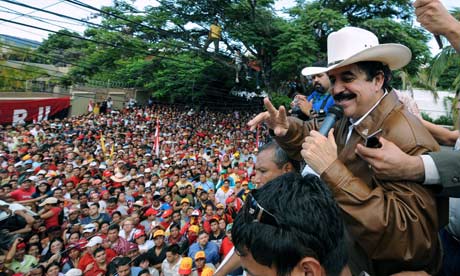
Resistance forces who are calling for the reinstatement of President Manuel Zelaya have continued street demonstrations for the past 148 days. They remain steadfast against any election without Zelaya’s reinstatement and are calling for the immediate end to violence and repression by the coup regime.

“Elections under these conditions would be an act of fraud against the people of Honduras,” said Dr. Luther Castillo, a young Garifuna (African and indigenous descendant) physician from the Atlantic Coast region of Honduras, who is secretary of communications for the National Resistance Front Against the Coup.

Castillo reports that a new wave of repression has been unleashed by the coup regime. “The military has attacked our Garifuna Community Hospital, and arrested many peaceful demonstrators.”

“These elections are illegal because they were called by an unconstitutional government. They were set up to legitimize the illegal coup against the constitutional government of Manuel Zelaya” said Waldina Mejia, a spokesperson for the Honduran Resistance, who is currently in the US.

The National Resistance Front Against the Coup is calling for the international community not to recognize the election and to support the restoration of their constitution and their duly elected government.

They are also calling for a constitutional assembly to respond to the letters from 600,000 marginalized Hondurans who want equal treatment under the law in their own country.

The US State Department has said that the US will recognize the results of the November 29th elections. The International Republican Institute (IRI) and the National Democratic Institute (NDI) (both conservative think tanks who were active in destabilizing the region in the 1980’s) are sending observers to the elections, indicating that they recognize them as legitimate and not the farce elections that they are.

"We support the people of Honduras and the Honduran resistance in protesting the continuing repression, the illegal coup and the fraudulent elections in Honduras. An election held at gunpoint cannot be free and fair,” said Manolo de Los Santos, spokesperson for IFCO/Pastors for Peace.

IFCO/PASTORS FOR PEACE
418 West 145th Street, 3-FL.
New York NY 10031
tel: 212.926.5757 - fax 212.926.5842 - e-mail ifco@igc.org

November 15, 2009

Honduras: A Victory for "Smart Power"


by Eva Golinger,
Monthly Review

Henry Kissinger said that diplomacy is the "art of restraining power." Obviously, the most influential ideologue on US foreign policy of the twenty-first century was referring to the necessity to "restrain the power" of other countries and governments in order to maintain the dominant world power of the United States. Presidents in the style of George W. Bush employed "Hard Power" to achieve this goal: weapons, bombs, threats, and military invasions. Others, like Bill Clinton, used "Soft Power": cultural warfare, Hollywood, ideals, diplomacy, moral authority, and campaigns to "win the hearts and minds" of those in enemy nations. The Obama administration has opted for a mutation of these two concepts, fusing military power with diplomacy, political and economic influence with cultural penetration and legal maneuvering. They call this "Smart Power." Its first application is the coup d'état in Honduras, and as of today, it's worked to perfection.

During her confirmation hearing before the Senate, Secretary of State Hillary Clinton remarked that "We must use what has been called smart power, the full range of tools at our disposal -- diplomatic, economic, military, political, legal, and cultural -- picking the right tool or combination of tools for each situation. With smart power, diplomacy will be the vanguard of our foreign policy." Clinton later reinforced this concept affirming that the "wisest path will be to first use persuasion."

So, what is intelligent about this concept? It's a form of politics that is difficult to classify, difficult to detect, and difficult to deconstruct. Honduras is a clear example. On one hand, President Obama condemned the coup against President Zelaya while his ambassador in Tegucigalpa held regular meetings with the coup leaders. Secretary of State Clinton repeated over and over again during the past four months that Washington didn't want to "influence" the situation in Honduras -- that Hondurans needed to resolve their crisis, without outside interference. But it was Washington that imposed the mediation process "led" by President Oscar Arias of Costa Rica, and Washington that kept funding the coup regime and its supporters via USAID, and Washington that controlled and commanded the Honduran armed forces, involved in repressing the people and imposing a brutal regime, through its massive military presence in the Soto Cano military base.

Washington lobbyists also wrote the San José "agreement," and in the end, it was the high-level State Department and White House delegation that "persuaded" the Hondurans to accept the agreement. Despite the constant US interference in the coup d'état in Honduras -- funding, design, and political and military support -- Washington's "smart power" approach was able to distort public opinion and make the Obama administration come out as the grand victor of "multilateralism."

What "smart power" achieved was a way to disguise Washington's unilateralism as multilateralism. From day one, Washington imposed its agenda. On July 1st, spokespeople for the Department of State admitted in a press briefing that they had prior knowledge of the coup in Honduras. They also admitted that two high-level State Department officials, Thomas Shannon and James Steinberg, were in Honduras the week before the coup, meeting with the civil and military groups involved. They said their purpose was to "impede the coup," but how, then, can they explain that the airplane that forcefully exiled President Zelaya left from the Soto Cano military base in the presence of US military officers?

The facts demonstrate the truth about Washington and the coup in Honduras and the subsequent successful experiment with "smart power." Washington knew about the coup before it happened, yet continued to fund those involved via USAID and NED. The Pentagon aided in the illegal forced exile of President Zelaya, and later, the Obama administration used the Organization of American States (OAS) -- during a moment at which it was on the border of extinction -- as a façade to impose its agenda. The discourse of the Department of State always legitimated the coup leaders, calling on "both parts . . . to resolve the political dispute in a peaceful way through dialogue." Since when is an illegal usurper of power considered a "legitimate part" capable of dialogue? Obviously, a criminal actor who takes power by force is not interested in dialoguing. Based on this Washington logic, the world should call on the Obama administration to "resolve its political dispute with Al Qaeda in a peaceful way through dialogue, and not war."

The Obama/Clinton "smart power" achieved its first victory during the initial days of the coup, persuading the member states of the OAS to accept a 72-hour wait period to allow the coup regime in Honduras to "think through its actions." Soon after, Secretary of State Clinton imposed the mediation efforts, led by Arias, and by then, so much space had been ceded to Washington that the US just stepped in and took the reigns. When President Zelaya went to Washington and met with Clinton, it was obvious who was in control. And that's how they played it out, buying more and more time up until the last minute, so that even if Zelaya returns to power now he will have no space or time to govern.

The people were left out, excluded. Months of repression, violence, persecution, human rights violations, curfews, media closures, tortures, and political assassinations have been forgotten. What a relief, as Assistant Secretary of State Thomas Shannon remarked upon achieving the signature of Micheletti and Zelaya on the final "agreement," that the situation in Honduras was resolved "without violence."

Upon the signing of the "agreement" this past October 30th, Washington immediately lifted the few restrictions it had imposed on the coup regime as a pressure tactic. Now they can get visas again and travel north, they don't have to worry about the millions of dollars from USAID, which hadn't even been suspended in the first place. The US military in presence in Soto Cano can reinitiate all their activities -- oh wait, they never stopped in the first place. The Southern Command (SOUTHCOM) of the Pentagon affirmed just days after the coup that "everything is normal with our armed forces in Honduras, they are engaging in their usual activities with their Honduran counterparts." And Washington is already preparing its delegation of elections observers for the November 29th presidential elections -- they are already on their way.

Forget about Cold War torturer Billy Joya who was scheming with the coup regime against the resistance; or the Colombian paramilitary forces sent in to help the coup regime "control" the population. Don't worry anymore about the sonic warfare LRAD weapon used to torture those inside the Brazilian embassy in an attempt to oust Zelaya from the building. Nothing happened. As Thomas Shannon said, "we congratulate two great men for reaching this historic agreement." And Secretary of State Clinton commented that "this agreement is a tremendous achievement for the Hondurans." Wait, for whom?

In the end, the celebrated "agreement" imposed by Washington only calls upon the Honduran Congress -- the same Congress that falsified Zelaya's resignation letter in order to justify the coup, and the same Congress that supported the illegal installation of Micheletti in the presidency -- to determine whether or not it wants to reinstate Zelaya as president. And only after receiving a legal opinion from the Honduran Supreme Court -- the same one that said Zelaya was a traitor for calling for a non-binding poll vote on potential future constitutional reform, and the same one that ordered his violent capture. Even if the Congress' answer is positive, Zelaya would not have any power. The "agreement" stipulates that the members of his cabinet will be imposed by those political parties involved in the coup, the armed forces will be under the control of the Supreme Court that supported the coup, and Zelaya could be tried for his alleged "crime" of "treason" because he wanted to have a non-binding poll on constitutional reform.

Per the "agreement" a truth commission would supervise its implementation. Today, Ricardo Lagos, ex president of Chile and staunch Washington ally, was announced as the leader of the Honduran Truth Commission. Lagos is co-director of the Board of Directors of the Inter-American Dialogue, a right-wing think tank that influences Washington's policies on Latin America. Lagos also was charged with creating a Chilean version of the National Endowment for Democracy (NED), la Fundación Democracia y Desarrollo, to "promote democracy" in Latin America, US-style. Upon leaving the presidency in 2006, Lagos was named President of the Club of Madrid -- an exclusive club of ex presidents dedicated to "promoting democracy" around the world. Several key figures involved in currently destabilizing left-leaning Latin American governments are members of this "club," including Jorge Quiroga and Gonzalo Sánchez de Lozada (ex presidents of Bolivia), Felipe González (ex prime minister of Spain), Václav Havel (ex president of the Czech Republic), and José María Aznar (ex prime minister of Spain), amongst many others.

In the end, "smart power" was sufficiently intelligent to deceive those who today celebrate an "end to the crisis" in Honduras. But, for a majority of people in Latin America, the victory of Obama's "smart power" in Honduras is a dark and dangerous shadow closing in on us. Initiatives such as ALBA have just begun to achieve a level of Latin American independence from the dominant northern power. For the first time in history, the nations and peoples of Latin America have been collectively standing strong with dignity and sovereignty, building their futures. And then along came Obama with his "smart power," and ALBA was hit by the coup in Honduras, Latin American integration has been weakened by the US military expansion in Colombia, and the struggle for independence and sovereignty in Washington's backyard is being squashed by a sinister smile and insincere handshake.

Bowing before Washington, the crisis in Honduras "was resolved." Ironically, the same crisis was fomented by the US in the first place. There is talk of similar coups in Paraguay, Nicaragua, Ecuador, and Venezuela, where subversion, counterinsurgency and destabilization increase daily. The people of Honduras remain in resistance, despite the "agreement" reached by those in power. Their determined insurrection and commitment to justice is a symbol of dignity. The only way to defeat imperialist aggression -- soft, hard, or smart -- is through the union and integration of the people.

"The illegal we do immediately. The unconstitutional takes a little longer." -- Henry Kissinger

October 21, 2009

Protest PR Firm's Propaganda for Honduran Coup Regime


The Honduran coup regime has hired the services of Chlopak, Leonard, Schechter & Associates, a Washington DC based public relations firm, to clean up its image. SOA Watch will join Hondureños por la Democracia and others at 12:30pm today for a protest at their offices. Please support the protest by letting the PR firm know that their implicit endorsement of the Honduran coup regime and its record of human rights violations is simply unacceptable. You can send an email message through this webpage and call them at (202) 289-5900 to register your opposition.

September 28, 2009

A fast way to Pressure Canadian Gov on Honduras


Please take a few minutes to voice your concern over human rights abuses in Honduras

Honduran President Manuel Zelaya, who was forced into exile following a military coup in the country on June 28, defied the coup regime's efforts to keep him out of the country by staging a return to Honduras on September 21. Despite a hastily-imposed curfew, thousands of Hondurans defied the coup regime's orders and gathered in front of the Brazilian embassy in the capital, Tegucigalpa, where Zelaya is currently in refuge, to support the democratically-elected President.

The coup regime is responding with a brutal crackdown on the Honduran democracy movement. We are receiving reports by the hour of cases of brutal military repression and assaults which have resulted in a large number of injuries and an unconfirmed number of deaths, including that of an eight year old child. The military has surrounded the Brazilian embassy and is out in force in poor neighbourhoods. The national stadium is reported to have been converted into a large holding center for the detained.

The coup regime leader, Roberto Micheletti, has threatened to cancel the embassy's immunity if Zelaya is not handed over to the de facto regime.

In the face of this escalation of violence, Canada is one of the only countries that has failed to act effectively to isolate the coup regime. We need to speak out now and demand action from the Canadian government, before it's too late.

PHONE:

Call Canadian Minister of State for the Americas Peter Kent and deliver the following message:

"I want Canada to work for the unconditional immediate reinstatement of President Zelaya and to pressure the Honduran military to stop the violence against the people and their democratically elected president, Manuel Zelaya. Canada should make clear that it will not recognize the November elections and announce further sanctions against the coup regime and its leaders."

Call Minister Kent at: 613-944-2300.

EMAIL:

Send a message to Minister Kent here: http://en.maquilasolidarity.org/node/895

--
Maquila Solidarity Network
606 Shaw St. Toronto, ON M6G 3L6 Canada
416 532-8584

www.maquilasolidarity.org
>

September 23, 2009

Testimonies by Honduran coup resistors


By Denise M.
Special to Rebel Youth

The lack of media attention to the coup in Honduras disgusts me. Not enough attention is being brought to human rights violations that are being committed by this military regime that assumed power through violent means and ousted democratically elected president, Manuel Zelaya. President Zelaya is now in the Brazilian embassy demanding that dictator Roberto Micheletti steps down. Thousands of supporters are out in the streets defending their president, despite the terrorist actions that have been taken by the military and the police. These are two testimonies written by two coup resistors.


The names of the authors were removed for their own protection.


From XXXX

Friends,

I am now in a building close to Brazil’s embassy with 30 comrades, the majority of which are members of the Artists of the National Front Against the Coup D’etat (Artistas del Frente Nacional Contra el Golpe de Estado).

We came to this place to rest, all the while knowing that at any moment the military and the police could enter the perimeter where we, around 5000 people, are to protect President Manuel Zelaya.

They attacked at 5:45am with guns and teargas. They killed an undetermined number of comrades from the first barricade at the end of the Guantaste bridge. They also surrounded and attacked the barricade of La Reforma bridge.

After doing approximate calculations, the militant operation counted with around 1000 active policemen and militaries.

They cornered and beat up. 18 were severely hurt and taken to the Escuela Hospital. In Barrio Morazan and in Barrio Guadalupe, they are still hunting down the brave students that organized the precarious barricades.

At this moment it is 8am. In front of Brazil’s embassy they now placed a loudspeaker which is blasting the national anthem while they search the houses that border the embassy. They threw teargas bombs inside the embassy. The president remains inside threatened by the coup participants that have explained to the media the “legal” reasons for searching these homes.

Thousands of people that were heading towards the city of Tegucigalpa (where the Brazilian embassy which is where Zelaya is) have been detained all around the city. The city is completely empty: a ghost town. The curfew has been extended to entire day.

The repression against defenseless protestors was brutal. In various occasions, Globo Radio and Channel 36 were taken off the air.

Hundreds have been imprisoned.

We are alienated.

Here we are, the principal members of the planning of great cultural events of resistance: poets, singers, musicians, photographers, film makers, painters…humans.


Read an interview with President Zelaya on his return.

Wednesday morning: Honduras


Rebel Youth magazine expresses its support to a series of emergency demos occurring around the world, including Toronto, Vancouver and Montreal.

September 22, 2009

latest on Honduras-snipers aiming into embassy


After Manuel Zelaya appeared in the Brazilian embassy in Tegucigalpa, the country's capital, repression has intensified. This link below is to a blog that is dedicated to following coup events:

http://hondurascoup2009.blogspot.com/

here's a few snippets:

...Members of the union of electrical workers of the National Electric Company (ENEE) called in to Radio Globo to announce that the Micheletti government intends to cut electricity in the entire country today...They've taken Channel 36 off the air that way...Radio Globo... is reporting that the
police and military has shot into the Brazilian Embassy...Sharpshooters are now being placed on top buildings in and around the Brazilian Embassy
...A friend who lives a couple of kilometers from the Brazilian embassy wrote at 4:30 this morning to report hearing gunshots: "We can hear gun shots and more from our house, about 2km from the Brazilian Embassy. There are hundreds injured. We can hear many gunshots." This as Martha Lorena Alvarado, of the de facto regime,denies that any shots were fired. Romeo Vasquez Velasquez said "we will maintain the order no matter what the cost. "

Another good blog that deals with various subjects including the coup in Honduras is Left Turn.

some posts:

July 27, 2009

Latest on Honduras and Colombia


As reported in Granma and the People's Weekly World online blog, the general strike continues to keep the economy dead in its tracks. Literally, as extensive roadblocks have stopped the flow of people and goods. The report says some police officers have joined the strike and that "Many people called Radio Globo, a radio station that is keeping its microphones open for the people, to report that they had been victims of repression by the army forces who attempted to halt their movement."

The Honduras armed forces have said that they will support the agreement being sought to return President Manuel Zelaya to Honduras, but with severe limits on his powers. This signals that the army is taking a somewhat moderate but still pro-establishment approach compared to Roberto Micheletti, who holds an extreme view of absolutely refusing to have Zelaya return. It's up to the people now. Here's hoping that the strike spreads.

Zelaya has set up camp on the Nicaragua border, this after crossing into Honduras twice over the past few days. Zelaya was the target of a coup d'etat after he tried to hold a referendum to gauge public opinion on changing the constitution to allow him to run a second time.

Meanwhile in Colombia, the Uribe government continued it's campaign of bloody repression. It bombed a FARC camp south of the country's capital. Any hope of peace is dismal while Alvaro Uribe is president. It should be noted that in Colombia Uribe is also planning to change the constitution in order for him to run for a third term in office. If anybody needs to be overthrown it's Uribe.

reports on the honduran regime's attempts to close down radio and free media outlets. Links.

from Indymedia newswire


Listen the transmission of Radio Liberada from some place of Honduras: http://208.43.218.127:8070/

We encourage the national and international independent means groups to broadcast in your free radios or make a mirror of this transmission.

Mirrors: 1 2 3

More information in the Independent Media Center of Honduras Indymedia Honduras: http://chiapas.indymedia.org/honduras/

More information in Radio is the one of less:

http://www.radioeslodemenos.org/

Minute by minute by Kaos in the Network: http://www.kaosenlared.net/noticia/secuestrado-presidente-honduras-militares

Information and transmission by the Association of Radios and Participating Programs of El Salvador (HARPS): http://www.arpas.org.sv/

We know that they have been closing free media in Honduras. This morning (note: report is from late June) the Radio Progreso, one of the older communitarian radios of the continent has been closed by the military. Other communitarian radios have decided to protect their equipment.

The electrical energy, the telephone and the Internet have being interrupted by the coup participants trying to block the communications and make the informative censure.

And the situation worries to us in that the networks of communitarian radios of the Lenca town and the Garífuna town stay, as well as the free media: COMUN, Revistazo, the COFADEH and the rest of groups of the independent and communitarian media movement in Honduras.

July 9, 2009

The Canadian Government on Honduras: Lessons for Today and Tomorrow


* By Arnold August, July 7, 2009

On June 28 Peter Kent, Minister of State of Foreign Affairs (Americas) in the Canadian Stephen Harper Government of the Conservative Party issued a statement in preparation for the Organisation of American States (OAS) emergency meeting to be held later that same day at 3 P.M.

Kent declared that “Canada condemns the coup d’état that took place [on June 28] in Honduras, and calls on all parties to show restraint and to seek a peaceful resolution to the present political situation, which respects democratic norms and the rule of law, including the Honduran Constitution.” The next day, June 29, the important right-wing Canadian national newspaper, National Post, approvingly analyzed the government’s statement indicating that it “...echoed the mushrooming opposition to the coup, but didn’t mention Mr. Zelaya by name or directly call for his return to power.”

On June 29, in a White House joint press conference with visiting Columbian President Uribe, President Obama stated that “...the coup was not legal and that President Zelaya remains the president of Honduras, the democratically elected president there.”

This statement represents a verbal shift in US policy.

Reflecting this change in wording, the next day, June 30, the 192-member United Nation General Assembly met on Honduras and unanimously adopted a resolution which “demands the immediate and unconditional restoration of the legitimate and Constitutional Government of the President of the Republic, Mr. José Manuel Zelaya Rosales.” The Canadian delegation of course voted with the other 191 UN members.

Once again the National Post expressed in its June 30 edition what seems to be their approval, indicating that:

“The decision by Canada to join the measure’s sponsors marked an evolution of [Canada’s] position on Mr. Zelaya’s removal Sunday by the Honduran armed forces...Until Tuesday [June30], Canada had called for resumption of the democratic process in Honduras, but stopped short of calling for Mr. Zelaya’s reinstatement. The United States appeared to hold a similar position, until U.S. President Barack Obama said Monday [June 29] that Washington believes Mr. Zelaya ‘remains the democratically elected president... ’ ”

On July 1, the Organization of American states (OAS) including Canada resolved unanimously to “condemn the coup” and “to reaffirm that President Zelaya is the constitutional President of Honduras and to demand the immediate, safe and unconditional return of the president to his constitutional functions.”

On July 2 the National Post wrote that “though Canada has followed the lead of Venezuela and other leftist Latin American countries in demanding Mr. Zelaya’s reinstatement, Peter Kent, Minister of State for Foreign Affairs for the America’s, said Ottawa’s support is focused on efforts led by the OAS....There is reason to believe that responsible individuals in the [current] government will recognize that an unacceptable line was crossed and that they must return to the democratic side....While Mr. Kent said there could be no compromise on whether Mr. Zelaya is reinstated, he signalled that Mr. Zelaya’s action ahead of his ousting had not gone unnoticed either.”

The newspaper went on to quote Mr Kent:

“ ‘The [provisional government – parenthesis by National Post] must first restore the democratic order of rule of law. Once there, the people of Honduras and those of the [provisional - parenthesis by National Post] government have every reason to believe that the OAS is paying attention and is well aware of transgressions made by all parties.’ ”

This statement represents a further departure from the UN and OAS resolutions, in favour of which the Canadian Government voted and whose essence in both instances demanded the immediate, safe and unconditional return of President Zelaya.

On July 4, the day before the stand-off on the Honduran airport runway between on the one hand President Zelaya and the people of Honduras and on the other hand the military government, according to a Reuters cable, Peter Kent declared to the OAS session: “ ‘It is far from clear that current conditions could guaranty his safety upon return.’ ” This policy was confirmed by CNN on July 4 when it was reported that “the Canadian delegate to the OAS meeting recommended Saturday night [July 4] that Zelaya not return immediately because of the danger in which he could find himself.”

There is no doubt that President Zelaya’s landing in Honduran capital’s international airport, under the conditions of July 5, presented a danger for him, his entourage and the tens of thousands of his supporters awaiting him in the face of the full armed force and repression of the military.

But what did the Canadian government do to add its voice and prestige to force the military de facto government to give way? Did it join with the countries of Central and Latin America and insist that the OAS and UN resolutions be applied in spirit and in letter? By recommending that Zelaya not return consists of an indirect or virtually direct signal of encouragement to the military regime to blame President Zelaya for any violence or bloodshed resulting from the application of the international resolutions.

On July 6, US State Department spokesperson Ian Kelly held a press briefing on Honduras and other issues. Regarding Honduras, in his opening statement, Mr. Kelley stated that “our goal remains the restoration of the democratic order in Honduras.”

A reporter could not help but notice that there was something very unclear and ambiguous. Taking into consideration the nebulous and double-standard US definition of democracy, a question by a reporter was quite significant.

A reporter asked: “Have you figured out ... when you see say you seek the restoration of democratic order, have you guys yet figured out what that means?”

Mr. Kelley: “Well, I think it means – in the most immediate instance, it means the return of the democratically elected president to Tegucigalpa [Honduran capital].”

If the reporter did not raise the issue, this key demand of the world’s people would not have been made explicit, even if it be only in words. Another discussion between M. Kelly and other reporters centered on the issue of Washington’s links and aid to Honduras. It remained unclear as Mr. Kelley evasively responded under questioning that some aid continued while other assistance was cut off or in the process of being evaluated and/or eliminated.

Regarding the US military ties with the de facto government, Mr. Kelly said in response to reporters’ questions that the “Southern Command has minimized contact with Honduran military.” Notice that contact has continued but has only been “minimized”, without any specification. However, specifications—did—come into the picture when reporters asked about the Soto Cano US military base in Honduras.

Question by reporter: “Was there any talk of allowing Zelaya’s plane to land at the U.S. military base there?” Response by Mr. Kelly: “...That base is controlled by the Honduran authorities, so it is not up to us to allow landing rights or anything.” How convenient!

The United States has for several decades used the Two-Track foreign policy towards Latin America: on the one hand direct intervention including military force and on the other hand “soft” diplomacy and negotiations, the latter both openly and behind closed doors. The July 6 briefing as indicated above is an example of how the current Washington administration simultaneously uses both Track I and Track II.

It is very positive indeed the Mr. Kelly stated on July 6 that the State Department will meet with President Zelaya on July 7 and not the de facto government if a representative of the latter should later come to Washington. However, this commitment only emerged once again as a result of questioning by reporters. While there are of course contradictions amongst US institutions such as the White House, the State Department, CIA, the FBI, the Pentagon, the South Florida extreme right-wing, etcetera, the US policy towards Honduras from June 28 up to an including July7 consists of this twin Two-Track policy: Track I: indirectly if not directly being involved in the military coup and the current thinly veiled support for the military. Track II: simultaneously using talks and diplomacy to “diffuse” the situation; but diffuse it is favour of whom?

On the one hand there are words of wisdom concerning restoring democracy and the elected president, while on the other hand placing the military coup leaders and the violently kidnapped President almost on the same footing.

The Canadian governments for its part have for many years been a spokesperson for Track II. (There have been exceptions for example the late Prime Minister’s Trudeau’s sincere outreaching to Cuba and Latin America during his 1976 visit to Cuba, thus reflecting the sentiment of the vast majority of Canadian people).

Engagement and diplomacy but for ulterior motives is supposed to predominate in Ottawa and in this way attempting to distinguish themselves from the US brutal policy of intervention which almost always held the upper hand over Track II. The people of Canada in its vast majority have a marked disdain for policies of intervention and aggression. The current Canadian government is part of the right-wing tendency.

There are really no hot beds of neo-cons in Canada flaming Track I policies as is done by such elements as the Cuban and Venezuelan exile communities in South Florida. The closest one can come to this is the establishment National Post and the section of the ruling circles which it represents. However, as we can see from the above, the Conservative Party and the conservative section of the ruling circles can easily accommodate itself to both Track I and Track II as the Honduran issue shows, even if the foreign policy changes like a chameleon from one day to the next.

The Obama government, in comparison to the Canadian Conservative government, is supposed to be on the center-left and opposed to the right-wing Bush era policies. The essence of all this is that Track I and Track II are two wings of the same policy consisting of domination and control, it is just a question of which one is more efficient and “works”. Both tracks are useful for “conservatives” as well as “liberals” and the two tracks can blend into each other from one moment to the next.

One of the lessons to be learned and on which action has to be taken immediately is to hold the Canadian government responsible for its violation of the OAS and UN resolutions. The Conservatives must change their position right now and distance itself from the US policy and instead ally itself with the vast movements in South America.

Already, some political parties in the Canadian Parliament have courageously and honourably raised objections to the Canadian government Honduras policy from June 28 to date. There can be no delays. The Honduran de facto government must be forced to step aside now and allow the President to return.

If the Canadian government is so concerned about the danger to the President if he returned to his country and people, the answer does not lie in keeping him away, but rather in forcing the abdication of the usurpers according the international resolutions and positions. I believe that the coup against Honduras is a blow directed against the movements for sovereignty and progress of all the peoples of Latin America.

The peoples of the world, especially now in Latin America, must be forever vigilant and oppose the Two Track policy of imperialism coming from the north. The peoples in the south of the Americas have been carving out their own concepts of sovereignty and democracy over the last 50 years through many sacrifices and struggles and thus deserve the full support of peoples in Canada and the USA.

* Arnold August, Montreal, Canada is an author and journalist specializing on Cuba.

July 7, 2009

Honduras: Harper government isolated


Harper government isolated as opposition to coup in Honduras grows

Reprinted from Rabbel.ca

At Saturday's special meeting of the Organization of American States (OAS) minister for the Americas, Peter Kent, recommended that ousted President Manuel Zelaya delay his planned return to the country.

Kent said the “time is not right,” prompting Zelaya to respond dryly: “I could delay until January 27 [2010],” when his term ends. Kent added that it was important to take into account the context in which the military overthrew Zelaya, particularly whether he had violated the Constitution.

Along with three Latin American heads of states, Zelaya tried to return to Honduras on Sunday. But the military blocked his plane from landing and kept a 100,000 plus supporters at bay. In doing so the military killed two protesters and wounded at least 30. On CTV Kent blamed Zelaya for the violence.

This was Kent's most recent attack against Zelaya. In June Kent criticized Zelaya's plan for a non-binding public poll on whether to hold consultations to reopen the constitution.

"We have concerns with the government of Honduras," he said a couple of weeks ago. "There are elections coming up this year and we are watching very carefully the behaviour of the government and what seems to be an attempt to amend the constitution to allow consecutive presidencies."

With political tensions increasing in Honduras, two days before the coup the OAS passed a resolution supporting democracy and the rule of law in that country.

Ottawa's representative to the OAS remained silent on the issue. Foreign Affairs took a similar position in the hours after Zelaya was kidnapped by the military. Eight hours after Zelaya's ouster last Sunday morning a Foreign Affairs spokesperson told Notimex that Canada had "no comment" regarding the coup. It was not until late in the evening, after basically every country in the hemisphere denounced the coup, that Ottawa finally did so.

Canada, reports Notimex, is the only country in the hemisphere that did not explicitly call for Zelaya's return to power. Unlike the World Bank and others, Ottawa has not announced plans to suspend aid to Honduras, which is the largest recipient of Canadian assistance in Central America. Nor has Ottawa mentioned that it will exclude the Honduran military from its Military Training Assistance Programme.

Ottawa's hostility towards Zelaya is likely motivated by particular corporate interests and his support for the social transformation taking place across Latin America.

From 1996-2006 Canadian companies were the second-biggest investors in the Central American country. It is unlikely that Zelaya won brownie points from the large Canadian mining sector -- including Breakwater Resources, Yamana Gold and Goldcorp that are active in Honduras -- when he announced that no new mining concessions would be granted.

Likewise, Zelaya's move earlier this year to raise the minimum wage by 60 per cent could not have gone down well with the world's biggest blank T-shirt maker, Montréal-based Gildan. Employing thousands of Hondurans at low wages Gildan produces about half of its garments in the country. While the political instability in Honduras initially hit the company's stock price, a Desjardins Securities analyst Martin Landry noted that in the long term the coup could help Gildan if it leads to a more pro-business government.

More broadly, the Harper government opposes Zelaya's gravitation towards the governments in the region leading the push towards a more united Latin America. A year ago Honduras joined the Hugo Chavez led ALBA, the Bolivarian Alliance for the People of Our Americas, which is a fast growing response to North American capitalist domination of the region.

Two years ago Harper toured South America to help stunt the region's recent rejection of neoliberalism and U.S dependence. “To show [the region] that Canada functions and that it can be a better model than Venezuela,” in the words of a high-level Foreign Affairs official.

During the trip, Harper and his entourage made a number of comments critical of the Venezuelan government. In a coded reference to Chavez, Harper discussed a "Latin American dictator."

Demonizing Chavez is part of Ottawa's attempt to block the leftward shift in the region. Supporting the coup in Honduras is part of the same plan.


Yves Engler is the author of The Black Book of Canadian Foreign Policy and other books. If you would like to help organize a talk as part of a book tour in September Please e-mail: yvesengler [at] hotmail [dot] com.


June 29, 2009

The return of the banana republic?

  • Honduran president expelled by army
    From Wikinews, combined sources
    Monday, June 29, 2009

    Honduran President Manuel Zelaya was expelled by the country's army on Sunday. Zelaya declares the action a coup d'état.

    "Today's events originate from a court order by a competent judge. The armed forces, in charge of supporting the constitution, acted to defend the state of law and have been forced to apply legal dispositions against those who have expressed themselves publicly and acted against the dispositions of the basic law," said the supreme court in Honduras.

    Zelaya was attempting to change the constitution via a constitutional referendum to allow himself to be re-elected following the 2009 Honduran political crisis.
    Speaking from Costa Rica, Zelaya said, "Tomorrow, I will attend in the Summit of Central American presidents in Managua."

    Leaders from around the world have reacted to the ouster, saying it is against the Inter-American Democratic Charter and the Vienna Convention.
    "I call on all political and social actors in Honduras to respect democratic norms, the rule of law and the tenets of the Inter-American Democratic Charter," President of the United States Barack Obama said, "Any existing tensions and disputes must be resolved peacefully through dialogue free from any outside interference."

    Meanwhile Peter Kent, the Canadian Minister of State of Foreign Affairs (Americas), stated: "Canada condemns the coup d'état that took place over the weekend in Honduras, and calls on all parties to show restraint and to seek a peaceful resolution to the present political crisis, which respects democratic norms and the rule of law, including the Honduran Constitution. Democratic governance is a central pillar of Canada's enhanced engagement in the Americas, and we are seriously concerned by what has transpired in Honduras."

    Based on the statement, Canada supports the democratically elected president. Or not. Based on the bold font portion of the quote, it seems that the Tory government supports the constitution and a peaceful resolution, perhaps implying a peaceful coup? Given that Harper prorogued parliament late last year, it should come as no surprise that in Honduras, the military has also invoked special powers to keep power in the hands of the establishment. The Harper government has not gone as far as other nations, which have pledged support for Zelaya specifically, rather than broad terms of peace and law and order.

    A role by US Special Forces?

    According to wikileaks, a confidential US Special Forces (7th, US Southern Command), briefing dated 17 May 2009 was created for Florida Congressman Miller.
    On page 7 of the document, it is proudly proclaimed that the 7th Special Forces Group has conducted missions in every Latin American country.
    On page 10 a map is given, revealing Special Forces deployments to 19 Latin American countries during 2009 alone, including two bases or missions in Honduras.
    Notable is a graph of Special Forces growth. Its numbers now substantially eclipse its previous 1968 peak during the height of the cold war.

The local U.S. military base is maintained at Soto Cano. It has a garrison of about 500 troops.

The Honduran military leader of the coup is Romeo Orlando Vasquez Velasquez a graduate of the Western Hemisphere Institute for Security Cooperation AKA School of the Americas, Fort Benning.

A constantly changing situation

  • International community overwhelmingly condemns coup.

  • United States President Obama recognizes Zelaya as the legitimate President of Honduras.
  • reports of arrests of foreign news reporters.
  • Battalions of troops (including the 10th infantry)are reported to have rebelled and now fight against the military dictatorship.
  • People have put up popular resistance and blockade "all the highways in the country".


news report

raw footage used in the above report 1....2


Reflections by comrade Fidel

A SUICIDAL MISTAKE

Three days ago, in the evening of Thursday 25th, I wrote in my Reflections: "We do not know what will happen tonight or tomorrow in Honduras, but the courageous behavior adopted by Zelaya will go down in history."

Two paragraphs before I had indicated that: "The situation that might result from whatever occurs in that country will be a test for the OAS and the current US administration."

The prehistoric Inter-American institution met in Washington the following day and in a halfhearted and spiritless resolution promised to immediately make the necessary efforts to bring about harmony between the contending parties; that is, a negotiation between the putschists and the Constitutional President of Honduras.

The high ranking military chief who was still in command of the Honduran Armed Forces was making public statements different from the President’s position while recognizing his authority in a merely formal way.

The putschists needed barely anything else from the OAS. They couldn’t care less for the presence of a large number of international observers who had traveled to that country to bear witness to a referendum and who had been talking with Zelaya until late into the night. Today, before dawn, they launched on the President’s home about 200 well-trained and equipped professional troops who roughly set aside the members of the Guard of Honor and kidnapped Zelaya --who was sleeping at the moment-- taking him to an air base and forcibly putting him on a plane to Costa Rica.

At 8:30 a.m. we learned from Telesur of the assault on the Presidential House and the kidnapping. The President was unable to attend the initial activity related to the referendum that was to take place this Sunday and his whereabouts were unknown.

The official television channel was silenced. They wanted to prevent the early spread of the news of the treacherous action through Telesur and Cubavision Internacional, which were reporting the events. Therefore, they first suspended the broadcasting centers and then cut off electricity to the entire country. At the moment, the Supreme Court and the Congress involved in the conspiracy had yet to make public the decisions that justified the plot. They first carried out the indescribable military coup and then legalized it.

The people woke up to a fait accompli and started to react with growing indignation. Zelaya’s destination was unknown. Three hours later the people’s reaction was such that we could see women punching soldiers with their fists and the latter’s weapons falling off their hands as they were nervous and confused. At the beginning, their movements resembled a strange combat with ghosts; later, they tried to cover Telesur’s cameras with their hands and nervously aimed their guns at the reporters. Sometimes, when the people advanced the troops stepped back. At this point, armored vehicles carrying cannons and machineguns were sent in as the people fearlessly discussed with the crews of the armored vehicles. The people’s reaction was amazing.

Approximately at 2:00 in the afternoon, a tamed majority in Congress --in coordination with the putschists—toppled Zelaya, the Constitutional President of Honduras, and appointed a new head of State announcing to the world that the former had resigned and showing a forged signature. A few minutes later, from an airport in Costa Rica, Zelaya related everything that had happened and categorically refuted the news about his resignation. The plotters had placed themselves in a ridiculous situation in the eyes of the world.

Many other things happened today. Cubavision took all of its time to expose the coup and keep our people informed.

Some events were purely fascist in nature and even if expected they are still astonishing.

Honduran Foreign Minister Patricia Rodas was the putschists’ main target, second only to Zelaya. Another detachment was sent to her residence. She was brave and determined, and she acted quickly; she did not waste time and started denouncing the coup in every way possible. Our ambassador contacted Patricia to learn about the situation; other ambassadors did likewise. At a given moment, she asked the diplomatic representatives of Venezuela, Nicaragua and Cuba to meet with her since she was being fiercely hounded and required diplomatic protection. Our ambassador, who from the first moments was authorized to offer the minister all the constitutional and legal support, proceeded to visit her in her own residence.

When the diplomats were already in her house, the putschist command sent Major Oceguera to put her under arrest. The diplomats stood between the woman and the officer and claimed she was under diplomatic protection and could only be moved accompanied by them. Oceguera discussed with them in a respectful fashion. A few minutes later, 12 or 15 men in uniform and covering their faces with ski masks rushed into the house. The three ambassadors embraced Patricia but the masked men using force managed to separate the Venezuelan and Nicaraguan ambassadors; Hernandez held her so strongly by one arm that the masked men dragged them both to a van and drove to an air base where they finally separated him and took her away. As he was there in custody, Bruno, who had news of the kidnapping called him to the cell phone; one of the masked men tried to violently snatch the phone out of his hands and the Cuban ambassador, who had already been punched in Patricia’s home, shouted: "Don’t push me, cojones!" I don’t remember if the term was ever used by Cervantes, but there is no doubt that ambassador Juan Carlos Hernandez has enriched our language.

Later, he was abandoned in a road far from the Cuban mission not before being warned that something worse could happen to him if he talked. "Nothing can be worse than death," he answered with dignity, "and still I’m not afraid of you." Then people from the area helped him to return to the embassy and from there he immediately called Bruno again.

There is no way to negotiate with that putschist high command. They must be asked to abdicate while other younger officers, uninvolved with the oligarchy, take charge of the military command; otherwise, there will never be in Honduras a government "of the people, by the people and for the people."

There is no hope for the cornered and isolated putschists if the problem is faced with determination.

Even Mrs. Clinton stated this afternoon that Zelaya is the only President of Honduras and the Honduran putschists can’t even breathe without the support of the United States of America.

Zelaya, a man who was in his pyjamas just a few hours ago, will be recognized by the world as the only Constitutional President of Honduras.


Fidel Castro Ruz
June 28, 2009
6:14 PM.

Popular stories