January 25, 2013

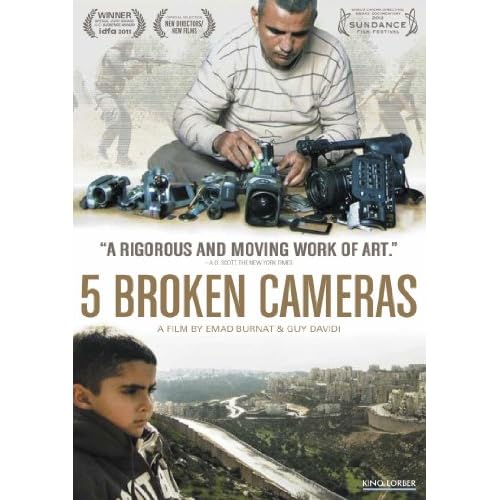
“5 Broken Cameras” Documentary Review


Peter Miller

Ever since the latest assault by Israel on Gaza, which resulted in over 130 Palestinian deaths, and displayed the terror used by the Israeli Government in order to perpetuate the colonization of Palestine, more and more Canadians have started to question Canada’s unconditional support of Israel.

Now two documentaries critical of Israel, “5 Broken Cameras” and “The Gatekeepers” are nominated for the Academy Awards as best documentary film.

“5 Brocken Cameras” follows the story of Emad Burnat as he films his village’s resistance to a separation fence implemented by Israel that expropriated Palestinian agricultural land. The film is structured around the destruction of Burnat’s 5 cameras that occur between 2005 and 2009. At one point, Burnat’s camera saves his life when a bullet is fired into it as he is filming.

The documentary displays an inspiring, non-violent resistance from villagers in Bil’in, who received solidarity from around the world as they protested the occupation of their agricultural land. Emad Burnat and many of the villagers are unemployed and live off the land, harvesting olive trees. Therefore, losing their land brings great hardship to the people in Bil’in.  The documentary shows the tremendous courage of the Palestinian protestors, who face relentless repression by Israeli solders as they take part in weekly protests and direct action in order to get their land back.

Two of Burnat’s best friends are leaders of the resistance, and particularly inspiring. Bassem Abu Rahmah who also goes by Phil in the film, is loved by all the children in the village. Burnat’s filming reveals Phil’s kind-heartedness as he plays with children and jokes with his friends. It is amazing to see Phil act as such a strong, loving spirit encouraging fellow villagers to take part in the struggle, despite all of the hardship that has occurred.

Burnat’s other close friend is Adeeb Abu Rahmah. His bravery is shown many times. At one point he hugs an olive tree, demanding the soldiers turn around and leave the land. At another time he falls purposefully on the ground while in confrontation with Israeli Soldiers during a protest. He spreads his arms out and dares the soldiers to shoot him.  Soon after while still on the ground, he again begins demanding them to leave.

The inspiring film can also be hard to watch. Terrifying examples of Israel’s repression of Palestian protest are caught on Burnat’s camera. In nightly raids, Israeli soldiers arrest children in the village and take them away for the night in order to make them afraid of ever protesting again. During protests, shots are fired, and tear gas is always used. One of Burnat’s friends dies from a gunshot wound, 2 of his brothers are arrested, and at one point, Burnat’s camera captures a soldier shooting his brother at point blank in the leg, as other soldiers hold his brother down.

Burnat is targeted because his videography is documenting the gruesome repression of his villagers, and helping motivate solidarity around the world for Palestinian people. At one point he captures soldiers coming to his door in order to arrest him during a nightly raid. He is placed in house arrest at one point, and films himself during it because he has hardly anything else to do.

The film’s nomination in the Academy Awards is a positive development. Let’s hope that it’s nomination will cause more people to see it, and become witnesses to the colonization of Palestinian land by Israel. Let’s also hope that as more and more people watch this film they not only witness the repression of Palestinian people, but also are galvanized to take action against Canada’s unrelenting support of Israel’s crimes. Let’s keep our fingers crossed that that film wins at the Academy Awards and sends a message to Canadian and American people that our governments are on the wrong side of history when it comes to this conflict.

Jan. 28 Idle No More rallies, Canada-wide


Ottawa – March and Rally
Contact; Anil Naidoo anil@canadians.org
Place and Time: 11:10am
Victoria Island March –– gather at #CommonCauses banner and march together in solidarity to Parliament Hill for Speeches.
2:15pm Parliament Hill - Maude Barlow delivers a message on behalf of Common Causes.

Nanaimo – Rally
Contact; Paul Manly paulmanly@shaw.ca
Place and Time – 12:00 noon – Diane Krall Plaza (in front of the Library) 90 Commercial Street, Nanaimo

Sechelt/Sunshine Coast – Rally
Contact; Jef Keighley keighley@dccnet.com
Place and Time – 4:00 to 5:30pm - Gather at the corners of Wharf Street and the Sunshine Coast Highway, 4:00 to 5:30pm – Action along Sunshine Coast Highway

Vancouver – Rally w/INM
Contact; Harjap Grewel hgrewal@canadians.org
Place and Time - 12:00 noon at 1138 Melville Street, Vancouver, Aboriginal Affairs and Northern Development Canada.

Courtney/Comox – Rally
Contact; Kathie Woodley riverside11@shaw.ca
Place and Time – 12:00 noon at 3310 Comox Road across from the I-Hos Gallery.

Kelowna – Rally at Enbridge Hearings
Contact; Lois B, loandcoagain@hotmail.com
Place and Time: 12:30pm at the Sandman Inn, 2130 Harvey Street, Kelowna

Kamloops – Information Evening w/INM
Contact; Anita Strong, dnastrong1@gmail.com
Place and Time; 6pm at the Smorgasbord Deli, 225 - 7th Ave. Kamloops.

Edmonton –Solidarity Event
Contact: Bill Moore-Kilgannon billmk@pialberta.org
Place and Time; 12:15pm – Churchill Square

Saskatoon - Townhall
Contact; Rick Sawa rj.sawa@inet2000.com
Place and Time - 11:00 am - Multi-purpose room at Station 20 West 1120 20th Street West, Saskatoon

Prince Albert – Video Release
Contact – Rick Sawa rj.sawa@inet2000.com
Place and Time; Video and press release on January 28th of weekend action.

Toronto – Banner Drop
Contact Mark Calzavara mcalzavara@canadians.org
Place and Time – 8-9am - Banner Drop along Don Valley Parkway at Wynford overpass (North of Eglinton)
Banner Message -Don’t Sell Out Canada’s Future commoncauses.ca

Guelph – Screening and Discussion
Contact - nrchaloner@hotmail.com
Place and Time – 7pm - Room 103 – University Centre, University of Guelph – Toxic Trespass screening with Q &A
Possible mid-afternoon march – TBC

London – Rally
Contact – jkennedy@golden.net
Place and Time - 10:30am – 546 King Street (at William), London - in front of Conservative MP Susan Truppe’s constituency office.

Oakville –
Contact - Clare Henderson reclaimcanada@gmail.com
Place and Time - 8:00am Oakville GO Station start
The Reclaim Our Democratic Canada Get off the Omnibus Tour

Windsor – Rally
Contact - Douglas Hayes dhayes18@cogeco.ca
Place and Time – 4pm - 186 Talbot Rd. Essex. Windsor - in front of Conservative MP Jeff Watson's constituency office

Montreal - Film Screening and Solidarity Statements
Contact - Abdul Pirani abdul.pirani@cgocable.ca
Place and Time - 7pm, Concordia H110, Hall Building, 1455 Maisonneuve W. Montreal

Halifax – March and Rally
Contact – Angela Giles – agiles@canadians.org
Place and Time - 10am – Gathering at the Holiday Inn parking, March across the MacDonald Bridge, rally at either Halifax Commons or Citadel Hill

Summerside – Rally – Note the Change
Contact - Leo Broderick - lcb45@eastlink.ca
Place and Time – 12pm Noon - 250 Water Street in front of National Revenue Minister Gail Shea’s MP Office

Saint John - Townhall
Contact – Leticia Adair adairl@nb.sympatico.ca
Place and Time – 7pm - Saint John Arts Centre, 20 Hazen Avenue
Town Hall with Rob Moir, Pat Riley and Stephanie Merrill
For Information;  506 633-0398

Peterborough -
Contact – Roy Brady rbrady1@cogeco.ca
Date: Wednesday, January 30,
Place - George St. United Church
Time - 7:00 - 9:30 pm

January 20, 2013

First Nations: The Long Shadow of Assimilation

Hennessy's Index: A number is never just a number
National Office of the Canadian Centre For Policy Alternatives (CCPA)
Hennessy's Index is a monthly listing of numbers, written by the CCPA's Trish Hennessy, about Canada and its place in the world. For other months, visit:http://policyalternatives.ca/index
  • 150,000

    Number of Aboriginal children who were taken from their families and forced into residential schools as part of Canada’s assimilation policy from the 1870s onward. In 2008, the government apologized to Aboriginal peoples “for failing them so profoundly.” (Source 12)
  • 70 cents

    Amount Aboriginal peoples earned for every dollar non-Aboriginals earned in 2006. At this rate, the income gap between Aboriginal peoples and the rest of Canadians won’t disappear for another 63 years, unless Canada adopts a new approach. (Source)
  • 1 in 4

    Number of children within First Nations families who live in poverty in Canada, much higher than the 1 in 10 children in non-Aboriginal families who live in poverty. (Source)
  • 444

    Number of recommendations to improve the lives of Canada’s First Nations people within the landmark Royal Commission on Aboriginal Peoples report, now 16 years old.  (Source 12)
  • $7.5 billion

    Estimated annual cost of doing nothing to resolve First Nations employment and social problems in Canada (in 1996 alone). (Source)
  • 5-7

    Number of Aboriginal youth suicides for every non-Aboriginal Canadian youth. Suicide rates among Inuit youth are among the highest in the world, 11 times the national average.  (Source)
  • 600

    Number of unresolved cases of missing and/or murdered Aboriginal women in Canada. (Source)
  • 120

    Number of Aboriginal communities with a drinking water advisory, as of October 31, 2011. Of the more than 500,000 First Nations people who live on Canada’s reserves, thousands live without indoor plumbing.  (Source)
  • Nearly half

    Number of houses on Canadian reserves in need of major repair. The federal auditor general says Aboriginal housing is subject to overcrowding and requires more federal funding to keep up with the growing Aboriginal population. (Source 12)
  • $169-$189 million

    Estimated federal government underfunding of capital expenditures on reserves annually. The Assembly of First Nations (AFN) says 40 new schools, at a cost of $12.5 million each, and 85,000 housing units would have to be built to meet current needs. (Source)
  • C-45

    The federal omnibus bill that sparked a movement in Canada called Idle No More, which points to eight legislative bills that violate treaties. Amnesty International says changes to the Canadian Environmental Assessment Act, the Fisheries Act, the Navigable Waters Act, and the proposed Safe Drinking Water for First Nations Act have profound implications for the rights of Indigenous peoples as set out in treaties, affirmed in the constitution, and protected by international human rights standards. (Source 123)
  • 35.1

    Section of Canada’s constitution that commits the Prime Minister and First Ministers to meet with Aboriginal peoples before changing federal responsibilities that affect First Nations. (Source)
  • December 11, 2012

    The day Chief Theresa Spence’s hunger strike began. She says she is willing to die for her people “because the suffering is too much”. Her request: a commitment by the Prime Minister to meet with Canada’s First Nations chiefs. (Source)
  • 24,815

    Number of tweets attributed to the #IdleNoMore Twitter hashtag on December 23, 2013 alone. The movement has not only gone viral, support has spread beyond the Canadian border in a phenomenon considered “too big to track”. (Source 12)

Popular stories