January 16, 2013

Mali: Labour, peace, African and French youth voices against the intervention


Launched just days ago, a brutal military intervention by the French "socialist" government of Francois Hollande is being carried out in Mali. The war includes areal bombing assault and, now, a ground assault by troops.

As People's Voice noted earlier in January:

A consequence of the western imperialist powers' intervention in Libya in 2011, under the guise of the Responsibility to Protect doctrine (R2P), which cost the lives of thousands of civilians, was the destabilization of the west African state of Mali.  On Dec. 20, the United Nations Security Council adopted Resolution 2085, authorizing deployment of an African‑led International Support Mission (AFISMA) in northern Mali.... An estimated 1.2 million Tuareg people inhabit the Saharan interior of Africa, living as nomadic pastoralists in Mali, Algeria, Niger, Libya, and Burkina Faso. Since the European powers first colonized the region, causing wide‑scale displacement and suffering, the Tuareg have struggled for better living conditions and the right to self‑determination. They have continued this struggle against the Western‑backed leaders of their now independent nations.

The main pretext for this imperialist war is the intensification of the strife and war between the Malian army and the militant organizations that claim to be fighting for the independence of Northern Mali in Azawad. In this context, Malian President Dioncounda Traore (who was appointed after a military coup last March) "asked" for action which resulted in a December 2012 UN Security Council resolution.

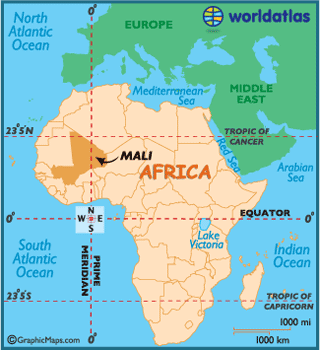
Mali is a landlocked West African country, well-known internationally for its music and cultural history, home of the famous historic trade city of Timbuktu. The country is also a former French colony (see this link here which shows a 1936 map of West Africa; read here about the pact France forced on its former colonies after 'independence').

The military "operation" focuses on the Muslim Tuareg people's homeland in the north of the Mali, in an area known as the Sahel. The Sahel is an the ecoclimatic and biogeographic zone of transition between the Sahara desert in the North and the Sudanian Savannas. It is home to vast natural resources with the world third largest uranium reserves as well as substantial oil reserves.

One of the main companies involved is the French energy corporation Areva, which is the second largest producer of uranium in the world.  Areva has been extracting for decades in neighbouring Nigeria, although they have lost their exclusive rights recently.

Uranium is a very important energy source for France. The World Nuclear Association says that over 75 percent of electricity is produced from nuclear energy in France, and the country is also the world's largest net exporter of nuclear-generated electricity with a revenue of more than 3 billion Euro a year.

The French force includes at least 2,500 French troops as well as Gazelle helicopter gunships, as well as six Mirage 2000D fighter jets based in Chad and four Rafale fighter jets from France in the bombing runs.

The war is taking place with the full support of the United States and NATO, as well as the European Union, the Economic Community Of West African States (ECOWAS) -- and the Harper Conservative government of Canada.

About 2340 troops are expected from neighbouring African countries; Britain is also sending two C-17 aircraft to carry troops and military equipment while Denmark and Belgium are also sending troop transport aircraft and helicopters respectively. The US is providing military intelligence.

The Harper Conservatives, who have no money or time for the Aboriginal peoples and Idle No More, immediately sent one C-17 cargo plane to Mali on Tuesday to offer logistical support to the French, airlifting supplies to Bamako. There is a summary of Canadian mining and other corporate investments in Mali here.


Below are some statements by labour, peace, and communist youth organizations of South Africa and France.


Geo-strategic goals, not humanitarianism

(The intervention) constitutes the continuation of the implementation of the imperialist plans for the geo-strategical control of broader areas of Africa, as we have seen it in 2011 with the bloody intervention and bombing of Libya. Their goal are the energy resources which are object of fierce rivalry between imperialist forces and centers, which however go hand in hand in the slaughter of the peoples under various pretexts each time. World Peace Council


Plunder and control of uranium mines

...After the genocide in Rwanda and the demolition of Libya, France continues to use the military bases it maintains in Africa in order to strengthen its role in the inter-imperialist competition and to serve the interests of its monopoly groups who are plundering the wealth-producing resources (gold, uranium etc.).  (...)  aiming for the protection of the French interests in the uranium mines found in Tuareg areas of the West-African Region, the inter-imperialist competition for the control of the wealth-producing resources of Mali and the placement of puppet-governments in the African countries serving the leading imperialist forces...  World Federation of Trade Unions


No war for Areva and Total!


It did not take much for our country to start the onslaught of Mali. In the name of freedom and the fight against terrorism, the (French) government arises as the savoir of Africa. This speech, appropriate for the clash of civilizations, is shameful. We've known this policy to justify intervention in Afghanistan, Iraq or Libya. With what results? Destabilization, violence and armed militias in those countries that are completely divided.

No war on behalf of (the companies) Areva and Total! We refuse to make a war on behalf of corporate interests. The war will only bring its share of desolation and not solve anything. Armed intervention is an opportunity to strengthen the positions of French multinationals in the region, Areva in Niger and Total West Africa, which operate without resources that local people benefit.  Communist Youth of France


A task for the people of Mali and Africa, not imperialism

In our minds we still harbour fresh memories of French military invasion of Libya in 2011 as part of NATO, leading to a regime change; French military "residence" in Ivory Coast which was actively involved in regime change; and French military presence in the Central Africa Republic, to "protect" the so-called French interests but not to keep peace and as part not to prevent rebels from capturing that country.


This time around France is "fighting" rebels which seek to capture Bamako, the capital city in Mali. We see this as nothing but an agenda by France to defend its hegemony and advance its capitalist interests in the country and the region at large. (...) The people of Mali and the African Union must be the ones taking a leading role in solving the problems experienced in Mali and in Africa respectively, not imperialist countries and former colonisers such as France which in the first place are part of the root causes to these problems and their historical development. Young Communist League of South Africa


January 15, 2013

Found on the internets...


We think this silly song is really mocking us, and while Rebel Youth is not pro-religion (although we think it is difficult to be against something that does not exist) we are really not anti-feminist. Nevertheless... Sing to the tune of the Major-General’s Song from Gilbert and Sullivan’s “Pirates of Penzance”.

I am the very model of a modern Marxist-Leninist.
I’m anti-war, and anti-God and very anti-feminist;
My thinking’s dialectical, my wisdom’s undebateable,
When I negate negations they’re undoubtedly negatable.
And yet I’m no ascetic – I’m always full of bonhomie
When lecturing to classes on the primitive economy;
And comrades all agree that they have never heard a smarter cuss
Explain the basic reasons for the slave revolt of Spartacus

(Chorus)
Explain the basic reasons,etc.

I’m fierce and unrelenting when I’m extirpating heresies
Yet patient and forgiving to the comrade who his error sees;
In short, as a propagandist, agitator and polemicist
I am the very model of a modern Marxist-Leninist.

(Chorus)
In short, as a propagandist, agitator and polemicist etc.
I am the very model of a modern Marxist-Leninist.

My love of Party history comes very close to mania.
I teem with information on the Bund in Lithuania.
My speech on the Decembrists is replete with fun and pleasantry.
I know the different stages in collectivising peasantry.
With Russian Social-Democrats I’m always glad to clench a fist
(While carefully distinguishing the Bolshevist and Menshevist);
But when I’m confronted with a regular Bukharinite
I get a rise in temperature (both centigrade and fahrenheit).

(Chorus)
He gets a rise in temperature, etc.

I know what Lenin said about the concept of the deity,
And why it’s very dangerous to worship spontaneity.
In short, as a propagandist, agitator and polemicist
I am the very model of a modern Marxist-Leninist.

(Chorus)
In short, as a propagandist, agitator and polemicist
I am the very model of a modern Marxist-Leninist.

In fact when I begin to try to fight against bureaucracy
To criticise myself a bit, and practice more democracy,
And bringing Marx’s teachings up to date I’m much more wary at,
And when I’ve done with phrases like “impoverished proletariat”;
When I’ve learned that workers think that nothing can be sillier,
Than “monolithic unity” and biased Russophilia -
Then people will exclaim: “Hurrah! He’s not a stupid sap at all!
A better Marxist-Leninist. has never studied Capital!”

(Chorus)
A better Marxist-Leninist. has never studied Capital!” etc

My policies and theories have an air of unreality
Because I am a victim of the cult of personality
But still, as propagandist, agitator and polemicist
I am the very model of a modern Marxist-Leninist.

(Chorus)
But still, as propagandist, agitator and polemicist
I am the very model of a modern Marxist-Leninist.

January 13, 2013

Photo: Sir John A gets a paint-job in Kingston, Ontario


Taiaiake Alfred, a professor of indigenous governance at the University of Victoria, said the word genocide is a “powerful emotional trigger,” but that it nevertheless applies to Canadian Indians, now and in the past. He cited United Nations criteria for the crime, which include committing any of the following with intent to destroy a group, in whole or in part: killing their members, causing serious bodily or mental harm, deliberately inflicting conditions of life calculated to bring about the group’s physical destruction, imposing measures intended to prevent births, or forcibly transferring children to another group.”

“Our genocide, even if we accept that it’s historical and ended technically with the residential schools, there’s been no adequate reparations. There’s been no reparations at all, really. The individuals themselves have been compensated to some degree, but when it comes down to it, the collectivities, the communities that were affected in terms of their ability to sustain themselves into the future, are not being provided with any kind of adequate redress,” Prof. Taiaiake said.

From the National Post


Support for Idle No More continues to grow


Students of Colour Montreal honours and respects the Idle No More movement as part of the continuing 500 years of resistance by Indigenous peoples in the colonized Americas. Further, SoCM stands in solidarity with Chief Theresa Spence, Emil Bell and other fasting Elders, honouring the validity of their tactics and demands.

Communities of colour must stand in solidarity as we ourselves reside on Indigenous land. Harper's Conservative government is expanding a colonial agenda rooted in the exploitation of the lands and the Original Peoples. The welfare of all people and the sustainability of the environment are increasingly overshadowed by the pursuit of the material enrichment of imperialist corporations and the advancement of neo-colonial capitalism. Bill C-45, one of many omnibus budget bills, will drastically change the Indian Act and environmental protection laws in this country. The Harper government’s disregard of the nation-to-nation treaty relationship further entrenches institutionalized White supremacy and strips Indigenous nations of their sovereign rights. The Canadian Government relies on anti-Indigenous racism and the complicity of the settler population to push through these illegitimate pieces of legislation. This continues the genocidal process of elimination through assimilation in the guise of integration - an explicit goal of the Canadian settler state since its inception.

The cultural genocide of Indigenous peoples and the expropriation of Turtle Island’s resources continues to operate on the same patriarchal logic that legitimized the fatal and racist work conditions experienced by various communities of Colour in Canada. Examples include the enslavement of Black and Indigenous peoples, the use of Chinese railroad labourers, and today’s  exploitation of temporary workers. Fundamentally, these are linked by a systematic commodification of non-White bodies in the labour and economic market of Canada. This comes at a cost to the environment, the health and safety of our communities, and contributes to the further entrenchment of the white dominant colonial state on stolen Indigenous lands.

We also recognise the role of our non-Indigenous members as settlers. Simultaneously, as racialized people, the historical backgrounds of our communities and diasporas are sprung from colonial rule. For generations, we have experienced firsthand the ravages of colonialism: war, sickness, famine, forced migration, slavery, expropriation, etc. As individuals and communities, we have experienced the indignity and dehumanisation of colonization. It would be myopic of us to ignore the Idle No More movement as separate from our own struggles. However, it remains crucial for People of Colour to understand our participation in Canada’s settler state and to work in solidarity for the decolonization of Indigenous peoples.

Ultimately, Indigenous struggles for the long term survival and well-being of their communities and lands must be the primary concern of every inhabitant of Canadian soil. This movement is beyond Canada and its defined borders: Idle No More is a worldwide challenge to the treatment of Indigenous peoples on colonized lands everywhere. It is a movement grown from the personal experiences of millions (living and passed) not mere political rhetoric or academic discourse.

In solidarity, we promise to be in the streets with you.

Students of Colour Montreal
studentsofcolourmontreal@gmail.com
https://www.facebook.com/StudentsOfColourMontreal

Contact (français): Thien Vo 438.882.2916

Contact (English): Kai Cheng 514.219.4250/Jillian Sudayan 514.941.9267

Popular stories