October 13, 2012

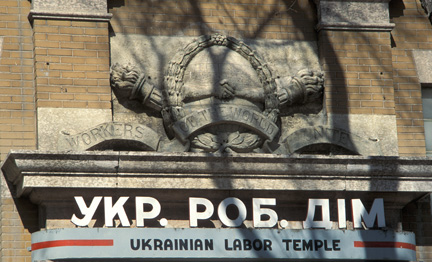
Ukrainian Labour Temple plaque unveiled.

Workers of the World Unite says the main sign

On September 29, Winnipeg's Ukrainian Labour Temple finally received a plaque marking it as a National Historic Site. Close to one hundred people attended the unveiling ceremony which included performances by the hall's orchestra and choir.

The ULT and its manor continue to play an active role in Winnipeg's progressive community, including as a venue for meetings of the Communist Party's Mathew Popowich Club. (On this point, the plaque has an error.)

The ceremony was postponed for a year after Parks Canada officials received a communication from Ottawa forbidding the choir from singing the Internationale as part of the program.

The text of the plaque is:

"Constructed in 1918‑1919, this imposing building was at the centre of a radical left‑wing movement committed to improving the lot of Ukrainian workers and farmers. Housing a printing shop and the headquarters of several national organizations devoted to education and mutual aid, it also served as a base for the promotion of Ukrainian performing arts. It was a gathering place for strikers during the Winnipeg General Strike of 1919 and for the Communist Party of Canada until the 1950s. Continuing to serve a cultural function, this neoclassical building is one of the grandest and largest labour temples in Canada."


The Temple was built primarily by volunteer labour and financed by donations and served as a key hub for Ukrainian culture and political activism at the time. The Ukrainian Labor News and other Ukrainian language publications were prepared and distributed from the temple.

In addition to being an important gathering place for the CPC, the building holds an especially historic place in the Canadian labour movement, having served as a rallying centre for trade unionists during the 1919 Winnipeg General Strike. The temple was raided by authorities searching for evidence of alleged sedition and conspiracy.

The structure was designated a provincial heritage site in 1995 and it remains the only surviving labour hall associated with the turbulent events of the general strike. To this day it serves as national headquarters for the Workers Benevolent Association, established within its walls in 1922.

"I believe that proclaiming the Winnipeg Ukrainian Labour Temple a national historic site also quite rightly pays tribute to the founding members," says Myron Shatulsky, a member of the Association of United Ukrainian Canadians and chair of the board of directors of the Ukrainian Labour Temple Foundation.

"These socialist-minded Ukrainian immigrants, some of whom had yet to receive their naturalization papers, and facing the possibility of arrest and deportation, sought and established a path along which they could achieve a better life for themselves, their children, their descendants, and for all Canadians. It is truly a historic event."


With files from the Peoples Voice Manitoba Bureau and the National Union of Public and General Employees (NUPGE)


October 12, 2012

De-bunking the myth of the good old days: sexism, racism and the working class in Canada after WWII


The historic 1945 Ford Strike in Windsor
Special to Rebel Youth

This article is part one of a two-part series.

Racialised and gendered work is a common feature of the development of capitalism. The need for a super-exploitable vulnerable group of workers is beneficial to the big business community as it helps bring about a much lower floor of wages and working conditions.

In the post-war era, the overt racism and overt gender discrimination of workers was still around, although less prevalent.  Institutionalized racism and sexism, however, was still very widely practised.  Racialised and gendered labour therefore represented a super-exploited strata of the working class in the post-war era.

The Drive System

The history of discrimination of the working class in the Canadian "labour market" comes about from its very beginning. There were "preferred" labourers, and the male Anglo-white labour was given a privilege position within the industrial framework.  While the Anglo-white male labourer was indeed heavily exploited, the exploitation of racialised and female labourers was even greater.

At the turn of the century, the primary management method by which employers managed to increase productivity was the drive system. The drive system was used to increase the worker’s effort at the job by “…close supervision, abuse, profanity and threats” and hold down the cost of labour.

Toss an apple

During this period of time, the foreman was the supreme ruler on the shop floor, hiring was, at times, arbitrary – some employers tossing an apple to a crowd of workers and whoever caught it would work. At other times, hiring was rather nepotistic -- ie. the friends and family of employees being unfairly favoured. Many workers were hired for jobs based on ethnic stereotypes.

Due to the large amount of surplus labour supply, workers who the foreman found unsatisfactory or did not like could be removed with impunity. The foreman typically had the power to set wages too, so there could be many different wages for workers doing the exact same job.

HR is born

Eventually, as a response to the class struggle and growing pressure from the labour movement in Canada and internationally (including the gains by working people in USSR and socialist countries), as well as tighter labour markets, the capitalists were forced to replace this system with somewhat more equitable forms of management.

Human resource departments became more common and formal rules were established for firms as a way to retain employees. This process was not uniform, however.  Labour historians identify three distinct labour markets that emerged in the post war era. The three types of markets were not equally accessible for gendered and racialised workers.

Three categories of workplaces

The "secondary labour market" was the lowest. Comprised of small manufacturing, service, retail sales, and temporary office work, workers in the secondary labour market had very little control over the labour processes.  The secondary labour market jobs were also the lowest paid, the least secure, with very little union coverage and almost no seniority provisions.

Above the secondary was the "subordinate primary market." The jobs in subordinate primary market are more stable, have seniority, are more likely to be unionized, and have relatively higher wages. Work in the subordinate primary market includes jobs with major manufacturers, secretary jobs, and assembly line work.

The "independent primary market" employed workers in professional fields, like skilled trades, teachers, lawyers, consultants and technicians.  Independent primary labour allowed for even higher wages, benefits, and transferable skills making their working lives much more stable since they can transfer easily to other firms.

This article has been edited from the original essay. A full biography is presented in part two.


October 11, 2012

The case of officer 728


As progressive-minded activists look back on the past months of protest, a bitter reminder of the police violence and repression has come forward in the form of what is being called "Le cas de l'agente 728."


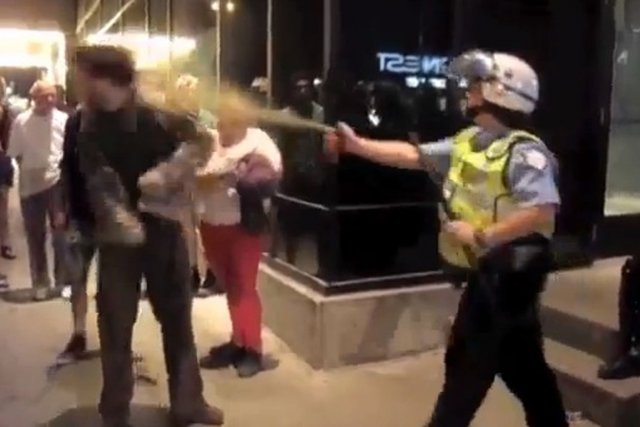
Officer 728 of the Montreal police, Madame Stefanie Trudeau, was widely condemned last spring for her excessive use of force against student demonstrators (see photo at left). While hardly unique, the incident was caught on YouTube. Now, in a video and audio recording presented by Radio-Canada, the violent arrest of four people, for reasons still unclear, by Trudeau has also been exposed.

Home invasion

In the video, Officer 728 with other police invade a residence and grab an individual by the throat, chocking him. The assault took place on October 2nd, when Rudy Orchietti, a resident of Plateau Mont-Royal, opened the door to some musician friends who came to his apartment on rue Papineau, not far from down town Montreal.

Orchietti has a beer in his hands. He is standing on the sidewalk by the door. At that moment, Officer 738 launches into action. Things quickly become chaotic and violent. Orchietti is arrested. When a friend intervenes the police lash out. They force their way into the apartment as if on a hunt. The friend is caught -- pinned by the neck and immobilized.

Officer 728 then confiscated the cell phones of those arrested, but triggered involuntarily a recording on one phone. In the conversation she had with her supervisor, broadcast on Radio-Canada, she speaks of rats referring to the people in the apartment, the fucking red squares, and asshole artists. "I didn't pepper spray them," Officer 728 adds, even though she "was on the edge" -- but fear she would wind up on TV again prevented her.

QS demands more


The SPVM apologized for the "disturbing" images and suspended Officer 728 during an internal investigation. But left-wing political party Québec solidaire expressed distrust of the ethics committee studying this case.

"These committees are composed mainly of former police officers. They are not independent enough, "says MNA Amir Khadir. "We must also tackle the root of the problem, the culture of permissiveness... This culture is of "racial profiling" and "social profiling." And also the lack of accountability," he said.


The violence comes after renewed calls, this time by teachers and educators, for a public investigation into the police violence of last spring and summer.

Over 3000 arrests in Quebec

During the massive mobilization by the Quebec student movement which grew to include widespread public support, and coming less than two years after the brutal G20 protests in Toronto, Quebec was witness to the biggest wave of police repression in recent history, marked by 3387 arrests from February 16th to the 3rd of September, 2012.


(Several of these arrests took place during the notorious "kettle" tactic for which Montreal Police Department (SPVM) have been criticized by the United Nations’ Council of Human Rights. Often these arrests were carried out in a brutal manner, the prison conditions were harsh and they were not permitted to talk to a lawyer or relatives.)

Police brutality also inflicted numerous injuries on demonstrators including, two eyes lost, teeth broken, a fractured skull, as well as broken arms and legs. "Media reports and on-line videos revealed that the police forces generally seemed animated by a profound contempt for students, expressed by the insults, often sexist and homophobic," educator Francis Dupuis-Déri wrote in Le Devoir.


A broader problem

Police brutality is widespread across Canada, compounded by the "law and order" and "war on terror" rhetoric of right-wing politicians and the corporate media, who consistently glorify the police and attempt to justify police crimes.

For example, since November 11, 1987, when Officer Allan Gosset killed Anthony Griffin, police in Montreal have killed at least 37 people. Most have gone unpunished, as coroners, prosecutors, and cabinet ministers cooperate to protect the cops.    The situation in Montreal is not improving. Moroccan immigrant Mohamed Anas Bennis left his Montreal mosque at 6:30 am on Dec. 1, 2005. At 7:20 am, at the corner of Kent Street and Cote-Des-Neiges, he was shot twice and killed by a police officer. The shooting took place during a joint operation by the Montreal police, Quebec Provincial Police, and the RCMP, allegedly targeting "Algerian scam artists" linked to "international terrorism."

Quebec City police were assigned to investigate the killing, starting a process which can only be described as a cover-up. Eleven months later, it was announced that no charges would be laid, since there was "no evidence" that a criminal act had occurred.

In this context the Young Communist League has stepped-up its call for civilian and community control over police and prisons, ending racial profiling by police, and the dismantlement of the RCMP and CSIS.

Maintaining the health tax: Québec solidaire deplores the government's about-face


Québec solidaire deplores the Government's decision to renege on its commitment to eliminate the health tax in an almost complete about-face.

"We find that the government has dropped this demand very quickly; Marois (gave-in) to the emotional blackmail by the Chamber of Commerce and their faithful mouthpieces -- the other opposition parties. Now applied more gradually, this tax (remains) a full frontal attack on the middle class and workers who pay a lot of taxes for fewer public services, " said Françoise David, MP Gouin.

For example, a person who has a net income of $ 20,000 will pay $ 200 this year and $ 100 in the future. "A person of $ 20,000 of income is not rich!" said Ms. David.

QS are upset by the timidity of the government, who will add only one level of taxation for higher net worth individuals. This new level is a meagre increase of 1.75% marginal tax rate, for income above $ 100,000. QS also regrets that the Minister of Finance has abandoned the idea of ​​reducing tax credits on capital gains and dividends.

Rather than measures that affect individuals, Amir Khadir, MNA for Mercier, invites the Government to get more revenue from large corporations and financial institutions.

"Billions are awarded their grants and benefits of all kinds, their tax rate is very low and billions more escape into tax havens. The government could very quickly make some room to move in the budget by ending the tax complacency towards the very wealthy, "said Mr. Khadir.

Anger about Malala Yousafzai should not be used for more war


We reprint this letter to the editor calling for the deplorable attack on young Pakistani woman Malala Yousfzai to not be an excuse to whip up war fever by imperialism.


Dear Editor,

Your editorial (Why the Taliban are afraid of a 14 year-old girl, Oct 10th 2012) perversely exploits the attack on Malala Yousafzai by calling for "overwhelming force to bear" on the Taliban.  Malala herself in an interview with CNN last year said deal with the Taliban through talks and building more schools.  Using force has only lead to killing more young women, not making them safer.  For example in May a New York Times article described how President Barack Obama hand-picked a 17 year-old girl to be killed by drone without a trial.  The UK Bureau of Investigative Journalism estimates about 175 children have been killed by drones, and says the US sends a 2nd round of drones every attack which kills rescue workers.  Last month NATO admitted its bombs killed 8 Afghan women and girls collecting firewood.  Anger at the attack on Malala should not be used for more war which will kill more girls and women, that is senseless and not what Malala stood for.

S. Saleh Waziruddin
Niagara Falls, Ontario

Find out more:

CNN interview clip

Secret ‘Kill List’ Proves a Test of Obama’s Principles and Will

'Double tap' By Gwynne Dyer

Afghanistan: Nato admits up to eight women killed in airstrike


Approach with caution: CLASSE on upcoming education summit

Camille Robert speaks at a press conference

Montreal, 20 September 2012

Following the announcement of the cancelling of the tuition fee increase and the abrogation of the Law 12 (formerly Bill 78), the CLASSE (the Coalition large de l’Association pour une solidarité syndicale étudiante / Broad Coalition of the Association for Student Union Solidarity) wishes to salute the courage and determination of all those who were active over the last few months.

The organisation wishes, at the same time, to recall that this victory is not the end of the struggle, and that the student and popular mobilization must continue.

“If the Parti Québécois is passing today a series of measures which answer to our demands, it is because we have held to our principles, and have defended them with an approach that was combative, yet unifying,” said Camille Robert, co-spokesperson for the CLASSE. “In the future, our approach will win out over any regressive measure.” The CLASSE therefore notes that it remains opposed to any increase in tuition fees, including indexing to inflation. “Education is a public service, which must remain accessible; not a commodity, with a price that varies with the market,” said Jeanne Reynolds, co-spokesperson of the organisation.

In this sense, the CLASSE is approaching the upcoming summit on education with caution.  ”The PQ deputies are arguing for the indexing of tuition fees to inflation. Until the results of this summit emerge, the cancelling of the tuition hike is, in a way, a temporary victory. The improvements to the student aid system [of loans and bursaries] must also be maintained beyond the current academic year. It is for this reason that we will remain mobilized”, explained Mme Reynolds. Beyond a summit on the financing [of higher education], the CLASSE insists that there be held an “Estates-General” (Etats-Généraux) which will allow collective reflection on the mission of post-secondary education.

Finally, the CLASSE invites once again the population to join them in the streets of Montreal and Quebec on Saturday the 22 September. “We can be proud of what we have accomplished, but we must bear in mind that the battle for access to education does not end today. In this sense, we continue to defend the idea of free education as a project of society”, concluded Camille Robert.

For more information:
Ludvic Moquin-Beaudry, press attaché for the CLASSE:  514-835-2444
Email: communication@asse-solidarite.qc.ca
web: www.bloquonslahausse.com

We told you so!


Reprinted from the Oct. 16th issue of People`s Voice

Here at People's Voice we aren't shy about making the case for policies to put people before profits. Occasionally we have been accused of exaggerating the facts to make a political point. So it's great to see mainstream media reports which back up our arguments.

Here are two recent examples, starting with corporate taxation.

For years, we have called to stop the reduction of taxes on corporations, a neoliberal policy that puts an increasing burden on working people.

Don't take our word for it. Turns out that "the tax burden for businesses in Canada is second lowest among 14 major countries and lowest among developed countries, according to a KPMG survey of international tax competitiveness." (That's the Globe and Mail speaking on Sept. 25.)

KPMG's Elio Luongo (probably no relation to Roberto of the Vancouver Canucks) says that "the tax system is often what tips the scales" in attracting investment.

India had the lowest overall tax levels. China, Mexico and Russia ranged third, fourth and fifth. Among developed countries, Britain ranked second, followed by the Netherlands, the United States, Germany, Australia and Japan.

KPMG uses an index composed of corporate income tax, capital taxes, sales taxes, property taxes, local business taxes and statutory payroll taxes, using rates applicable as of Jan. 1, 2012.

Comparing major international cities, KPMG also found that Toronto, Vancouver and Montreal are all in the top 10 among 55 cities with populations of more than two million. All 16 Canadian cities analyzed by KPMG had lower tax rates than the least taxed U.S. city - Baton Rouge, Louisiana. So much for all the whining from corporate shills about Canada's "heavy tax burden"!

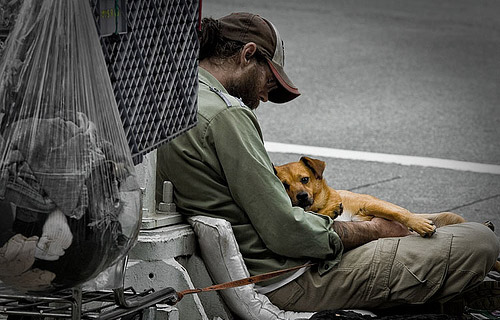
Then we come to the supposedly complex problem of homelessness. People's Voice has long stated that simply building more low-income housing would be a great way to cut spending on health care, emergency services, policing, etc. Too expensive, according to right-wing politicians and corporate think tanks.

Now, a new study by Stephen Gaetz, director of the Canadian Homelessness Research Network, based on research from across North America, suggests it's far cheaper to give a homeless person a place to live than to provide a patchwork of emergency services.

Gaetz says governments spend at least $4.5 billion a year dealing with homeless people, including the costs of emergency health care, mental‑health services, law enforcement, shelters and food banks. Their use of the health system is high and unpredictable, and many end up homeless again after brushes with the law upon release from jail.

For chronically homeless people who are frequent users of social services, the annual savings are $25,899 per person, enough for a "housing first" approach across Canada, according to the newly formed Canadian Alliance to End Homelessness.

$4.5 billion would build an estimated 45,000 housing units. Such an investment over several years would end street homelessness across Canada. Too expensive? No, and we'll continue to say "told you so".

Popular stories