December 9, 2010

12th International Meeting of Communist and Worker`s Parties

12 IMCWP, Tshwane Declaration

-------------------------------------------------

From: South African Communist Party, Thursday, 09 December 2010

http://www.sacp.org.za , mailto:international@sacp.org.za

==================================================

12th International Meeting of Communist and Workers` Parties

3rd - 5th December 2010, Tshwane, South Africa

TSHWANE DECLARATION

The 12th International Meeting of Communist and Workers` Parties took place in Tshwane, South Africa from the 3rd to the 5th of December 2010 with theme "The deepening systemic crisis of capitalism. The tasks of Communists in defence of sovereignty, deepening social alliances, strengthening the anti-imperialist front in the struggle for peace, progress and Socialism".

102 delegates representing 51 participating Parties from 43 countries and from all continents of the world came together in order to take forward the work of our previous meetings, and to promote and develop common and convergent action around a shared perspective

THE DEEPENING CAPITALIST CRISIS

The international situation continues to be dominated by the persisting and deepening crisis of capitalism. This reality confirms the analyses outlined in the declarations of our 2008 Sao Paulo and 2009 New Delhi 10th and 11th International Meetings. The current global crisis of capitalism underlines its historical limitations and the need for its revolutionary overthrow. It shows the intensification of the basic contradiction of capitalism between the social character of production and the private capitalist appropriation.

The crisis is systemic - despite pre-2008 capitalist illusions to the contrary, capitalism cannot escape its in-built, systemic tendency to go through cycles of boom and bust. The current global crisis is a particularly severe manifestation of a capitalist downturn occasioned by capitalist over-production. Now, as in the past, there is no answer, within the logic of capitalism, to these periodic crises other than crisis itself, marked by the massive and socially irrational destruction of assets - including mass job lay-offs, factory closures, and the wholesale attack on wages, pensions, social security and erosion of people`s livelihoods. This is why, at our previous two meetings, we correctly asserted that the current crisis was not merely attributable to subjective failings, to the greed of bankers or financial speculators. It remains a crisis embedded in the systemic features of capitalism itself.

The persisting crisis is compounded by significant shifts in the international balance of forces. In particular, there is the on-going relative decline of US economic global hegemony, general productive stagnation in most advanced capitalist economies, and the emergence of new global economic powers, notably China. The crisis has intensified the competition between the imperialist centres and also between the established and emerging powers. This includes the US-led currency war; the concentration and centralization of economic and political power within the EU deepening its character as an imperialist block led by its main capitalist powers; a distinct sharpening of the inter-imperialist struggle for markets and access to

raw materials; expanding militarism, including the strengthening of aggressive alliances (for example, the NATO Lisbon Summit with its "new" dangerous strategic concept), the profusion of regional points of tension and aggression (notably in the Middle East, Asia and Africa), coups in Latin America, the intensification of neo-imperialist tendencies of fanning ethnic conflicts and the increasing militarization of Africa through, amongst other things, AFRICOM.

At the same time it has become clear that capitalism`s trajectory with its profit-maximising, headlong destruction of natural resources, and of the environment in general poses a grave threat to the sustainability of human civilization itself. The political elites in the dominant capitalist states with their various proposals for "green technologies" and carbon trading at best represent adjustments which increase the profitability of capital while deepening the commodification of nature, and the transfer of climate change crises onto less developed countries. The crisis of the capitalist system that we face as humankind is directly linked to capitalism`s inability to reproduce itself except through a voracious pursuit of compound growth. It is a crisis that can only be overcome through the abolition of capitalism itself.

Faced with these realities, everywhere capital fights back, seeking to preserve profits and to transfer the burden of its crisis onto the working class by intensifying exploitation based on gender and age, the urban and rural poor, and a wide range of middle strata. Exploitation is intensified, the state is used to rescue private bankers and financial houses while exposing future generations to unsustainable levels of debt, and there are intensified efforts to roll back social gains.

In the entire capitalist world, labour, social, economic, political and social security rights are being abolished. At the same time the political systems are being made more reactionary , restricting democratic and civil liberties, especially trade union rights. The retrenchments, including major spending cuts in the public sector are having a devastating impact on workers, especially women workers. There are also attempts to divert popular distress and insecurity into reactionary demagogy, racism and xenophobia, as well as to legitimise fascist forces. These are expressions of anti-democratic and authoritarian tendencies also marked by the escalation of anti-communist attacks and campaigns in many parts of the world. In Africa, Asia and Latin America we are witnessing the imposition on our peoples of new mechanisms of national and class oppression, including economic, financial, political and military means as well as the deployment of an array of pro-imperialist NGOs.

However, for the mass of peoples, in particular in Africa, Asia and Latin America, it is important to remember that, even before the current global economic crisis, life under capitalism was a continuing crisis, a daily struggle for bare survival. Even before the current global crisis, one billion people were living in squalid slums, and half of the world`s population was surviving on less than $2 a day. With the crisis these realities have been massively aggravated.

Most of these urban and rural poor, along with family members working as vulnerable migrants in foreign countries, are the displaced victims of the accelerated capitalist agrarian development under-way in Africa, Asia and Latin America. Global capitalism, spear-headed by the major corporates in the agro-industrial sector, has declared war on nearly one-half of humanity - the three billion remaining rural people in Africa, Asia and Latin America.

At the same time inhuman barriers are being set up against immigrants and refugees. There is an ever-increasing mushrooming of urban and semi-urban slums populated by desperate marginalised masses typically involved in a variety of activities for survival. The accelerated capitalist agrarian transformation in countries with a lower level of capitalist development has genocidal implications.

THE IMPORTANCE OF THE RESISTANCE STRUGGLES OF THE WORKING CLASS AND POPULAR FORCES

Across the world, capital`s attempts to load the burden of the crisis onto workers and the poor is being met by working class and popular resistance.

Over the past year the anti-people assault on labour rights, social-security rights and wages provoked an escalation of popular struggles notably in Europe.

Imperialist aggression in the Middle East, Asia and Latin America continues to meet resolute popular resistance.

In Africa and Latin America, anti-imperialist forces, trade unions, and social movements have escalated their struggles for the rights of the people and against the plunder by the multinational corporations. These struggles have, in some cases, led to the emergence of progressive, popular national governments that declare programmatically for national sovereignty, social rights, development and for the protection of their natural resources and biodiversity, giving renewed impetus to the anti-imperialist struggle.

In the current reality, it is an historic imperative that as Communist and Workers` Parties we participate, to strengthen and transform these popular defensive battles into offensive struggles for the acquisition of broader workers` and people rights and for the abolition of capitalism.

In advancing this strategic agenda, communists stress the significance that the organisation of the working class, and the development of the struggles of the labour movement in a class-oriented direction, have in the struggle for the acquisition of political power by the working class and its allies.

Within the framework of this struggle we attach particular importance to:

* The defence, consolidation and advance of popular national sovereignty

* The deepening of social alliances

* Strengthening the anti-imperialist front for peace, for the right to full-time stable work, labour rights and social rights such as free health and education.

THE DEFENCE, CONSOLIDATION AND ADVANCE OF POPULAR SOVEREIGNTY

In the face of the intensified aggression of transnational capital, the struggle against imperialist occupation of countries, against economic and political dependency and to defend popular sovereignty has become increasingly salient. In these struggles it is important for communists to integrate these struggles with the struggle for social and class emancipation.

Communists, fighting against imperialism, struggle for equitable international relations between states and peoples on the basis of mutual benefit.

The defence, consolidation and advance of popular sovereignty is of particular importance in Africa and for other peoples that have experienced decades and even centuries of colonial and semi-colonial oppression. 2010 marks the 50th anniversary of the commencement of the formal de-colonisation of Africa. Yet everywhere, including in the African diaspora, the grim legacy of the slave-trade, of colonial dispossession and plunder persist. Notwithstanding 50 years of formal de-colonisation, everywhere imperialist interventions are reinforced, the dominance of the monopolies is being strengthened with the aid of domestic capital. The struggle against them requires the active protagonism and unity of the popular masses, and the broadening of popular democratic rights.

DEEPENING SOCIAL ALLIANCES

The ongoing crisis of capitalism and its anti-civilisation fight-back are creating the conditions to build broad social, anti-monopolistic and anti-imperialist alliances capable of gaining power and promoting deep, progressive, radical, and revolutionary changes.

Working class unity is a fundamental factor in ensuring the construction of effective social alliances with the peasantry, the mass of urban and rural poor, the urban middle class strata and intellectuals. Particular attention needs to be paid to the aspirations of, and challenges confronting youth.

The land question, agrarian reform and rural development are important issues for the development of popular struggle in lesser developed countries. These are inextricably linked to food sovereignty and security, sustainable livelihoods, the defence of bio-diversity, the protection of national resources, and the struggle against agro-industrial monopolies and their local agents.

In these struggles, the legitimate and progressive aspirations of indigenous peoples in defence of their cultures, languages and environments have an important role.

THE ROLE OF COMMUNISTS IN STRENGTHENING THE ANTI-IMPERIALIST FRONT FOR PEACE, ENVIRONMENTAL SUSTAINABILITY, PROGRESS AND SOCIALISM

Imperialism`s crisis and counter-offensive are leading to the broadening and diversification of the forces that objectively assume a patriotic and anti-imperialist stand. Everywhere, in our diverse national realities, Communists have a responsibility to broaden and strengthen the anti-imperialist political and social front, the struggles for peace, environmental sustainability, progress, and integrate them in the fight for socialism. The independent role of Communists and the strengthening of the Communist and Workers` parties is of vital importance to ensure a consistent anti-imperialist perspective of broader movements and fronts.

Special attention must be given to the existing relation between various resistance struggles and the necessary ideological offensive for the visibility of the alternative of socialism and to the defence and development of scientific socialism. The ideological struggle of the communist movement is of vital importance in order to repulse contemporary anti-communism, to confront bourgeois ideology, anti-scientific theories and opportunist currents which reject the class struggle, and combat the role of social democratic forces that defend and implement anti-people and pro-imperialist policies by supporting the strategy of capital. We have a key role to play in drawing the critical links in theory and above all in practice between different arenas of popular struggle in the development of internationalist class solidarity.

We are living in an historic epoch in which the transition from capitalism to socialism has become a civilisational imperative. The all-round crisis of capitalism once more underlines the inseparable nature of the tasks of national liberation and social, national and class emancipation.

In the face of deepening capitalist crisis, the experiences of socialist construction demonstrate the conditions of the superiority of socialism.

The strengthening of the cooperation among Communist and Workers` Parties and the strengthening of the anti-imperialist front, should march side by side.

We, the Communist and Workers` parties meeting in Tshwane, in a situation marked by a massive onslaught against workers and popular forces, but also with many possibilities for the development of the struggle, express our profound solidarity with workers and peoples and their intense struggles, reiterating our determination to act and struggle side by side with working masses, youth, women, and all popular sectors that are victims of capitalist exploitation and oppression.

We reaffirm our appeal to the widest range of popular forces to join us in a common struggle for socialism which is the only alternative for the future of humankind.

We point to the following main axes for the development of our joint and convergent actions:

1. With the capitalist crisis deepening, we will focus on the development of workers` and peoples` struggles for labour and social rights, the strengthening of the trade-union movement and its class orientation; the promotion of the social alliance with peasants and the other popular strata. Particular attention will be given to the problems of women and youth who are among the first victims of the capitalist crisis.

2. In the face of the all-round imperialist aggression and the sharpening of the inter-imperialist rivalries, we will intensify the anti-imperialist struggle for peace, against imperialist wars and occupation, against the dangerous "new" NATO strategy and foreign military bases, and for the abolition of all nuclear weapons. We will extend active internationalist solidarity with all people and movements facing and resisting oppression, imperialist threats and aggression.

3. We will resolutely fight anticommunism, anti-communist laws, measures and persecution; to demand the legalisation of CPs where outlawed. We will defend the history of the communist movement, the contribution of socialism in advancing human civilisation.

4. We affirm our solidarity with the forces and peoples engaged in and striving for socialist construction. We reaffirm our solidarity with the Cuban people and their socialist revolution, and we will continue vigorously to oppose the blockade and to support the international campaign for the release of the Cuban Five.

5. We will contribute, within the specific context of our national realities, to the reinforcement of international anti-imperialist mass organizations like WFTU, WPC, WFDY, WIDF. We particularly welcome and salute the 17th World Festival of Youth and Students to be held in South Africa from 13th-21st December 2010.

*End*


December 8, 2010

Court's out, let's go party!


Stephen Kimber wrote an excellent book about the Cuban Five case, and explores the history of anti-Cuba terrorism. Today's excerpt is very enlightening. You can see more at the book's website: http://cubanfive.ca/

DAY IN THE FIVE - WHOSE FAIR TRIAL?
by Stephen Kimber on December 8, 2010 | No Comments


On December 8, 1998, after a 14-day trial, jurors in Puerto Rico acquitted five anti-Castro exile militants of plotting to kill Fidel Castro.

Afterwards, two of the jurors told reporters the verdict was intended to send a "message to the Cuban people that we're with you."

The jurors then left the courthouse, singing the Cuban national anthem in the company of the no-longer-accused. That night, they all celebrated together at a popular local Cuban restaurant.

"Prosecutors had hoped that holding the trial in Puerto Rico would give them a better shot at convictions than in Miami," the Miami Herald explained after the verdict. In Miami, the newspaper noted, "juries regularly acquit anti-Castro plotters."

The prosecutors may have been wrong about Puerto Rican juries.

But they definitely knew their Floroda juries.

That's why, even as prosecutors in Puerto Rico had opposed defence motions to move the assassination plot trial to Miami, prosecutors in Miami were fighting even harder to oppose defence motions for a change of venue in the case of the Cuban Five.

The Five were arrested in September 1998, just three months before the verdict in the Puerto Rico case.

For more details on the case against the Puerto Rican plotters-the one on which they were acquitted-check out this excerpt from Sting in the Wasp's in-progress narrative.

Hockey Fans for Peace


Kimball Cariou

Millions of Canadians enjoy hockey - and we also oppose the war in Afghanistan. A new Facebook group, "Hockey Fans For Peace", urges the NHL and the mass media to recognize this reality, by ending the practice of using hockey games and broadcasts to promote the view that full support for the war is the only acceptable position for any genuine hockey fan.

Failing this, we call upon the NHL and the mass media to provide equal access to hockey fans who oppose the war and want to bring the troops home immediately. We also encourage other sports to refrain from promoting support for the war in Afghanistan. Within a few days, Hockey Fans For Peace will have "Cherry" pink t-shirts on sale, featuring our logo (crossed hockey sticks with a "peace sign" puck). We invite you to join our Facebook group, to ask others to join, and to help spread the word: hockey, not war!

http://www.facebook.com/#!/home.php?sk=group_181250731886894&ap=1

December 7, 2010

G20: One protesters story of abuse

G20

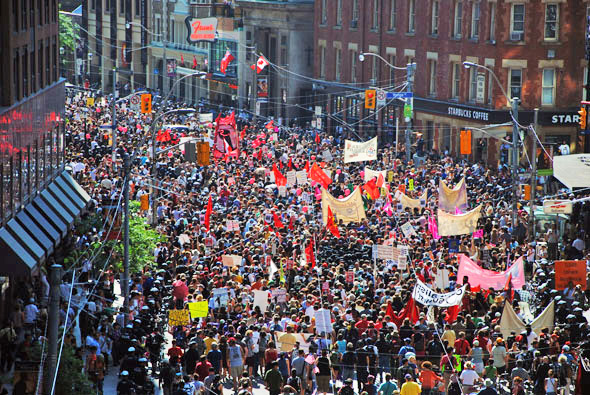
A historic 1,000 protesters were arrested at the Toronto G20 demonstrations, despite the majority of protest at the G20 demonstration in Toronto being peaceful.

"This is my statement about my illegal arrest, the police brutality and my illegal detention, Saturday June 26th-27th."

"SHUT UP YOU COMMIE CUNT"

At 7:30pm on Saturday June 26th I was in Queen's Park, the designated "legal protest zone." I was chanting along with other protesters when hundreds of riot police suddenly stormed the group." After watching the beat my friend unconscious, I ran from the line of police. I was tackled into a bush by several officers. I said repeatedly; "I am not resisting!" As I was being carried away, a female officer hit me in the face and said "Shut up you commie cunt."

At one point a male officer pushed my head into the pavement with his boot. He leaned down and said to me "It's ok bitch. We are taking you to a place with NO cameras."

"YOU ARE HURTING ME"

The police put me on the ground behind the police line, to hide the excessive force they were using. Three or five officers pushed on top of me, restraining me. I was lying face down on the pavement, still yelling "I am not resisting" and "you are hurting me".

After staying in this position for 45 minutes, I was searched. They asked me why I was there and what organization I was with. I refused to answer so my arms were pulled behind my back until I was screaming in pain. The officers laughed at me and continued verbally abusing me. They searched my bag and found my BC drivers license. This abuse resulted in lacerations on my right cheek, severe pain in my abdomen and chest area, bruising on my wrists, arms, ankles, right shoulder, and head.

STRIP SEARCH

When I was taken off the ground, I was taken to a holding truck, then to a prisoner holding bus with other protesters. I was then taken to the holding cells at the film studios at Pape an Eastern. It was 8:45pm. I was placed in a cell with 14 other female prisoners for 3 hours, and then moved. I was very vocal about my needs for water, food, and a phone call, but all questions were ignored. The officers in the detention center were verbally abusive, calling us "anarchists" and "rioters." After 8 hours I was strip searched and put into a cell with one other female prisoner.

NO FOOD, NO WATER

My needs for food, water, and a phone call were ignored and also repeated requests for a sweater (the cells were heavily air conditioned) and toilet paper. When water was finally given it was just a tiny Styrofoam cup full. I told the officers that I'm vegan and I'm extremely allergic to dairy products. When food finally did arrive, I got a white bun with butter and cheese. They did not understand, or care that I could have an allergic reaction and vomit or convulse. Therefore I did not eat for 20 hours.

At 11:00pm I was fingerprinted and photographed. I was told I was being charged with "Obstruction of an Officer" and "Unlawful protesting/gathering". After 13 hours I was given access to a phone in order to call legal representation but I was watched, listened to and ordered to hurry up. I was transferred to various cells around the detention center. One cell was covered in pepper spray. It got all over my hands, feet, and clothing.

COURT

At 2:00pm Sunday June 27th I was taken to the provincial court in Etobicoke. I was held in a cell with 10 other prisoners. Again, I was verbally abused and my needs were ignored. I became physically ill and began shaking due to low blood sugar and dehydration. I ate one of the buns they gave us because of my physical condition. The bun had butter on it. I don't know if it was dairy, but I had stomach cramps. I met with a lawyer there after being detained for an unknown amount of time.

When I went into my bail hearing, my place of residence was wrong. The cort did not know that I was paying rent in Toronto. After explaining I was a resident of Toronto, I was finally released on bail. I was barred from participating in any protest or gathering of people, entering downtown, and could not leave Toronto.

"A COMPLETE VIOLATION OF MY RIGHTS"

Emotionally, this whole ordeal was terrifying. The way I was treated by the arresting officers, and the officers in the detention center, was appalling. I felt unsafe and scared the whole time. The words that were used when I was being ordered around were demeaning and patronizing. This was a complete and total violation of my rights as a human.

December 6, 2010

Making the case for Mass Action

By Johan Boyden and Drew Garvie
Rebel Youth, Issue 10, Summer-Fall 2010

In the context of the continuing debate about strategy and tactics in the Canadian youth and student movement, activists and organizations need to ask “what kind of youth movement are we building?"

We have now had several months to reflect on the events that unfolded when the G20 occupied Toronto, and also last winter’s 2010 Olympic demos in Vancouver. These events continue to be discussed within the youth and student movement, across English-speaking Canada and Quebec. The debate occurs at a time when there is a widespread critique of diversity of tactics post-G20.

Many are asking: what are other more effective, united and militant alternatives?

G20 Redux by Garvie


Rebel Youth Magazine
Issue 10, Summer-Fall 2010

For the thousands that participated in the marches, the victims of arrest, and the many at home, the G20 police riot exposed the brutal and dirty methods of Capital. It demonstrated the shallowness and ugly underbelly of bourgeois “democracy.” As the Canadian Civil Liberties Association has said, the police response was “unprecedented, disproportionate and, [even] unconstitutional.”

Why were such brutal means used? The answer can only be intimidation. The ruling class thought they could get away with a more aggressive approach.

But whether Harper and his thugs in blue “won-out” that weekend remains to be seen. Many people still face charges. A movement united around a call for an inquiry is still battling it out with the police’s PR machine. And if events leading up to the G8 and G20 demonstrations are an indicator, there is reason to believe that Harper’s intimidation and attempt at criminalizing dissent will not have its desired effects.

Drew Garvie, YCL Ontario organizer, identifies six-points

1. Stay home

Months prior to the G20 visit, the corporate media and the “Integrated Security Unit” (headed up by the RCMP) tried to desperately intimidate potential protesters. This included tough talk about the “fence”, “protest zones”, new weapons such as the sound cannon, warnings that parents should keep their kids at home, and continual talk about the largest police/military presence assembled on Canadian soil. The security budget scandalized the public when it was announced to be over $1 billion dollars (approx. 7 times that of Pittsburgh’s G20 security costs last year).

The message was clear: “if you don’t want trouble, stay home.” Despite the scare-tactics, almost 40 000 people turned up to protest against the G20. These were the biggest protests in Toronto in many years, and importantly, the largest in Ontario since the economic crisis.

2. “People First”

The week was characterized by lively, creative and democratic resistance. Marches raised many demands: Indigenous sovereignty, climate justice, (im)migrant justice, LGBITQ rights, women’s rights, labour movement struggles like anti-scab legislation, and student’s issues such as accessible education. For example, the Canadian Federation of Students outreached on an international level to the Asian, All-African, Latin American and Caribbean, General Union of Arab, European and United States’ Students organizations, who together issued a joint statement condemning the G20.

The main march took place under the broad “people first” slogan against the Harper Conservative’s pro-corporate attack of working families during the economic crisis. The crowds on the streets also showed that the youth and students’ movement overwhelmingly chose the people’s side of the barricades. The demonstrations became a flashpoint, highlighting the glaring problems of corporate power and capitalism.
Most demonstrators were able to participate from start to finish united, without any incident or attacks. This democratic right and necessity to protest should have been enjoyed by all demonstrators. However in the last few days peaceful protesters as well as journalists, legal observers, and by-standers who had no involvement in the protests, were subjected to a police riot.

3. Saving capitalism

These events happened outside “the fence.” But without drawing the connection to what was happening inside the “G20 perimeter” we are left with an incomplete picture.
This set of G summits was particularly important because global capitalism continues to be mired in a profound economic and structural crisis, notwithstanding the soothing media reports that the ‘worst is behind us’ and that recovery is well under way.

In reality, there is no recovery for most working people. Unemployment and job insecurity remain high, with over 1.5 million out of work. Soon EI benefits will be running out for hundreds of thousands of these unemployed workers. Nor is there any recovery for young workers suffering 14.6% unemployment, for women still earning unequal pay, for students trying to finish their education, for Aboriginal peoples facing systemic joblessness and grinding poverty, for new immigrants and their families trying to build a better life, or for pensioners and others on fixed income.

So what kind of recovery is this? It’s a recovery for the profits of the biggest banks and corporations, and for those who own and control them. Saving capitalism and restoring profit margins were the main concerns of the ‘leaders’, rather than solving the burning problems afflicting the world today.

At the Summit itself, Harper and the rest of the world’s leading criminals agreed to halve deficits by 2013. This translates into drastically increasing the burden on working people globally and locally and gutting public services. (Solutions such as corporate profits being taxed more equitably or cutting military spending on wars and occupations are other options, but they are not in the capitalist’s playbook.)

4. Largest mass arrests in Canadian history

By the end of the weekend, over one thousand and ninety people – mainly youths – had been jailed: the largest mass arrest in Canadian history. Protesters, journalists and passer-by’s were subject to illegal searches, illegal detention, police brutality, harassment, sexual assaults, and detention in cells nick-named “Guantanamo North” where civil liberties were systematically violated and detainees had little access to food and water (see our first-hand account in this issue).

“For the first time ever visiting Toronto I felt unsafe speaking French on the street” one young Montreal activists told RY about police targeting Québécois youth and cars with Québec licence plates. Another activist we spoke to said they met people in the cells “scooped right off the street, randomly, who didn’t even know what ‘G20’ meant.”

And in this ominous direction lies a threat – fascism: the open, terrorist dictatorship of the most reactionary sections of the ruling class, no longer cloaked with limited electoral rights and constitutional protections.

5. The role corporate media

This message was not reinforced by the corporate media, however, which largely ignored the massive peaceful protests. Instead, the news decided to focus on the small-scale property destruction that took place at the G20.

It is mistaken to think that the people’s movement scored a significant victory by attacking the attention of the big business media, which reported on the burning police cars because of the magnitude of that event. Rather, they chose to intensively cover that issue, just as they ignore other protests. To put things in perspective, the amount of G20 “property damage” was comparable to the sixteen police cruisers and numerous buildings damaged in Montreal’s 2008 hockey riot when the Habs eliminated the Bruins. (Less than twenty people were arrested.)

6. The real criminals

However, the main argument used to justify the police riot continues to be that a “Black Bloc” riot precipitated it. “Criminal elements were mixed in with the peaceful protestors.” Five police cars were allowed to burn for hours in front of TV crews. After the G20 the newspapers published front-page photos of the police’s “G20 most wanted list” featuring young people. There is overwhelming evidence, however, that police allowed a small group of protesters a free-hand in engaging in petty property destruction.

As journalist and film director Paul Jay said: “At some point over the weekend the Operational Commander of the Integrated Security Unit watched the action unfold and made two fateful decisions [...] not to immediately move some of the thousands of available police officers into position to stop a hundred or so people from breaking store windows [... and then] to order the arrests of around nine hundred peaceful protestors.” (see “Who Commanded the G20 Commander?” on YouTube).

The police ‘riot’ and the mass arrests did not come about spontaneously, or result from the overzealous behaviour of individual officers. They were carefully worked out well in advance, provided with legal ‘cover’ by Ontario premier Dalton McGinty’s secretive Order-in-Council measure, and vetted by the Office of Prime Minister Stephen Harper. All three – Harper, McGinty and Toronto Police Chief Blair – are culpable for this ‘reign of terror’ on the streets of Toronto.

December 5, 2010

Sydney Levy reports on BDS and Caterpillar weaponized bulldozers


I have remarkable news. The Israeli press is reporting that Caterpillar is withholding the delivery of tens of D9 bulldozers—valued at $50 million—to the Israeli military.(1) These are weaponized bulldozers that are used to illegally destroy homes and orchards of Palestinian families. And they are the very same bulldozers as the one that killed a 23-year-old American peace activist named Rachel Corrie seven years ago when she tried to protect the home of the Nasrallah family in Gaza.

That's why the next part of the story is even more amazing. The news reports say that the deliveries have been suspended now because Rachel's parents, Cindy and Craig Corrie, are bringing a civil suit against the government of Israel in a court in Tel Aviv.(2) The deliveries are to stop during the length of the trial. We take this as an indirect admission by the company that these bulldozers are being used to violate human rights and to violate the law. The Corrie story is sadly just one of thousands of stories of loss and pain.

A suspension of the sale of bulldozers is what we have been asking Caterpillar for over seven years now. This is a great win, but this is no time to let off the pressure.

Caterpillar and the U.S. government have neither confirmed nor denied the news. And news reports describe the company's move as a temporary decision only. To urge the U.S. government to make this policy permanent, please sign the U.S. Campaign to End the Israeli Occupation’s petition to President Obama to continue this new policy.

We need to hold both our government and corporations profiting from the occupation accountable. TIAA-CREF, one of the largest financial services in the United States, invests heavily in Caterpillar (over $250 million as of their last financial report). Thanks to you, we've already gathered over 17,000 in our petition to TIAA-CREF, asking it to divest from Caterpillar and other companies that profit from the Israeli occupation. But we need more! Tell your friends to sign our petition. If TIAA-CREF divests from Caterpillar, it will have a rippling impact everywhere.

Since 2003, Jewish Voice for Peace has been filing annual shareholder resolutions to pressure Caterpillar with a growing coalition of interfaith partners. We've organized protests. We've taken over a CAT dealership. We've worked in support of Presbyterian and Methodist divestment initiatives from the company, and with your help, we are asking TIAA-CREF to divest from Caterpillar as well.

Caterpillar has never budged... until now.

Caterpillar's irresponsible behavior comes with a heavy price tag. In the last ten years, at least 11,795 homes have been demolished.(3) These statistics, gruesome as they are, cannot do justice to the pain of so many families, to their razed livelihoods and their shattered dreams.

The picture above does not come from an earthquake scene. It depicts the man-made destruction and the hopelessness that the Caterpillar bulldozers bring at the hand of the soldiers who wield them. Let's make sure that this is the last picture of this kind we get to see.

Thank you and shabbat shalom,


Sydney Levy
Jewish Voice for Peace

Popular stories